Masking and reconstruction
A mask controls which values the model can see and which values it learns to predict. The transaction-history tutorial uses disputed=rf.Boolean(mask=True): every retained transaction’s label is hidden and supervised. That simple policy needs no selector.
This later guide introduces optional policies for hiding ordinary inputs or reconstructing selected parts of a record. These advanced choices are independent of exporting embeddings.
Choose the intended effect
| Goal | Field configuration |
|---|---|
| Supervise every retained occurrence, never embedded | mask=True |
| Ordinary input | mask=False |
| Train-only learned-mask dropout | mask=0.15 |
| Train-only structural dropout | mask=rf.Mask(rate=0.15, skip=True) |
| Reconstruct sampled values | mask=rf.Mask(rate=0.15, reconstruct=True) |
| Reconstruct amounts selected by the application | mask=rf.Mask(query="routing.hide_amount", reconstruct=True) |
| Remove an input in every stage without a target | mask=rf.Mask(skip=True, dropout=False) |
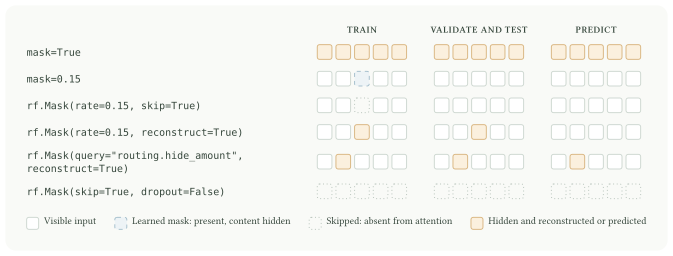
mask=True is shorthand for rf.Mask(skip=True, dropout=False, reconstruct=True). Under a repeated branch, this selects every retained transaction. It differs from mask=1.0, which hides every input using learned-mask dropout during training and creates no reconstruction objective.
Without skip, a selected value remains a present coordinate represented by a learned mask. With skip=True, its input content is not tensorized or embedded and its coordinate is absent from encoder attention. Reconstruction targets still retain their pristine values for the loss.
A mask selects whole values: one Number, Text value, or Set, for example. It does not select individual tokens inside Text or members inside Set.
Configure a policy
| Option | Meaning |
|---|---|
query |
Boolean selector in the input; omitted means every retained owner occurrence is eligible. |
rate |
Fraction of eligible occurrences to sample; omitted means select all eligible occurrences. |
skip |
Omit selected input representations instead of using a learned mask. |
reconstruct |
Add an objective for selected observed values, or request predictions. |
dropout |
Apply only during training; defaults to not reconstruct. |
dropout=True and reconstruct=True cannot be combined. Rates must be between zero and one. A zero rate removes the policy; a rate of one normalizes to no rate, making selection deterministic.
The normalized policy determines when selection runs:
| Policy | Train | Validate/test | Predict |
|---|---|---|---|
dropout=True |
Active | Off | Off |
dropout=False, no rate |
Active | Active | Active |
dropout=False, fractional rate |
Sampled | Sampled with epoch fixed at zero | Off |
Validation and test use different random streams. Sampling depends on seed, stage, owner address, epoch, and record layout; do not assume that changing batching preserves exactly the same selections.
Select within nested data
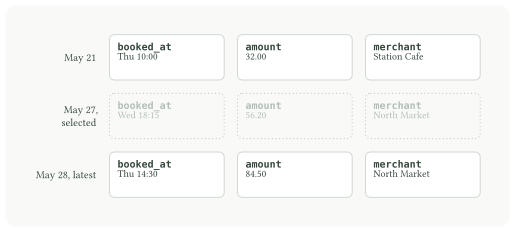
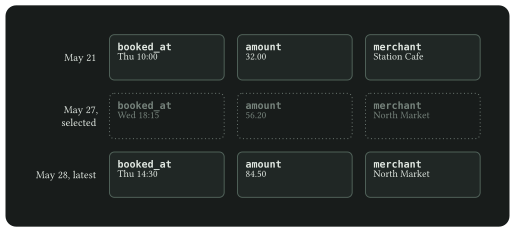
A selector is an ordinary Boolean value prepared by the application. For an optional amount-reconstruction objective, attach routing.hide_amount to each transaction. Here it selects only the middle amount to hide and reconstruct; the ordinary dispute objective still supervises all three transactions:
trxns:
  - booked_at: "2026-05-21T10:00:00"
    amount: 32.00
    merchant: Station Cafe
    disputed: false
    routing:
      hide_amount: false
  - booked_at: "2026-05-27T18:15:00"
    amount: 56.20
    merchant: North Market
    disputed: true
    routing:
      hide_amount: true
  - booked_at: "2026-05-28T14:30:00"
    amount: 84.50
    merchant: North Market
    disputed: false
    routing:
      hide_amount: false
The leaf’s mask query starts from its containing transaction:
import relflow as rf

model = rf.Model.xs(
    trxns=rf.Branch(
        length=32,
        overflow="tail",
        booked_at=rf.DateParts(
            dateparts=["day_of_month", "day_of_week", "hour_of_day"],
        ),
        amount=rf.Number(
            mask=rf.Mask(query="routing.hide_amount", reconstruct=True),
        ),
        merchant=rf.Category,
        disputed=rf.Boolean(mask=True),
    ),
)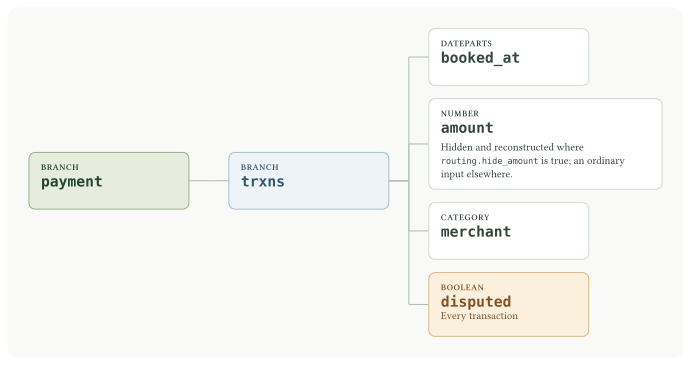
routing is not declared as a model field. The selected amount is represented by a learned mask and reconstructed from the remaining context. The other amounts remain ordinary inputs and receive no amount-reconstruction loss. All dispute labels remain hidden and supervised independently of this choice.
For conditional amount prediction, keep every amount field and selector in the source schema, using amount: null where the requested amount is unknown. Only selected amount positions have inferred: true. The directly bound, unconditional disputed field can be omitted from all prediction transactions.
The selector must provide exactly one non-null Boolean per retained owner record; integers, lists, missing paths, and null selectors are rejected. A node’s value query selects its source value; Mask.query independently selects which owner occurrences receive the policy.
Place a policy on the branch when all descendants should share a decision:
trxns = rf.Branch(
    length=32,
    overflow="tail",
    mask=rf.Mask(rate=0.10, skip=True),
    amount=rf.Number,
    booked_at=rf.DateParts(
        dateparts=["day_of_month", "day_of_week", "hour_of_day"],
    ),
    merchant=rf.Category,
)
Each selected transaction hides all three fields and any nested descendants. A root mask similarly broadcasts through an observation. Reconstructing branch or root policies create objectives on active descendant leaves, whose extensions must support reconstruction.
Derive a selector
For a separate amount-reconstruction task, a processor can derive a selector from each transaction’s application verification flag. Keep this Boolean derivation outside the model:
import polars as pl

@rf.preprocess
def select_unverified(frame: pl.DataFrame) -> pl.DataFrame:
    return frame.with_columns(
        trxns=pl.col("trxns").list.eval(
            pl.element().struct.with_fields(
                predict_amount=pl.element()
                .struct.field("amount_verified")
                .fill_null(False)
                .not_(),
            )
        )
    )

amount = rf.Number(
    mask=rf.Mask(query="predict_amount", reconstruct=True),
)
Include amount inside trxns and pass preprocessor=select_unverified to its data module. For direct prediction pass preprocess=select_unverified to model.predict(...). Each source transaction retains the amount field and verification flag; the processor adds a non-null Boolean selector inside that transaction before mask resolution.
Combine policies
Pass a tuple or list of rf.Mask objects to combine selections:
amount = rf.Number(
    mask=(
        rf.Mask(rate=0.10),
        rf.Mask(query="routing.hide_amount", skip=True, reconstruct=True),
    ),
)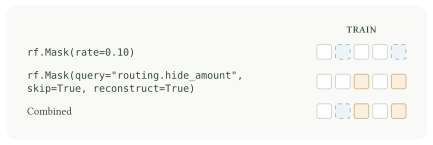
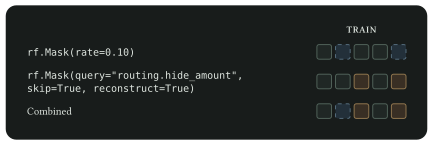
Ancestor and local selections accumulate. A skip wins over a learned mask; reconstruction selections accumulate independently. A child policy cannot restore an input hidden by an ancestor. Duplicate policies are normalized away.
Targets during training and prediction
Fitting needs observed target values. Explicit nulls can contribute value-state objectives for selected nullable fields; structurally absent positions do not invent labels. Use Boolean dispute labels for all retained transactions in the basic supervised example, rather than nulls standing in for unknown outcomes. A fractional reconstruction policy trains its decoder but does not request ordinary prediction output. To request deterministic reconstruction later, update the policy.
A directly bound, unconditional target such as disputed=rf.Boolean(mask=True) may be omitted from prediction input. For a repeated target, its containing branch records must remain to establish output positions. Targets using an explicit value query or conditional reconstruction selector still need their source structure and selector to be bindable.
For example, disputed=rf.Boolean(query="was_disputed", mask=True) reads an explicit source column. Prediction must keep was_disputed in every source transaction, with null for an unknown answer; the direct-binding omission shortcut does not apply to that query.
Conditional predictions retain their structural positions. Finite and automatic branch lengths both write variable lists of sibling result structs; a finite cap does not add public padding. Null collections, empty collections, and null items remain distinct. See repeated coordinates. Use each coordinate’s inferred flag to identify requested outputs. See Prediction output for the Arrow contract.
Pretraining and fine-tuning shows how to change objectives between training stages. The proof catalog includes sampled reconstruction, nested selectors, branch ablation, and prefix-only sequence prediction in P051–P054. The incomplete-evidence proof and contextual-consistency proof study missing evidence and reconstruction-based anomaly scores, with their controls and limitations.