Model Presets
rf.Model.xs(...), .sm(...), .md(...), .lg(...), and .xl(...) build the same schema with different architecture defaults. Start with xs or sm to establish a working payment model, then compare larger configurations on validation data. See Your First Model for the basic training workflow.
Bundled Sizes
These are the bundled revision-1 configurations:
| Setting | xs |
sm |
md |
lg |
xl |
|---|---|---|---|---|---|
Shared width, d_model |
64 | 128 | 256 | 384 | 512 |
| Root encoder layers | 1 | 2 | 3 | 4 | 6 |
| Child branch encoder layers | 1 | 1 | 2 | 2 | 3 |
| Root, branch, and leaf heads | 2 | 4 | 8 | 8 | 8 |
| Root attention outputs | 1 | 2 | 4 | 8 | 16 |
| Child branch attention outputs | 1 | 2 | 4 | 4 | 8 |
Feed-forward multiplier, ffnx |
8 | 8 | 8 | 8 | 8 |
Every size uses MHA encoders and zero dropout. Each attention reduction has one layer and positional information; its heads and dropout inherit the owning branch. Leaf decoders use query pooling, one cross-attention block (n_linear=1), and automatic decoder positioning (decoder_position=None). Automatic positioning is off for a single predicted position and on when the target has more than one position.
RelFlow’s hidden activations use tanh GELU, and its neural normalization uses RMSNorm with epsilon 1e-5. These choices are fixed. Pretrained text encoders retain their own architectures.
A size name describes defaults, rather than a parameter-count range or a prediction-quality guarantee. The schema, vocabularies, requested decoders, and external text encoders also determine model size.
Which Node Owns A Setting?
A preset fills three separate scopes:
| Scope | Settings supplied |
|---|---|
| Model root | Encoder n_layers, n_heads, ffnx, attention, dropout, and root reduction. |
| Every child branch | Its own encoder settings and reduction, at every nesting depth. |
| Each leaf | Decoder n_heads, ffnx, pooling, n_linear, dropout, and decoder_position. |
d_model is shared across the whole model. Root overrides apply to the root; branch overrides apply to that branch. Leaf decoder heads do not inherit a containing branch’s override.
For example, this sm model changes root depth, the history’s feed-forward multiplier, and the dispute decoder’s heads independently:
import relflow as rf

model = rf.Model.sm(
    n_layers=3,
    amount=rf.Number,
    merchant=rf.Category,
    recent_transactions=rf.Branch(
        length=32,
        overflow="tail",
        ffnx=4,
        amount=rf.Number,
        merchant=rf.Category,
        days_ago=rf.Number,
    ),
    disputed=rf.Boolean(mask=True, n_heads=2),
)
The history keeps the sm branch depth of one layer. Its leaves keep their own ffnx=8 defaults. Changing the history’s multiplier does not change them. Each ffnx must be a positive integer; its hidden feed-forward width is ffnx * d_model.
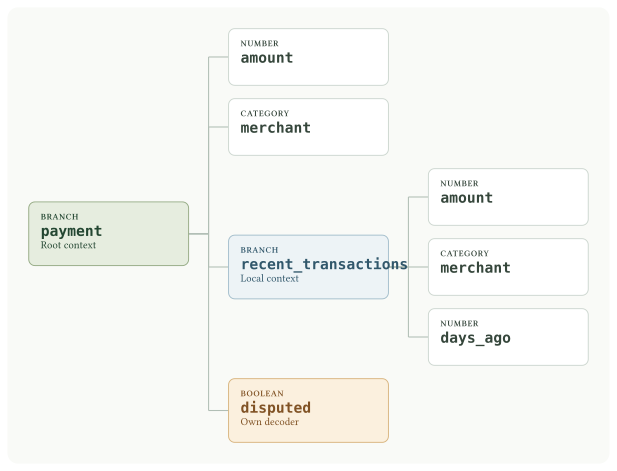
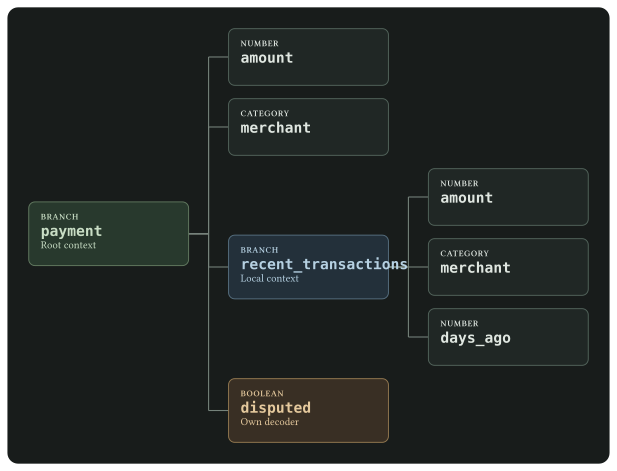
The multiplier controls a branch’s sequence encoder, coordinate encoder, and learned reduction. On a leaf it controls query-decoder feed-forward blocks and aligned sibling-context projection. It does not change the number of retained transactions or the shared output width.
Overrides And Explicit None
Resolution follows this order at each node:
- An explicitly supplied option wins, including one equal to the ordinary default.
- An omitted option uses that scope’s preset value.
- Options outside the preset keep their ordinary datatype or branch defaults.
An explicit reduction replaces the whole reduction object. For example, reduction=rf.Attention() selects one output and one layer even under xl. It does not inherit xl’s output count. rf.Mean() and None also replace the preset reduction completely.
None is a deliberate value where the option accepts it:
| Option | Meaning of None |
|---|---|
Root or branch attention |
Disable encoder attention; the reduction remains separately configured. |
Root or branch reduction |
Pass through routed child slots instead of reducing them. |
Node dropout |
Use zero dropout. |
Leaf decoder_position |
Use the automatic scalar/repeated-target policy. |
Attention reduction n_heads or dropout |
Inherit the owning branch’s value. |
A width override must be compatible with every effective attention head count. It does not rewrite branch or leaf heads. Invalid geometry is rejected at the affected address. Reusing a branch or leaf definition in another model creates a separately resolved tree and leaves the original definition unchanged.
The preset leaves history lengths, overflow, field roles, queries, objective weights, and datatype-specific options to the application. Set batch size on the loop, such as model.fit(data, batch_size=128, max_epochs=30). Constructor batch size remains the initial value, defaulting to one. Optimization, schedulers, training budgets, hardware, and data-loader settings belong to the training workflow, not the size profile.
For YAML configurations, preset: sm chooses the same bundled policy. Python overrides win over file options, which win over the preset. See Model Templates.
Save, Load, And Extend
The resolved schema records the model’s actual architecture. model.preset holds the immutable construction policy, including its name and revision. Saving preserves both. Loading uses those saved values rather than applying a newer version of a bundled preset.
model.save("artifacts/payment.rf")
restored = rf.Model.load("artifacts/payment.rf")
restored.extend(
    rf.where("address") == rf.Address(),
    country=rf.Category,
)
The new country field receives the saved sm leaf defaults. Existing nodes keep their resolved options, including the earlier dispute-head override. Updating a trained model does not reapply the preset to its existing tree. See Schema Mutation for learned-state boundaries.
rf.Model(schema=schema) restores an already resolved architecture. It carries no preset policy unless loaded from a saved artifact that contains one; newly extended nodes then use ordinary defaults. Preset factories reject schema= because the schema already specifies its architecture.
Selecting another size constructs a new architecture. Increasing width, depth, or output count on a trained model does not provide automatic weight compatibility.
Define An Application Preset
Use rf.presets.Preset with frozen root, branch, and leaf configurations, then bind it to a model subclass with rf.presets.factory:
compact = rf.presets.Preset(
    name="payment-compact",
    revision=1,
    d_model=96,
    root=rf.presets.BranchDefaults(
        n_layers=2,
        n_heads=4,
        reduction=rf.Attention(n_outputs=2),
    ),
    branch=rf.presets.BranchDefaults(
        n_layers=1,
        n_heads=4,
        reduction=rf.Attention(n_outputs=1),
    ),
    leaf=rf.presets.LeafDefaults(n_heads=4),
)

class PaymentModel(rf.Model):
    compact = rf.presets.factory(compact)

payment_model = PaymentModel.compact(
    amount=rf.Number,
    merchant=rf.Category,
    disputed=rf.Boolean(mask=True),
)
The result is a PaymentModel. Inherited built-in factories also construct the calling subclass. Policy names must be nonempty and revisions positive; use a new revision when changing an application’s defaults. Common leaf settings also apply to registered third-party tensorfields without replacing their extension options.
Ordinary Python construction uses these factories rather than a preset= or size= selector. A schema child named preset or size remains an ordinary field. YAML templates reserve their own top-level preset entry.
Capacity, Embeddings, And Cost
The size ladder increases shared width and root depth while keeping child encoders shallower. More reduction outputs let a branch send more context to its parent. These are useful axes to compare; their values are engineering starting points rather than benchmark-derived quality thresholds.
Each branch owns separate weights, and each decoded field adds its own decoder. Wider feed-forward layers, more branches, deeper encoders, longer histories, and larger vocabularies can all increase memory or compute. Attention output slots also add learned parameters and affect the parent’s input size. Reducing those slots occurs after that branch’s encoder, so it does not remove the branch’s own input-attention work.
n_layers counts sequence encoder blocks. A branch with multiple active direct leaves can also have a separate coordinate-attention block. Head count partitions the shared width; adding heads at a fixed width does not multiply the MHA projection parameter count.
An attention reduction may have more outputs than inputs. In that case it expands context rather than compressing it. Mean reduction emits one summary; no reduction preserves routed child slots. Completely inactive subtrees emit no structural outputs. See Branch for these contracts.
With root embed=True, the default xs model emits one width-64 vector, while md emits four width-256 vectors. Set reduction=rf.Attention(n_outputs=1) when an application needs one root vector, then evaluate the resulting bottleneck. Reduction outputs are context vectors, not additional prediction records; target coordinates still come from the schema.
Zero dropout permits the eligible packed encoder training path for partially present inputs. Nonzero dropout can change both learning and execution cost. GQA, MQA, Mean reduction, and disabled attention likewise change model behavior; measure them on the actual task. GQA and MQA apply to branch encoders; reduction and decoder query attention retain MHA. Turning off reduction positioning alone does not make a branch with positional encoder attention permutation invariant.
Compare task quality on fixed validation splits and record the actual parameter count, peak memory, and throughput for the schema and hardware used. Increase one capacity axis at a time. A larger preset can underfit, overfit, or cost more without improving the task. See Evaluation and Performance.
This reference describes the 0.3.1 API, reviewed against source commit 18d582cca2af3dafde65b756111b32aed5b3e580. The bundled policies, resolution rules, and checkpoint handling show the implementation at that pinned revision. Encoders and decoders consume the resolved schema; the policy supplies construction defaults and future additions.