Reusable representations
After learning from payment histories, you may need another prediction from the same evidence: whether a merchant will be paid again, or which payments deserve review. Export the learned context and test it as input to separate predictors, alongside existing spending summaries. This lets you evaluate reuse without fitting the history model again for each task. Each predictor still needs its own labels and held-out assessment.
An embedding is a numeric representation of the context the model has learned. Set embed=True where you want to export one. Exporting adds no learning objective; use a model already trained with supervision or reconstruction.
Choose where to export
Continue with the saved payment model from Pretraining and fine-tuning. It already includes the account profile and transactions, including the latest payment once. Turn on exports at its root and trxns branch:
import relflow as rf

model = rf.Model.load("artifacts/payment-disputes.rf")
model.update(
    rf.where("address").is_in(
        [rf.Address(), rf.Address("trxns")]
    ),
    embed=True,
)
The transaction dispute targets remain in place. The same prediction pass can now return their estimates and the context vectors used for a separate task predictor.
embed=True location |
Exported representation |
|---|---|
| Root | The root’s reduced context. |
| Branch | The branch’s reduced context. |
| Leaf | The decoder’s pooled context before its datatype output head. |
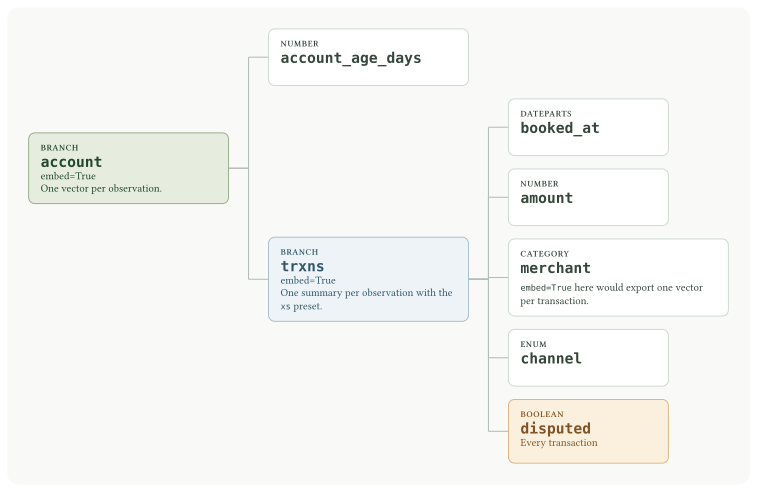
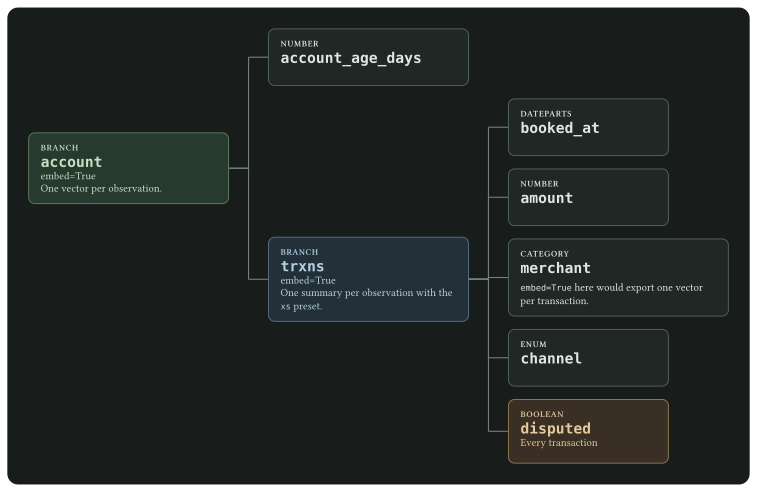
The pretraining example uses the xs preset with one-output reductions. This therefore exports one vector for the account snapshot and one summary of its transactions per observation. It does not export one vector per transaction. A nested branch inside trxns would retain those outer transaction positions when exporting its own summary.
For a separate predictor of transaction outcomes, pair the summary with the corresponding transaction’s fields and label. A leaf embedding can instead provide a contextual vector at each transaction position.
A leaf embedding is different from its raw input embedding: it can include ancestor context and visible, aligned sibling fields. A branch embedding summarizes the inputs controlled by that branch’s reduction.
Read the output
This example uses prediction output, which keeps representations separate from decoded field results.
Use the same account profile and trxns records in your application’s request file, omitting disputed from every transaction. The snapshot cutoff remains the final booking time; all vectors describe the evidence available then. Export the vectors in prediction mode:
requests = rf.ArrowDataModule(
    predict="payments/finetuning/requests.parquet",
)
result = model.predict(datamodule=requests, batch_size=256, devices=1)
Each row’s representations list holds one record per exported vector. An empty path is the anonymous root, and ["trxns"] is the transaction summary. Rows come back in request order:
snapshot_vectors = []
history_vectors = []
for row in result.to_pylist():
    for record in row["representations"]:
        if record["path"] == []:
            snapshot_vectors.append(record["embedding"])
        elif record["path"] == ["trxns"]:
            history_vectors.append(record["embedding"])
For many rows, let Polars give you one row per vector, with an observation index that ties each vector back to its request row:
import polars as pl

vectors = (
    pl.from_arrow(result)
    .with_row_index("observation")
    .select("observation", "representations")
    .explode("representations")
    .unnest("representations")
    .with_columns(path=pl.col("path").list.join("/"))
)
snapshot_vectors = vectors.filter(pl.col("path") == "")
history_vectors = vectors.filter(pl.col("path") == "trxns")
Field names cannot contain /, so joining path segments does not merge distinct paths.
Exported vectors are float32 and L2-normalized along their fixed d_model axis; zero vectors remain zero. Each representation record also carries parents and output_index. For an account-level /accounts/trxns summary, parents=[a] selects account a. For the merchant leaf inside it, parents=[a,t] selects transaction t of account a. These are retained coordinates after queries and overflow, including structural holes.
rf.Attention(n_outputs=3) produces records with output_index 0, 1, and 2 at each summary site. reduction=None preserves the routed output stream, including its defined zero slots; its output indices do not claim an inferred source-record identity. A branch summary can exist for an empty collection when its reduction defines that output. A leaf embedding requires a valid item coordinate. Representation counts therefore need not match item counts. See Branch and the full Prediction output contract.
Evaluate an embedding on its intended downstream task. A useful dispute predictor does not by itself establish useful similarity or clustering. Preserve the schema and trained state with the model artifact.
To evaluate a frozen representation, keep the exporting model fixed and generate vectors in prediction mode for the training and held-out observations. Fit separate task predictors using only the training vectors and labels. Keep the exporting model fixed throughout: this measures what a downstream predictor can learn from the representation as exported.
Choose cohort and time boundaries before training. For an evaluation on unseen accounts, exclude held-out accounts from both representation learning and downstream predictor training. Each history vector represents the account at a defined decision cutoff; the task label records an outcome over a later period. Keep records after that cutoff out of the input snapshot.
Compare existing features alone, vectors alone, and their combination on the same observations. Choose predictor settings on the same validation split and assess the fixed choices on test data. For merchant-repeat prediction, measure precision and recall for the defined 30-day outcome window. For payment review, measure dispute recall at a fixed review capacity. These task metrics help decide whether the reusable representation earns a place in the workflow. Profile context and a second outcome explains how to prepare the observations and outcome windows for these experiments.
Learn without a label
You can export context before adapting to a supervised outcome. Load the reconstruction-trained artifact from the same payment workflow and request the root and transaction summaries:
reconstructed = rf.Model.load("artifacts/payment-pretrained.rf")
reconstructed.update(
    rf.where("address").is_in(
        [rf.Address(), rf.Address("trxns")]
    ),
    embed=True,
)
This model learned by reconstructing sampled transaction amounts and merchants; it has not learned from dispute labels. Run prediction with this model to generate vectors for a separately labeled task. embed=True alone creates no objective, and sampled reconstruction does not request ordinary decoded prediction output. Masking and reconstruction explains that distinction. Supervised and sampled reconstruction objectives can coexist, with each leaf’s weight scaling its contribution.
Pretraining and fine-tuning shows how to transfer reconstruction training to a labeled task. The reconstruction transfer proof compares frozen root embeddings with raw features, an untrained encoder, and training on independently permuted views.
Next, Other domains and outcomes shows how to organize purchase, review, report, and market histories around their own outcomes. Define and evaluate the representation for each schema and task before relying on it.