Query paths
Use query= when a model node reads a differently named or nested source. Every path starts from the value selected by its parent node. When names and nesting already match the schema, no query is needed; see Prepare observations.
Suppose the same payment from Prepare observations arrives inside a payload, with different names for its fields:
payment_id: payment-42
payload:
  transactions:
    - booked_at: "2026-05-21T10:00:00"
      gross_amount: 32.00
      merchant_info:
        name: Station Cafe
      was_disputed: false
    - booked_at: "2026-05-27T18:15:00"
      gross_amount: 56.20
      merchant_info:
        name: North Market
      was_disputed: true
    - booked_at: "2026-05-28T14:30:00"
      gross_amount: 84.50
      merchant_info:
        name: North Market
      was_disputed: false
import relflow as rf
model = rf.Model.xs(
query="payload",
trxns=rf.Branch(
query="transactions[-32:]",
length=32,
booked_at=rf.DateParts(
dateparts=["day_of_month", "day_of_week", "hour_of_day"],
),
amount=rf.Number(query="gross_amount"),
merchant=rf.Category(query="merchant_info.name"),
disputed=rf.Boolean(query="was_disputed", mask=True),
),
)The root selects payload. The branch selects the last 32 transaction records, then each child reads relative to a transaction. Children do not repeat the parent’s path. The list includes the latest payment exactly once at its end, and mask=True hides and predicts every transaction’s dispute label as before.
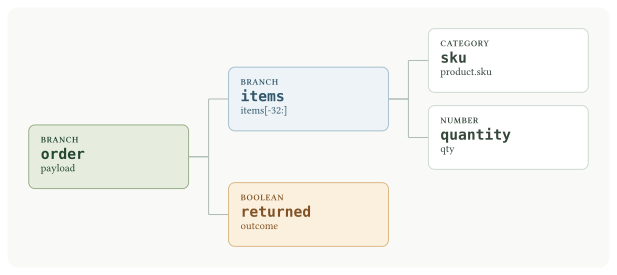
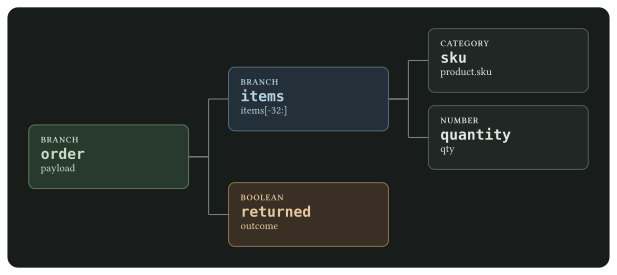
Without a query, the root uses the source row and a child selects its own name. A child branch must select a list of structs. Branch queries select source positions before branch geometry is resolved. With length=None, the branch keeps all selected slots. A finite length applies its overflow policy to that selection; each batch then uses its largest retained width. Descendant widths are determined from the retained parent records. See Branch.
Path syntax
| Path | Selection |
|---|---|
merchant_info.name |
A nested struct member |
["gross amount"] |
A member whose name needs quoting |
transactions[*].gross_amount |
A leaf value across one list axis |
transactions[0].merchant_info.name |
One position; negative indices count from the end |
transactions[-10:] |
A slice of each list |
attributes["country"] |
One literal Arrow map key |
[*] retains a list axis; it does not flatten it. Use it when a leaf path crosses an unmodeled list. Children of a modeled branch already operate on each branch element.
Slices use half-open, clamped bounds; steps such as [::2] are unsupported. Map keys may be strings, integers, or booleans that match the Arrow key type exactly. Duplicate matches are errors. Paths have no $ source-root prefix.
Structural absence
| Source condition | Result |
|---|---|
| Present, non-null value | valued |
| Present field with a null value | null |
| Null ancestor, out-of-range list index, or absent map key | padded |
| Required field absent from the Arrow schema | Binding error |
An omitted key in a Python record and an explicit null can become the same Arrow null slot. Represent a distinction explicitly if your application needs it.
Transform values before querying
Queries navigate structure. They do not filter, join, sort, compute expressions, or stack fields. If source transactions also include a kind field, a Polars preprocessor can retain purchases before the query reads payload. Filter whole transaction structs so their timestamps, amounts, merchants, and labels stay aligned:
import polars as pl

@rf.preprocess
def purchases(frame: pl.DataFrame) -> pl.DataFrame:
    payload = pl.col("payload")
    return frame.with_columns(
        payload=payload.struct.with_fields(
            transactions=payload.struct.field("transactions").list.eval(
                pl.element().filter(
                    pl.element().struct.field("kind").eq("purchase").fill_null(False)
                )
            )
        )
    )
Keep the review cutoff and future label window unchanged when filtering the source records.
Targets at prediction time
A directly bound mask=True target may be omitted from prediction input. Its containing repeated branches must remain: their lists define output positions. Training, validation, and testing still need target values.
An explicitly queried target, such as disputed above, must retain its queried source structure and field schema at prediction time. Keep was_disputed: null on every transaction for this model. Prefer direct binding when prediction requests should omit the label entirely.
When a query fails, inspect the processed Arrow schema, then read the path from its parent’s selected value. Errors identify the query segment and model address. See Preprocessing for preparing nested records and shared roles.