Customer Risk
A retailer wants to predict customer churn, future spending, and refunds for individual orders. Purchase and browsing histories supply different evidence; nested branches keep those contexts distinct.
One Observation
tenure_days: 420
orders:
  - age_days: 3
    line_items:
      - sku: A12
        quantity: 2
      - sku: B07
        quantity: 1
    refunded_next_month: false
sessions:
  - device: mobile
    events:
      - kind: view
        elapsed_seconds: 0
      - kind: add_to_cart
        elapsed_seconds: 24
churned: false
next_month_spend: 75.0
One record describes a customer at a decision time. Histories stop at that time; labels describe the following month. Define inactivity, refund attribution, and spending consistently before constructing the splits.
Keep Local Questions Local
import relflow as rf

model = rf.Model(
    name="customer",
    d_model=128,
    n_layers=3,
    n_heads=8,
    batch_size=128,
    embed=True,
    tenure_days=rf.Number,
    orders=rf.Branch(
        length=64,
        overflow="tail",
        age_days=rf.Number,
        line_items=rf.Branch(
            length=16,
            sku=rf.Category(size=8192),
            quantity=rf.Number,
        ),
        refunded_next_month=rf.Boolean(mask=True),
    ),
    sessions=rf.Branch(
        length=128,
        overflow="tail",
        device=rf.Category(size=8),
        events=rf.Branch(
            length=64,
            overflow="tail",
            kind=rf.Category(size=32),
            elapsed_seconds=rf.Number,
        ),
    ),
    churned=rf.Boolean(mask=True),
    next_month_spend=rf.Number(mask=True),
)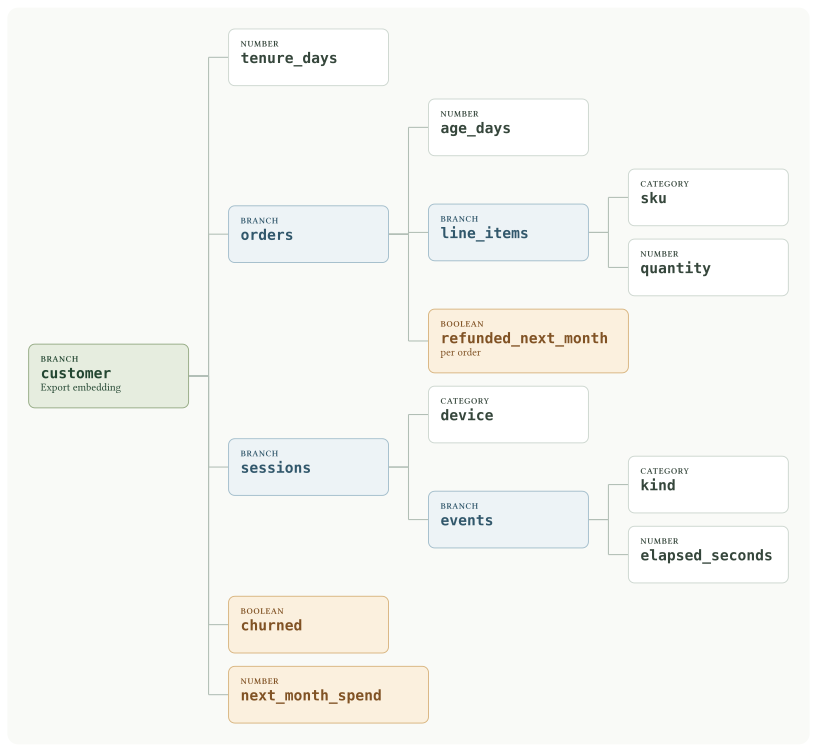
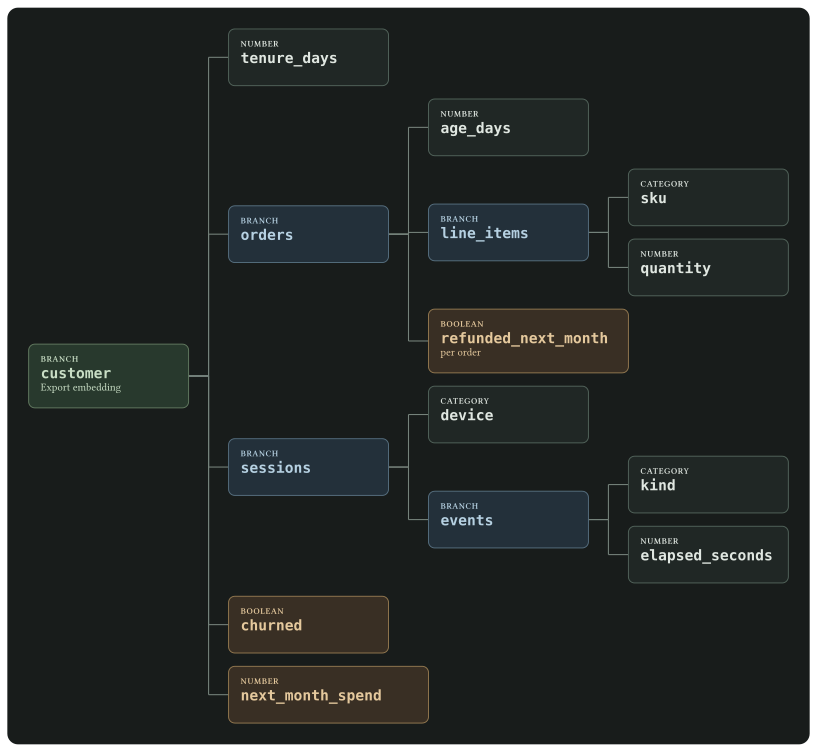
Line items form context within each order; events form context within each session. Each history then sends its reduced representation to the customer root. The refund decoder uses its ancestor route and visible sibling context; its predictions retain order coordinates even though the orders branch sends a summary upward. See Model Tree.
All three targets use mask=True. Their labels supply supervision but never input embeddings. At prediction time, omit the two root targets and omit refunded_next_month from each order. Keep the orders themselves: they define the repeated positions to predict.
Choose What To Preserve
The default Attention reduction sends one summary per parent coordinate. That bounds the context passed upward; it does not preserve a separate token for every raw item. If the task requires exact correspondence between a viewed SKU and a purchased SKU, establish that relationship in preprocessing or aligned schema structure. Nesting does not perform a database join.
overflow="tail" assumes histories are sorted oldest to newest. Here it applies independently to orders, sessions, and events; line items use the first-items policy. Choose these bounds for the application’s records.
Evaluate Each Outcome
Use Arrow or Polars data modules and the Lightning workflow. Hold out later observation windows, and prevent related customer snapshots from leaking across splits.
Inspect each objective separately: churn ranking and calibration, spending errors, and refund discrimination between orders from the same customer. A combined validation loss can hide a regression in one target. This example specifies a design, not measured model quality.
The output addresses are customer/churned, customer/next_month_spend, customer/orders/refunded_next_month, and the customer embedding. Preserve request identifiers and the retained order mapping when joining predictions back to application records; a learned summary is not an order identifier. See Prediction Output.