Pretraining And Fine-Tuning
Pretraining learns from relationships in a broad collection of records. Fine-tuning starts from those learned weights and adapts the model to a specific task. In relflow, both use trainer.fit(...); the data and reconstruction objectives determine what the model learns.
| Stage | Data | Objectives |
|---|---|---|
| Self-supervised pretraining | Records without task labels | Reconstruct sampled observed values with rf.Mask(rate=..., reconstruct=True). |
| Supervised fine-tuning | Labeled task records | Predict always-hidden labels with mask=True, optionally retaining some reconstruction objectives. |
| Resume a run | The same training task | Restore the model, optimizer, scheduler, and loop progress from a full Lightning checkpoint. |
Pretraining is optional. A supervised model can also start from newly initialized weights. An ordinary float mask, such as mask=0.15, only supplies input dropout; pretraining needs reconstruct=True to create an objective.
Pretrain On Histories
This customer record has no churn label. Purchase amounts and merchant types provide their own supervision when selected values are hidden:
tenure_days: 420
region: northeast
purchases:
  - days_ago: 12
    amount: 42.75
    merchant: grocery
  - days_ago: 3
    amount: 18.50
    merchant: cafe
import lightning.pytorch as lit
import relflow as rf
model = rf.Model(
name="customer",
d_model=128,
n_layers=3,
n_heads=8,
tenure_days=rf.Number,
region=rf.Category(size=64),
purchases=rf.Branch(
length=64,
overflow="tail",
days_ago=rf.Number,
amount=rf.Number(mask=rf.Mask(rate=0.15, reconstruct=True)),
merchant=rf.Category(
size=256,
mask=rf.Mask(rate=0.15, reconstruct=True),
),
),
)
model.optimizer = rf.adamw(learning_rate=1e-3)
pretraining_data = rf.ArrowDataModule(
model=model,
train=pretrain_table,
validate=pretrain_validation_table,
)
pretrainer = lit.Trainer(max_epochs=50)
pretrainer.fit(model=model, datamodule=pretraining_data)
model.save("artifacts/customer-pretrained.rf")The two tables are independent, application-supplied Arrow splits with this record structure. Histories are sorted oldest to newest for overflow="tail". Use rf.PolarsDataModule with eager frames when the application prepares its splits in Polars. Keep preparation consistent through the preprocessing pipeline.
Each sampled value is predicted from the remaining context; unselected values remain inputs. These fractional reconstruction policies also sample during validation and test, but are inactive during ordinary prediction. See Masking for selection and stage rules.
The example saves the final model. Use the checkpoint selection described in Training to save the best validation state instead.
Adapt To A Labeled Task
For fine-tuning, each customer record gains churned: false or churned: true, defined over a future outcome window. Its purchase history ends at the decision time. Pretraining and fine-tuning splits must respect the same evaluation boundaries; pretraining on held-out customers or future observations changes what the downstream evaluation measures.
Load the pretrained artifact, remove its sampled reconstruction policies, and add a supervised label:
finetuned = rf.Model.load("artifacts/customer-pretrained.rf")
reconstructed_inputs = rf.where("address").is_in(
    ["customer/purchases/amount", "customer/purchases/merchant"]
)
finetuned.update(reconstructed_inputs, mask=False)
finetuned.extend(
    rf.where("address") == "customer",
    churned=rf.Boolean(mask=True),
)
Amount and merchant remain visible inputs. Churn is always excluded from input embedding, while its observed label supplies the training loss. If the target already exists in the schema, use finetuned.update(target, mask=True) instead of adding it again.
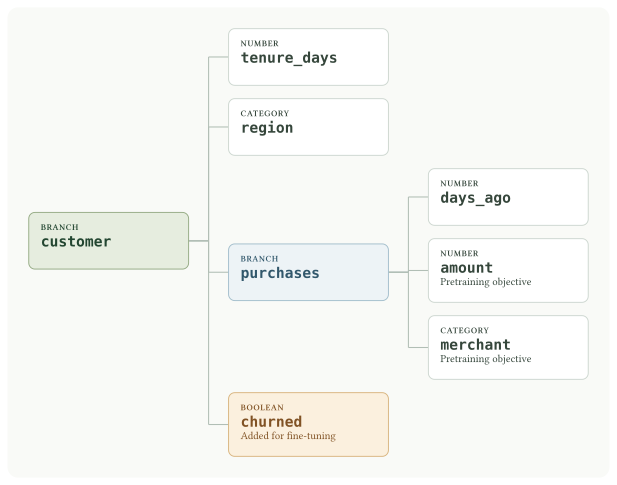
Schema edits rebuild modules and retain state entries whose names, types, and tensor shapes still match. The new target starts with newly initialized state; changing widths, field types, or structure can also reinitialize incompatible parts. Keep existing addresses and geometry stable when reusing a pretrained model. Adding a field can change context and reduction behavior even when existing weights transfer. Schema Mutation describes these boundaries.
Start A New Training Run
Assign a fresh optimizer factory after the edits and use a new Trainer with labeled Arrow splits. A smaller learning rate is a starting point to evaluate:
finetuned.optimizer = rf.adamw(learning_rate=1e-4)
finetuning_data = rf.ArrowDataModule(
    model=finetuned,
    train=finetune_table,
    validate=finetune_validation_table,
)
finetuner = lit.Trainer(max_epochs=20)
finetuner.fit(model=finetuned, datamodule=finetuning_data)
finetuned.save("artifacts/customer-churn.rf")
This starts new optimization from the transferred model state. Use ckpt_path with a full Lightning checkpoint when resuming the same task, including its optimizer and loop progress. Reapply any processors, scheduler, and desired compilation after loading and schema edits. For DDP, every rank must construct the same final schema.
Fine-tuning here updates the model end to end, including the new decoder and existing encoders. Loaded vocabularies and Number normalization statistics also continue learning from training observations; loading does not freeze them. Validation, test, and prediction reuse that state. For a fixed feature extractor, set embed=True on the desired root or branch, export embeddings in prediction mode, and fit a separate downstream model on those vectors.
At inference, omit churned from the input and read the prediction at customer/churned. See Prediction Output.
Keep Auxiliary Objectives Deliberately
To retain amount reconstruction alongside churn, keep that policy when adapting the pretrained artifact. Replace the earlier finetuned.update(reconstructed_inputs, mask=False) call with:
finetuned.update(
    rf.where("address") == "customer/purchases/merchant",
    mask=False,
)
finetuned.update(
    rf.where("address") == "customer/purchases/amount",
    weight=0.1,
)
Then add the churn target and start the new run as above. Keeping the amount policy preserves its trained decoder; removing reconstruction and later reenabling it creates a new decoder. Both amount and churn losses are now optimized. weight scales the amount loss rather than its sampling rate or a fixed fraction of the combined loss.
Compare fine-tuning against the same supervised task trained from scratch. Use the same held-out data and churn metric: pretraining loss and fine-tuning loss have different objective sets and are not directly comparable. Retaining auxiliary objectives may help or hurt the task, so evaluate that choice rather than assuming pretraining guarantees a better model. See Evaluation.