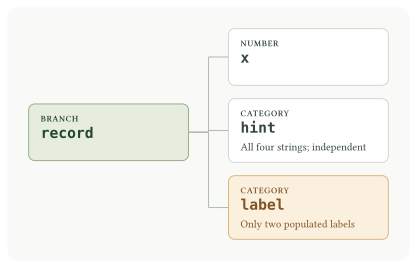
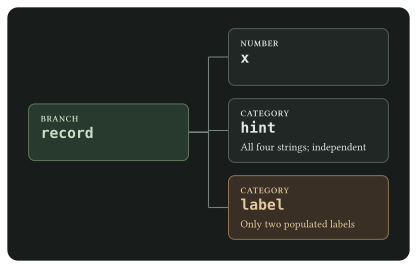
"""P056: a learned classifier exposes the difference between accuracy and vocabulary coverage."""

from collections.abc import Iterator
from functools import partial

import lightning.pytorch as lit
import numpy as np
import pyarrow as pa
from reporting import report

import relflow as rf

PROOF_ID = "P056"
BUDGET = 350
LABELS = ("negative", "positive", "novel-negative", "novel-positive")


def records(*, rows: int, seed: int, shifted: bool = False) -> Iterator[dict]:
    rng = np.random.default_rng(seed)
    signs = np.arange(rows) % 2
    rng.shuffle(signs)
    magnitudes = rng.uniform(0.2, 1.0, rows)
    hints = rng.integers(0, len(LABELS), rows)
    for index, (sign, magnitude, hint) in enumerate(zip(signs, magnitudes, hints, strict=True)):
        offset = 2 if shifted and index % 2 else 0
        yield {"x": float((2 * sign - 1) * magnitude), "hint": LABELS[hint], "label": LABELS[sign + offset]}


def build() -> rf.Model:
    return rf.Model.xs(
        batch_size=64,
        x=rf.Number,
        hint=rf.Category(p_unavailable=0.0),
        label=rf.Category(p_unavailable=0.0, topk=[2], mask=True),
    )


def run(seed: int, steps: int | None, accelerator: str) -> tuple[dict, dict]:
    lit.seed_everything(seed, workers=True)
    model = build()
    model.optimizer = rf.adamw(learning_rate=0.002)
    data = rf.SyntheticDataModule(
        model=model,
        train=partial(records, rows=4096, seed=seed + 1),
        validate=partial(records, rows=512, seed=seed + 2),
        seed=seed,
    )
    trainer = lit.Trainer(
        accelerator=accelerator,
        devices=1,
        max_epochs=-1,
        max_steps=BUDGET if steps is None else min(steps, BUDGET),
        deterministic=True,
        logger=False,
        enable_checkpointing=False,
        enable_progress_bar=False,
        enable_model_summary=False,
        num_sanity_val_steps=0,
    )
    trainer.fit(model, datamodule=data)
    model.eval()
    vocabulary = rf.Category.vocabulary(model, "/label")
    hints = rf.Category.vocabulary(model, "/hint")
    counts = rf.Category.counts(model, "/label")
    normalization = rf.Number.normalization(model, "/x")
    test = list(records(rows=2048, seed=seed + 3, shifted=True))
    source = pa.Table.from_pylist(test)
    output = model.predict(source)["predictions"].to_pylist()
    content = [row["label"]["content"] for row in output]
    actual = np.asarray([row["label"] for row in test])
    predicted = np.asarray([row["value"] for row in content])
    known = np.isin(actual, vocabulary)
    probability = np.asarray([row["probability"] for row in content])
    evaluated = trainer.test(
        model,
        datamodule=rf.SyntheticDataModule(model=model, test=partial(records, rows=2048, seed=seed + 3, shifted=True)),
        verbose=False,
    )[0]
    builtin = float(evaluated[".label/test.accuracy.content"])
    order = np.random.default_rng(seed + 4).permutation(len(test))
    corrupted = [{**row, "x": test[index]["x"]} for row, index in zip(test, order, strict=True)]
    broken = model.predict(pa.Table.from_pylist(corrupted))["predictions"].to_pylist()
    broken_values = np.asarray([row["label"]["content"]["value"] for row in broken])
    field = model.encode(source, strata="test")["/label"]
    metrics = {
        "steps": trainer.global_step,
        "output_vocabulary": vocabulary,
        "hint_vocabulary": hints,
        "coverage": float(known.mean()),
        "builtin_content_accuracy": builtin,
        "known_accuracy": float((predicted[known] == actual[known]).mean()),
        "all_row_accuracy": float((predicted == actual).mean()),
        "unknown_accuracy": float((predicted[~known] == actual[~known]).mean()),
        "unknown_mean_confidence": float(probability[~known].mean()),
        "shuffled_known_accuracy": float((broken_values[known] == actual[known]).mean()),
        "majority_baseline": float(max(np.mean(actual == label) for label in vocabulary)),
    }
    candidate_labels = {candidate["value"] for row in content for candidate in row["topk"]}
    return metrics, {
        "Known-only content accuracy reaches 0.95": builtin >= 0.95 and metrics["known_accuracy"] >= 0.95,
        "Built-in accuracy agrees with known-only external scoring": abs(builtin - metrics["known_accuracy"]) < 0.02,
        "Coverage is exactly one half": metrics["coverage"] == 0.5,
        "All-row accuracy exposes the coverage ceiling": metrics["all_row_accuracy"] <= 0.5,
        "Unseen output labels cannot be emitted": metrics["unknown_accuracy"] == 0.0,
        "Unknown answers still receive confident known-label predictions": metrics["unknown_mean_confidence"] > 0.8,
        "Shuffling x removes known-label accuracy": 0.40 < metrics["shuffled_known_accuracy"] < 0.60,
        "Predictions and candidates use populated output labels only": set(predicted) <= set(vocabulary)
        and candidate_labels == set(vocabulary),
        "Candidate probabilities normalize over populated labels": all(
            abs(sum(candidate["probability"] for candidate in row["topk"]) - 1.0) < 1e-5 for row in content
        ),
        "Labels known in another field remain unknown here": set(LABELS[2:]) <= set(hints)
        and not set(LABELS[2:]) & set(vocabulary),
        "Unknown target content uses the unavailable sentinel": bool(
            (field.targets[rf.TensorKey.content].reshape(-1).cpu().numpy()[~known] == -1).all()
        ),
        "Evaluation preserves output vocabulary and exposure counts": rf.Category.vocabulary(model, "/label")
        == vocabulary
        and rf.Category.counts(model, "/label") == counts,
        "Evaluation preserves hint vocabulary and numerical moments": rf.Category.vocabulary(model, "/hint") == hints
        and rf.Number.normalization(model, "/x") == normalization,
    }


if __name__ == "__main__":
    report(PROOF_ID, run, seed=5601)