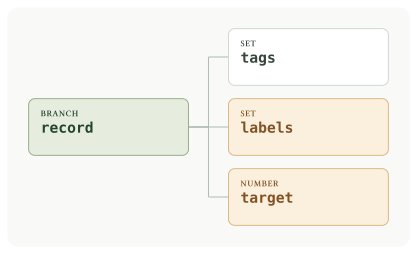
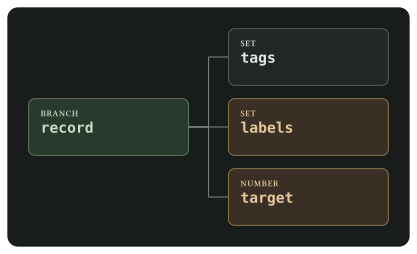
"""P058: learn known membership while exposing empty/all-OOV and null boundaries."""

from collections.abc import Iterator
from functools import partial

import lightning.pytorch as lit
import numpy as np
import pyarrow as pa
from reporting import report

import relflow as rf

PROOF_ID = "P058"
BUDGET = 400
PATTERNS = ((), ("red",), ("blue",), ("red", "blue"), None)


def records(*, rows: int, seed: int) -> Iterator[dict]:
    rng = np.random.default_rng(seed)
    for index in rng.integers(len(PATTERNS), size=rows):
        pattern = PATTERNS[index]
        tags = None if pattern is None else list(pattern)
        target = 3.0 if pattern is None else float(("red" in pattern) - 1.5 * ("blue" in pattern))
        yield {"tags": tags, "labels": None if tags is None else list(tags), "target": target}


def build() -> rf.Model:
    return rf.Model(
        d_model=32,
        n_layers=1,
        n_heads=4,
        dropout=0.0,
        batch_size=64,
        tags=rf.Set(p_unavailable=0.0),
        labels=rf.Set(p_unavailable=0.0, threshold=0.5, mask=True),
        target=rf.Number(mask=True, objective="mse"),
    )


def prediction(model: rf.Model, rows: list[dict]) -> tuple[np.ndarray, list[set[str]]]:
    output = model.predict(pa.Table.from_pylist(rows))["predictions"].to_pylist()
    values = np.asarray([row["target"]["content"] for row in output], dtype=np.float64)
    labels = [{candidate["value"] for candidate in row["labels"]["content"]} for row in output]
    return values, labels


def run(seed: int, steps: int | None, accelerator: str) -> tuple[dict, dict]:
    lit.seed_everything(seed, workers=True)
    model = build()
    model.optimizer = rf.adamw(learning_rate=0.002)
    data = rf.SyntheticDataModule(
        model=model,
        train=partial(records, rows=4096, seed=seed + 1),
        validate=partial(records, rows=512, seed=seed + 2),
        seed=seed,
    )
    trainer = lit.Trainer(
        accelerator=accelerator,
        devices=1,
        max_epochs=-1,
        max_steps=BUDGET if steps is None else min(steps, BUDGET),
        deterministic=True,
        logger=False,
        enable_checkpointing=False,
        enable_progress_bar=False,
        enable_model_summary=False,
        num_sanity_val_steps=0,
    )
    trainer.fit(model, datamodule=data)
    model.eval()
    vocabularies = {name: rf.Set.vocabulary(model, f"/{name}") for name in ("tags", "labels")}
    train = list(records(rows=4096, seed=seed + 1))
    test = list(records(rows=2048, seed=seed + 3))
    actual = np.asarray([row["target"] for row in test])
    baseline = float(np.sqrt(np.mean((actual - np.mean([row["target"] for row in train])) ** 2)))
    values, labels = prediction(model, test)
    augmented = [
        {**row, "tags": None if row["tags"] is None else [*row["tags"], *row["tags"], "never-seen"]} for row in test
    ]
    repeated, repeated_labels = prediction(model, augmented)
    order = np.random.default_rng(seed + 4).permutation(len(test))
    shuffled = [{**row, "tags": test[index]["tags"]} for row, index in zip(test, order, strict=True)]
    broken, _ = prediction(model, shuffled)
    probes = [
        {"tags": [], "labels": [], "target": 0.0},
        {"tags": ["never-seen"], "labels": ["never-seen"], "target": 0.0},
        {"tags": None, "labels": None, "target": 3.0},
        {"tags": ["red", "never-seen"], "labels": ["red", "never-seen"], "target": 1.0},
    ]
    boundary, boundary_labels = prediction(model, probes)
    fields = model.encode(pa.Table.from_pylist(probes), strata="test")
    input_field = fields["/tags"]
    target_bits = fields["/labels"].targets[rf.TensorKey.content]["membership"]
    metrics = {
        "steps": trainer.global_step,
        "vocabularies": vocabularies,
        "baseline_rmse": baseline,
        "nrmse": float(np.sqrt(np.mean((values - actual) ** 2))) / baseline,
        "known_exact_set_accuracy": float(
            np.mean(
                [
                    predicted == set(row["labels"])
                    for row, predicted in zip(test, labels, strict=True)
                    if row["labels"] is not None
                ]
            )
        ),
        "shuffled_nrmse": float(np.sqrt(np.mean((broken - actual) ** 2))) / baseline,
        "unknown_and_duplicate_drift": float(np.max(np.abs(values - repeated))),
        "boundary_predictions": dict(
            zip(("empty", "all_unknown", "null", "partial_unknown"), boundary.tolist(), strict=True)
        ),
        "all_unknown_target_exact_match": boundary_labels[1] == {"never-seen"},
    }
    return metrics, {
        "Known membership regression nRMSE below 0.15": metrics["nrmse"] < 0.15,
        "Known valued sets reconstruct above 0.95 exact accuracy": metrics["known_exact_set_accuracy"] >= 0.95,
        "Shuffled tags remove predictive accuracy": metrics["shuffled_nrmse"] > 0.85,
        "Unknown and duplicate members leave regression unchanged": metrics["unknown_and_duplicate_drift"] < 1e-5,
        "Unknown and duplicate members leave reconstructed sets unchanged": labels == repeated_labels,
        "All-unknown and empty inputs have identical known membership bits": bool(
            input_field.state[:2].eq(rf.Tokens.valued).all()
        )
        and bool((input_field.content["membership"][0] == input_field.content["membership"][1]).all()),
        "All-unknown and empty targets have identical membership bits": bool((target_bits[0] == target_bits[1]).all()),
        "Untrained fallback leaves all-unknown and empty predictions identical": abs(boundary[0] - boundary[1]) < 1e-5
        and boundary_labels[0] == boundary_labels[1],
        "Null remains distinct from valued empty content": abs(boundary[2] - boundary[0]) > 2.0,
        "Unknown target labels cannot be recovered": not metrics["all_unknown_target_exact_match"]
        and all("never-seen" not in row for row in boundary_labels),
        "Evaluation does not grow either vocabulary": all(
            rf.Set.vocabulary(model, f"/{name}") == vocabulary for name, vocabulary in vocabularies.items()
        ),
    }


if __name__ == "__main__":
    report(PROOF_ID, run, seed=5801)