"""P059: vocabulary persistence and new-label admission followed by measured learning."""

from collections.abc import Iterator
from functools import partial
from pathlib import Path
from tempfile import TemporaryDirectory

import lightning.pytorch as lit
import numpy as np
import pyarrow as pa
import torch
from reporting import report

import relflow as rf

PROOF_ID = "P059"
BUDGET = 300
CONTINUATION = 400
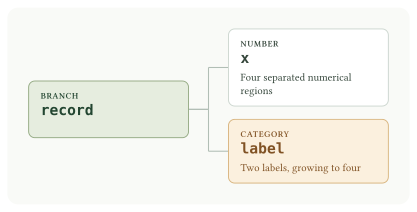
LABELS = ("negative", "positive", "far-negative", "far-positive")
CENTERS = (-1.0, 1.0, -3.0, 3.0)


def records(*, rows: int, seed: int, phase: str = "initial") -> Iterator[dict]:
    rng = np.random.default_rng(seed)
    indices = {"initial": (0, 1), "new": (2, 3), "mixed": (0, 1, 2, 3)}[phase]
    classes = np.resize(np.asarray(indices), rows)
    rng.shuffle(classes)
    noise = rng.uniform(-0.15, 0.15, rows)
    for index, deviation in zip(classes, noise, strict=True):
        yield {"x": float(CENTERS[index] + deviation), "label": LABELS[index]}


def build() -> rf.Model:
    return rf.Model.xs(
        batch_size=64,
        x=rf.Number,
        label=rf.Category(p_unavailable=0.0, topk=[3], mask=True),
    )


def fit(model: rf.Model, phase: str, seed: int, budget: int, accelerator: str) -> int:
    model.optimizer = rf.adamw(learning_rate=0.002)
    data = rf.SyntheticDataModule(
        model=model,
        train=partial(records, rows=4096, seed=seed + 1, phase=phase),
        validate=partial(records, rows=512, seed=seed + 2, phase=phase),
        seed=seed,
    )
    trainer = lit.Trainer(
        accelerator=accelerator,
        devices=1,
        max_epochs=-1,
        max_steps=budget,
        deterministic=True,
        logger=False,
        enable_checkpointing=False,
        enable_progress_bar=False,
        enable_model_summary=False,
        num_sanity_val_steps=0,
    )
    trainer.fit(model, datamodule=data)
    model.eval()
    return trainer.global_step


def prediction(model: rf.Model, rows: list[dict]) -> list[dict]:
    output = model.predict(pa.Table.from_pylist(rows))["predictions"].to_pylist()
    return [row["label"]["content"] for row in output]


def accuracy(output: list[dict], rows: list[dict]) -> float:
    return float(np.mean([value["value"] == row["label"] for value, row in zip(output, rows, strict=True)]))


def roundtrip(model: rf.Model, rows: list[dict], path: Path) -> tuple[rf.Model, bool]:
    before = prediction(model, rows)
    vocabulary = rf.Category.vocabulary(model, "/label")
    counts = rf.Category.counts(model, "/label")
    model.save(path)
    loaded = rf.Model.load(path).to(model.device)
    loaded.eval()
    after = prediction(loaded, rows)
    matches = rf.Category.vocabulary(loaded, "/label") == vocabulary
    matches &= rf.Category.counts(loaded, "/label") == counts
    matches &= all(
        a["value"] == b["value"] and abs(a["probability"] - b["probability"]) < 1e-5
        for a, b in zip(before, after, strict=True)
    )
    return loaded, matches


def run(seed: int, steps: int | None, accelerator: str) -> tuple[dict, dict]:
    lit.seed_everything(seed, workers=True)
    model = build()
    old = list(records(rows=1024, seed=seed + 3))
    new = list(records(rows=1024, seed=seed + 4, phase="new"))
    cold = prediction(model, new)
    checks = {
        "Cold prediction leaves the vocabulary empty": rf.Category.vocabulary(model, "/label") == (),
        "Empty output vocabulary returns no label and zero probability": all(
            row["value"] is None and row["probability"] == 0.0 for row in cold
        ),
    }
    initial_steps = fit(model, "initial", seed, BUDGET if steps is None else min(steps, BUDGET), accelerator)
    initial_accuracy = accuracy(prediction(model, old), old)
    vocabulary = rf.Category.vocabulary(model, "/label")
    counts = rf.Category.counts(model, "/label")
    normalization = rf.Number.normalization(model, "/x")
    checks["Initial known-label accuracy reaches 0.95"] = initial_accuracy >= 0.95
    with TemporaryDirectory(prefix="relflow-vocabulary-") as directory:
        model, matches = roundtrip(model, old, Path(directory) / "initial.pt")
        checks["Initial checkpoint preserves mapping, counts, and predictions"] = matches
        before_admission = accuracy(prediction(model, new), new)
        source = pa.Table.from_pylist(new)
        for strata in ("validate", "test", "predict"):
            model.encode(source, strata=strata)
        checks["Evaluation cannot admit new output labels"] = rf.Category.vocabulary(model, "/label") == vocabulary
        checks["Evaluation leaves exposure counts and numerical moments frozen"] = (
            rf.Category.counts(model, "/label") == counts and rf.Number.normalization(model, "/x") == normalization
        )
        checks["Unadmitted labels cannot be predicted"] = before_admission == 0.0
        parameters = {name: value.detach().clone() for name, value in model.named_parameters()}
        admission = pa.Table.from_pylist(list(records(rows=32, seed=seed + 10, phase="new")))
        model.encode(admission, strata="train")
        admitted = rf.Category.vocabulary(model, "/label")
        checks["Training admission appends both labels without moving old indices"] = (
            admitted[:2] == vocabulary and len(admitted) == 4 and set(admitted) == set(LABELS)
        )
        checks["Admission alone preserves existing learned parameter rows"] = all(
            torch.equal(parameters[name], value[: parameters[name].shape[0]])
            for name, value in model.named_parameters()
        )
        after_admission = accuracy(prediction(model, new), new)
        continuation_steps = fit(
            model, "mixed", seed + 20, CONTINUATION if steps is None else min(steps, CONTINUATION), accelerator
        )
        final_old = accuracy(prediction(model, old), old)
        final_new = accuracy(prediction(model, new), new)
        checks["Continued fitting learns new labels above 0.95 accuracy"] = final_new >= 0.95
        checks["Rehearsal retains old labels above 0.95 accuracy"] = final_old >= 0.95
        checks["Continued fitting preserves all admitted indices"] = rf.Category.vocabulary(model, "/label") == admitted
        model, matches = roundtrip(model, old + new, Path(directory) / "continued.pt")
        checks["Continued checkpoint preserves mapping, counts, and predictions"] = matches
    return {
        "initial_steps": initial_steps,
        "continuation_steps": continuation_steps,
        "initial_vocabulary": vocabulary,
        "final_vocabulary": admitted,
        "initial_accuracy": initial_accuracy,
        "new_accuracy_before_admission": before_admission,
        "new_accuracy_immediately_after_admission": after_admission,
        "final_old_accuracy": final_old,
        "final_new_accuracy": final_new,
        "two_class_chance": 0.5,
    }, checks


if __name__ == "__main__":
    report(PROOF_ID, run, seed=5901)