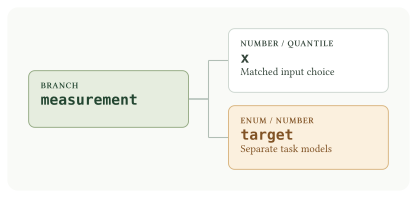
"""P077: compare numerical representations and the quantities their objectives estimate."""

from collections.abc import Iterator
from functools import partial

import lightning.pytorch as lit
import numpy as np
import pyarrow as pa
import torch
from reporting import report

import relflow as rf

PROOF_ID = "P077"
BUDGET = 400
TRAIN_ROWS = 8192
TEST_ROWS = 4096
GROUPS = ("amber", "birch", "cove")
LOCATIONS = np.array([-0.5, 0.0, 0.5])
SIGMA = 0.8


def records(*, rows: int, seed: int, contaminated: bool = False) -> Iterator[dict]:
    rng = np.random.default_rng(seed)
    u = rng.uniform(0, 1, rows)
    x = np.expm1(4 * u)
    amount = 0.2 * x + rng.normal(0, 0.1, rows)
    visible = x.copy()
    if contaminated:
        visible[rng.random(rows) < 0.02] *= 100
    for index in range(rows):
        yield {
            "x": float(visible[index]),
            "rank": "upper" if u[index] > 0.5 else "lower",
            "amount": float(amount[index]),
        }


def build(representation: str, task: str, objective: str = "mse") -> rf.Model:
    scalar = rf.Quantile if representation == "quantile" else rf.Number
    if task == "noisy":
        model = rf.Model.xs(
            batch_size=128,
            group=rf.Enum(values=GROUPS, p_unavailable=0.0),
            target=scalar(objective=objective, mask=True),
        )
    else:
        target = (
            rf.Enum(values=("lower", "upper"), p_unavailable=0.0, mask=True)
            if task == "rank"
            else rf.Number(objective="mse", mask=True)
        )
        model = rf.Model.xs(batch_size=128, x=scalar, fields={task: target})
    model.optimizer = rf.adamw(learning_rate=0.002)
    return model


def fit(model: rf.Model, train, validate, seed: int, steps: int | None, accelerator: str) -> int:
    data = rf.SyntheticDataModule(model=model, train=train, validate=validate, seed=seed)
    trainer = lit.Trainer(
        accelerator=accelerator,
        devices=1,
        max_epochs=-1,
        max_steps=BUDGET if steps is None else min(steps, BUDGET),
        deterministic=True,
        logger=False,
        enable_checkpointing=False,
        enable_progress_bar=False,
        enable_model_summary=False,
        num_sanity_val_steps=0,
    )
    trainer.fit(model, datamodule=data)
    model.eval()
    return trainer.global_step


def predict(model: rf.Model, rows: list[dict], task: str) -> np.ndarray:
    visible = [{"group": row["group"]} if task == "noisy" else {"x": row["x"]} for row in rows]
    predictions = model.predict(pa.Table.from_pylist(visible))["predictions"].to_pylist()
    name = "target" if task == "noisy" else task
    content = [row[name]["content"] for row in predictions]
    if task == "rank":
        return np.asarray([row["value"] == "upper" for row in content])
    return np.asarray(content, dtype=float)


def noisy_records(*, rows: int, seed: int) -> Iterator[dict]:
    rng = np.random.default_rng(seed)
    group = np.resize(np.arange(len(GROUPS)), rows)
    rng.shuffle(group)
    target = np.exp(LOCATIONS[group] + SIGMA * rng.standard_normal(rows))
    for index in range(rows):
        yield {"group": GROUPS[group[index]], "target": float(target[index])}


def cdf(values: np.ndarray) -> np.ndarray:
    """Analytical CDF of the equally weighted three-lognormal population mixture."""
    scaled = (np.log(np.maximum(values, 1e-300))[..., None] - LOCATIONS) / SIGMA
    return torch.special.ndtr(torch.from_numpy(scaled)).mean(dim=-1).numpy()


def inverse(percentiles: np.ndarray) -> np.ndarray:
    lower = np.zeros_like(percentiles)
    upper = np.full_like(percentiles, np.exp(LOCATIONS.max() + 10 * SIGMA))
    for _ in range(64):
        midpoint = (lower + upper) / 2
        below = cdf(midpoint) < percentiles
        lower = np.where(below, midpoint, lower)
        upper = np.where(below, upper, midpoint)
    return (lower + upper) / 2


def optima() -> dict[str, np.ndarray]:
    differences = (LOCATIONS[:, None] - LOCATIONS[None, :]) / (np.sqrt(2) * SIGMA)
    mean_percentiles = torch.special.ndtr(torch.from_numpy(differences)).mean(dim=1).numpy()
    return {
        "number_mse": np.exp(LOCATIONS + SIGMA**2 / 2),
        "number_mae": np.exp(LOCATIONS),
        "quantile_mse": inverse(mean_percentiles),
        "quantile_mae": np.exp(LOCATIONS),
    }


def run(seed: int, steps: int | None, accelerator: str) -> tuple[dict, dict]:
    stream = seed * 100
    test = list(records(rows=TEST_ROWS, seed=stream + 3))
    tail = np.asarray([row["x"] > np.expm1(4 * 0.95) for row in test])
    permutation = np.random.default_rng(stream + 4).permutation(TEST_ROWS)
    shuffled = [{**row, "x": test[index]["x"]} for row, index in zip(test, permutation, strict=True)]
    training = list(records(rows=TRAIN_ROWS, seed=stream + 1))
    mean = float(np.mean([row["amount"] for row in training]))
    target = np.asarray([row["amount"] for row in test])
    baseline = float(np.sqrt(np.mean((target - mean) ** 2)))
    labels = np.asarray([row["rank"] == "upper" for row in test])
    metrics = {
        "train_rows": TRAIN_ROWS,
        "test_rows": TEST_ROWS,
        "tail_rows": int(tail.sum()),
        "central_rows": int((~tail).sum()),
        "input_tasks": {},
        "noisy_targets": {},
    }
    checks = {}
    for task in ("rank", "amount"):
        for representation in ("number", "quantile"):
            for contaminated in (False, True):
                lit.seed_everything(seed, workers=True)
                model = build(representation, task)
                updates = fit(
                    model,
                    partial(records, rows=TRAIN_ROWS, seed=stream + 1, contaminated=contaminated),
                    partial(records, rows=1024, seed=stream + 2),
                    seed,
                    steps,
                    accelerator,
                )
                output = predict(model, test, task)
                control = predict(model, shuffled, task)
                key = f"{task}_{representation}_{'contaminated' if contaminated else 'clean'}"
                if task == "rank":
                    result = {
                        "steps": updates,
                        "accuracy": float(np.mean(output == labels)),
                        "central_accuracy": float(np.mean(output[~tail] == labels[~tail])),
                        "tail_accuracy": float(np.mean(output[tail] == labels[tail])),
                        "shuffled_accuracy": float(np.mean(control == labels)),
                        "majority_accuracy": float(max(labels.mean(), 1 - labels.mean())),
                    }
                    if not contaminated:
                        checks[f"{key}: accuracy reaches 0.90"] = result["accuracy"] >= 0.90
                        checks[f"{key}: shuffled accuracy at most 0.60"] = result["shuffled_accuracy"] <= 0.60
                else:
                    result = {
                        "steps": updates,
                        "rmse": float(np.sqrt(np.mean((output - target) ** 2))),
                        "baseline_rmse": baseline,
                        "normalized_rmse": float(np.sqrt(np.mean((output - target) ** 2)) / baseline),
                        "tail_rmse": float(np.sqrt(np.mean((output[tail] - target[tail]) ** 2))),
                        "central_rmse": float(np.sqrt(np.mean((output[~tail] - target[~tail]) ** 2))),
                        "shuffled_normalized_rmse": float(np.sqrt(np.mean((control - target) ** 2)) / baseline),
                    }
                    if not contaminated:
                        checks[f"{key}: normalized RMSE at most 0.35"] = result["normalized_rmse"] <= 0.35
                        checks[f"{key}: shuffled normalized RMSE at least 0.90"] = (
                            result["shuffled_normalized_rmse"] >= 0.90
                        )
                metrics["input_tasks"][key] = result
                checks[f"{key}: finite measurements"] = bool(np.isfinite(list(result.values())).all())
    noisy = list(noisy_records(rows=TEST_ROWS, seed=stream + 13))
    groups = np.asarray([GROUPS.index(row["group"]) for row in noisy])
    observed = np.asarray([row["target"] for row in noisy])
    targets = optima()
    metrics["population_optima"] = {key: values.tolist() for key, values in targets.items()}
    for representation in ("number", "quantile"):
        for objective in ("mse", "mae"):
            lit.seed_everything(seed, workers=True)
            model = build(representation, "noisy", objective)
            updates = fit(
                model,
                partial(noisy_records, rows=TRAIN_ROWS, seed=stream + 11),
                partial(noisy_records, rows=1024, seed=stream + 12),
                seed,
                steps,
                accelerator,
            )
            output = predict(model, noisy, "noisy")
            key = f"{representation}_{objective}"
            optimum = targets[key][groups]
            group_predictions = np.asarray([output[groups == group].mean() for group in range(len(GROUPS))])
            relative = float(np.mean(np.abs(group_predictions - targets[key]) / targets[key]))
            rank_error = cdf(output) - cdf(observed)
            result = {
                "steps": updates,
                "group_predictions": group_predictions.tolist(),
                "mean_relative_optimum_error": relative,
                "source_rmse": float(np.sqrt(np.mean((output - observed) ** 2))),
                "source_mae": float(np.mean(np.abs(output - observed))),
                "percentile_mse": float(np.mean(rank_error**2)),
                "percentile_mae": float(np.mean(np.abs(rank_error))),
                "optimum_source_rmse": float(np.sqrt(np.mean((optimum - observed) ** 2))),
                "optimum_source_mae": float(np.mean(np.abs(optimum - observed))),
            }
            metrics["noisy_targets"][key] = result
            checks[f"{key}: predictions are finite"] = bool(np.isfinite(output).all())
            checks[f"{key}: relative optimum error at most 0.25"] = relative <= 0.25
    checks["Percentile and source-unit MSE population optima differ materially"] = bool(
        np.mean(np.abs(targets["number_mse"] - targets["quantile_mse"]) / targets["number_mse"]) > 0.10
    )
    number_mse = np.asarray(metrics["noisy_targets"]["number_mse"]["group_predictions"])
    quantile_mse = np.asarray(metrics["noisy_targets"]["quantile_mse"]["group_predictions"])
    separation = float(np.mean((number_mse - quantile_mse) / targets["number_mse"]))
    metrics["learned_mse_separation_fraction"] = separation
    checks["Learned MSE predictions differ by at least 10 percent of source means"] = separation >= 0.10
    return metrics, checks


if __name__ == "__main__":
    report(PROOF_ID, run, seed=7701)