Can it discover hidden groups with different behaviors?

Clustering
Repeated identities follow four hidden numerical rules. Ask the Cluster field to recover the groups while predicting new observations.

Example

entity: entity-0017
x: 0.5
y: -6.27

The answer is shown here for explanation; it is hidden from the model when scored.

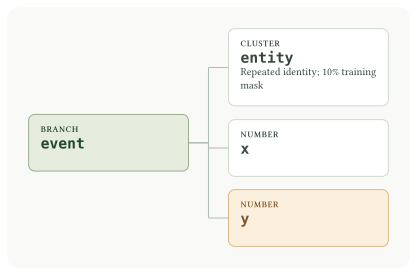
Model tree with event, entity, x, y. Amber cards are hidden prediction targets. Identity is sometimes reconstructed; y is always hidden.

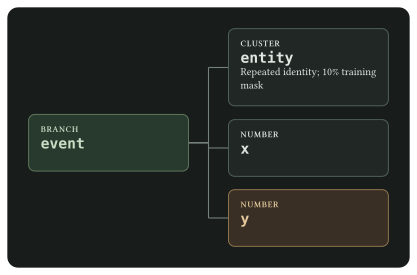
Model tree with event, entity, x, y. Amber cards are hidden prediction targets. Identity is sometimes reconstructed; y is always hidden.

Figure 1: Amber cards are hidden prediction targets. Identity is sometimes reconstructed; y is always hidden.

Comparison

Measure actual grouping agreement and held-out prediction, then shuffle identities and train a control with no persistent groups.

Result

P078 · Latest full run · Failing

Seed 7803 on cpu: 10 of 12 test checks met. The experiment did not meet every criterion. History: 0 of 3 full runs met every check, across 3 distinct seeds. History can include earlier source versions. The experiment code has changed since this run; these measurements describe its earlier version.

Comparison Latest measurement
Stable hidden groups 59.2% of baseline error
No persistent groups 100.0% of baseline error

Baseline error compares prediction error with a constant guess. 100% matches that guess; lower is better. Details specify the baseline and root-mean-square error calculation.

All three seeds fail the recovery checks at this budget. Some identity information helps prediction, but producing several clusters does not show the right groups were discovered.

Experiment details and code

Latest full run

Seed 7803, cpu, recorded 2026-09-22T17:15:18.830678+00:00. Outcome: not met.

Source fingerprint: 23a2948d330080f1bf73fad5326c9737274b95603687e909fdcb1b8f2d9d310e. Python 3.12.10; Torch 2.12.0.

Measurement Value
stable rmse: 2.64552; baseline_rmse: 4.46873; normalized_rmse: 0.592007; adjusted_rand: 0.227205; assigned_entities: 64; occupied_clusters: 7; assignments: 64 values; final 8: 7, 4, 2, 4, 4, 5, 4, 2; expected_partition: 64 values; final 8: 3, 0, 1, 0, 1, 3, 0, 1; status: committed: 0, 1; usage: 0.557843, 0.442025, 1.5263e-05, 2.28596e-05, 1.60137e-05, 3.81309e-05, 2.24091e-05, 1.79699e-05; steps: 600; training_mean: 0.00679766; noise_rmse: 0.1; shuffled: rmse: 5.13507; baseline_rmse: 4.46873; normalized_rmse: 1.14911; adjusted_rand: 0.227205; assigned_entities: 64; occupied_clusters: 7; assignments: 64 values; final 8: 7, 4, 2, 4, 4, 5, 4, 2; expected_partition: 64 values; final 8: 3, 0, 1, 0, 1, 3, 0, 1; status: committed: 0, 1; usage: 0.557843, 0.442025, 1.5263e-05, 2.28596e-05, 1.60137e-05, 3.81309e-05, 2.24091e-05, 1.79699e-05
no_regime rmse: 4.46884; baseline_rmse: 4.46873; normalized_rmse: 1.00002; adjusted_rand: -0.00541419; assigned_entities: 64; occupied_clusters: 8; assignments: 64 values; final 8: 4, 5, 3, 0, 0, 7, 4, 7; expected_partition: 64 values; final 8: 3, 0, 1, 0, 1, 3, 0, 1; status: committed: 0, 1; usage: 0.332908, 0.66696, 1.49208e-05, 2.24227e-05, 1.7405e-05, 3.72979e-05, 2.263e-05, 1.83784e-05; steps: 600; training_mean: 0.00679766; noise_rmse: 0.1
Behavioral checks
Behavioral check Outcome
stable: finite prediction and partition scores Met
stable: all 64 known identities have assignments Met
stable: evaluation preserves assignment state Met
no_regime: finite prediction and partition scores Met
no_regime: all 64 known identities have assignments Met
no_regime: evaluation preserves assignment state Met
Stable regimes recover ARI at least 0.80 Not met
Stable regimes predict with normalized RMSE at most 0.35 Not met
No-regime control has ARI at most 0.15 Met
No-regime control has normalized RMSE at least 0.85 Met
Shuffling stable test IDs gives normalized RMSE at least 0.85 Met
Shuffling stable test IDs increases normalized RMSE by at least 0.40 Met

Full run history

Runs may include earlier source versions. Repeating a seed is not an independent seed check.

Seed Outcome Recorded Code fingerprint
7801 not met 2026-09-22T17:14:32.346064+00:00 9748425926b4073698148ec07a04e313533adb880d64640fbd84de767b3b2dea
7802 not met 2026-09-22T17:14:55.425485+00:00 9748425926b4073698148ec07a04e313533adb880d64640fbd84de767b3b2dea
7803 not met 2026-09-22T17:15:18.830678+00:00 9748425926b4073698148ec07a04e313533adb880d64640fbd84de767b3b2dea

Recorded results.

Run this experiment

Proof execution is optional and separate from building this site. Use a RelFlow build matching the recorded provenance; replace the wheel path below with that artifact. Run from this documentation repository’s root:

uv run --with /path/to/matching-relflow.whl python proofs/run.py P078

Or, from a prepared proof environment, run the self-contained script directly:

PYTHONPATH=proofs python proofs/cluster/regime_recovery.py

Add --accelerator gpu for CUDA or --seed 42 for another seeded experiment. --steps 2 checks execution with a short training budget; it is recorded as a smoke run.

Download the complete proof.

Process, observability, and split unit

Randomly assign 64 opaque identities to four balanced groups. Each identity follows y = intercept[group] + slope[group] * x + Normal(0, 0.1), with x ~ Uniform(-1, 1). Intercepts are (-6, -2, 2, 6) and slopes are (-0.6, 0.6, -0.6, 0.6). The partition stays fixed across independent train, validation, and test observations. Neither the group nor its parameters are schema fields. Repeated IDs supply behavioral evidence through the hidden numeric target, and a reconstructing identity mask engages Cluster’s head.

The split unit is the observation of a known identity. This tests whether repeated evidence reveals stable groups, not unseen-identity generalization. Every split contains the same 64 identities with fresh x and noise samples.

In the no-regime control, an independently permuted identity can accompany any regime on each observation. Every numeric pair and the complete identity frequency distribution are retained, but an ID no longer identifies a curve. The conditional mean of the population remains zero for every x because the four intercepts and slopes each average to zero.

Model and predeclared gates

Fit the same xs model from the same initialization for stable-regime and no-regime data, each for 600 AdamW updates, batch 128, learning rate 0.003. Use adaptive bounds 2 through 8; the true count four is not supplied. Each arm receives 4,096 train, 1,024 validation, and 2,048 test rows. Validation is independent and does not select checkpoints. The reconstruction mask hides 10% of entity inputs during training; all entity inputs are visible at test.

The fixed gates require ARI at least 0.80 and source-unit normalized RMSE at most 0.35 for the stable arm. The separately trained no-regime control must have ARI at most 0.15 against the now-irrelevant generating partition and normalized RMSE at least 0.85. For a direct dependency check, shuffling stable test IDs must give normalized RMSE at least 0.85 and increase it by at least 0.40. Require finite metrics, full identity exposure, and frozen evaluation assignments. The population conditional-mean oracle for the no-regime arm has RMSE approximately 4.49; the informed regime oracle has noise RMSE 0.1. Count and usage have no success gate.

Remaining work

The three-seed panel retained the original gates and 600-update budget. All three runs failed both partition-recovery and prediction-quality gates; the threshold is not redefined to make these outcomes pass. Diagnose optimization and assignment behavior with training and validation data before proposing a distinct follow-up experiment or a ten-seed promotion panel.

This task has strongly separated intercepts; crossing curves, unbalanced groups, unseen identities, and a benefit over a parameter-matched Category model remain separate questions. No-regime assignments occupied seven or eight clusters. Their low ARI measures a lack of recovered meaning; Cluster did not automatically reject the spurious groups.

Complete experiment code

Code
"""P078: require real partition recovery and held-out skill from Cluster."""

from collections.abc import Iterator
from functools import partial

import lightning.pytorch as lit
import numpy as np
import pyarrow as pa
from reporting import report

import relflow as rf

PROOF_ID = "P078"
BUDGET = 600
BATCH_SIZE = 128
TRAIN_ROWS = 4096
TEST_ROWS = 2048
ENTITY_COUNT = 64
REGIME_COUNT = 4
INTERCEPTS = np.asarray((-6.0, -2.0, 2.0, 6.0))
SLOPES = np.asarray((-0.6, 0.6, -0.6, 0.6))


def partition(seed: int) -> np.ndarray:
    """A balanced random mapping known only to the generator and evaluator."""
    groups = np.arange(ENTITY_COUNT) % REGIME_COUNT
    return np.random.default_rng(seed).permutation(groups)


def records(*, rows: int, seed: int, partition_seed: int, no_regime: bool = False) -> Iterator[dict]:
    """Preserve numeric records exactly when shuffling the stable identity link."""
    rng = np.random.default_rng(seed)
    entities = np.resize(np.arange(ENTITY_COUNT), rows)
    rng.shuffle(entities)
    groups = partition(partition_seed)[entities]
    x = rng.uniform(-1.0, 1.0, rows)
    y = INTERCEPTS[groups] + SLOPES[groups] * x + rng.normal(0.0, 0.1, rows)
    if no_regime:
        entities = entities[rng.permutation(rows)]
    for entity, value, target in zip(entities, x, y, strict=True):
        yield {"entity": f"entity-{entity:04d}", "x": float(value), "y": float(target)}


def adjusted_rand(actual: np.ndarray, predicted: np.ndarray) -> float:
    """Adjusted Rand agreement, invariant to the arbitrary cluster labels."""
    _, left = np.unique(actual, return_inverse=True)
    _, right = np.unique(predicted, return_inverse=True)
    cells = np.zeros((left.max() + 1, right.max() + 1), dtype=np.int64)
    np.add.at(cells, (left, right), 1)
    joint = float(np.sum(cells * (cells - 1) / 2))
    row = cells.sum(axis=1)
    column = cells.sum(axis=0)
    left_pairs = float(np.sum(row * (row - 1) / 2))
    right_pairs = float(np.sum(column * (column - 1) / 2))
    all_pairs = len(actual) * (len(actual) - 1) / 2
    expected = left_pairs * right_pairs / all_pairs
    maximum = (left_pairs + right_pairs) / 2
    return 1.0 if maximum == expected else (joint - expected) / (maximum - expected)


def build() -> rf.Model:
    model = rf.Model.xs(
        batch_size=BATCH_SIZE,
        entity=rf.Cluster(bounds=(2, 8), p_unavailable=0.0, mask=rf.Mask(rate=0.1, reconstruct=True)),
        x=rf.Number,
        y=rf.Number(mask=True, objective="mse"),
    )
    model.optimizer = rf.adamw(learning_rate=0.003)
    return model


def predict(model: rf.Model, rows: list[dict]) -> np.ndarray:
    visible = [{"entity": row["entity"], "x": row["x"]} for row in rows]
    output = model.predict(pa.Table.from_pylist(visible))["predictions"].to_pylist()
    return np.asarray([row["y"]["content"] for row in output])


def measure(model: rf.Model, rows: list[dict], training_mean: float, partition_seed: int) -> dict:
    target = np.asarray([row["y"] for row in rows])
    predicted = predict(model, rows)
    baseline = float(np.sqrt(np.mean((target - training_mean) ** 2)))
    rmse = float(np.sqrt(np.mean((target - predicted) ** 2)))
    assignments = rf.Cluster.assignments(model, rf.Address("entity"))
    groups = partition(partition_seed)
    # Partial-budget smoke runs may not yet encounter every ID; absence remains
    # an explicit failed coverage gate rather than silently dropping entities.
    assigned = np.asarray(
        [assignments.get(f"entity-{index:04d}", {}).get("cluster", -1) for index in range(ENTITY_COUNT)]
    )
    return {
        "rmse": rmse,
        "baseline_rmse": baseline,
        "normalized_rmse": rmse / baseline,
        "adjusted_rand": adjusted_rand(groups, assigned),
        "assigned_entities": int((assigned >= 0).sum()),
        "occupied_clusters": int(len(np.unique(assigned[assigned >= 0]))),
        "assignments": assigned.tolist(),
        "expected_partition": groups.tolist(),
        "status": rf.Cluster.status(model, rf.Address("entity")),
    }


def run(seed: int, steps: int | None, accelerator: str) -> tuple[dict, dict]:
    metrics, checks = {}, {}
    partition_seed = seed * 100
    for arm, no_regime in (("stable", False), ("no_regime", True)):
        lit.seed_everything(seed, workers=True)
        model = build()
        options = {"partition_seed": partition_seed, "no_regime": no_regime}
        data = rf.SyntheticDataModule(
            model=model,
            train=partial(records, rows=TRAIN_ROWS, seed=seed * 100 + 1, **options),
            validate=partial(records, rows=1024, seed=seed * 100 + 2, **options),
            seed=seed,
        )
        trainer = lit.Trainer(
            accelerator=accelerator,
            devices=1,
            max_steps=BUDGET if steps is None else min(steps, BUDGET),
            max_epochs=-1,
            logger=False,
            enable_checkpointing=False,
            enable_progress_bar=False,
            enable_model_summary=False,
            deterministic=True,
            num_sanity_val_steps=0,
        )
        trainer.fit(model, datamodule=data)
        model.eval()
        state = rf.Cluster.assignments(model, rf.Address("entity"))
        training_mean = float(np.mean([row["y"] for row in records(rows=TRAIN_ROWS, seed=seed * 100 + 1, **options)]))
        test = list(records(rows=TEST_ROWS, seed=seed * 100 + 3, **options))
        measured = measure(model, test, training_mean, partition_seed)
        measured.update(steps=trainer.global_step, training_mean=training_mean, noise_rmse=0.1)
        if arm == "stable":
            shuffled = list(records(rows=TEST_ROWS, seed=seed * 100 + 3, partition_seed=partition_seed, no_regime=True))
            measured["shuffled"] = measure(model, shuffled, training_mean, partition_seed)
        metrics[arm] = measured
        checks[f"{arm}: finite prediction and partition scores"] = bool(
            np.isfinite([measured["rmse"], measured["normalized_rmse"], measured["adjusted_rand"]]).all()
        )
        checks[f"{arm}: all 64 known identities have assignments"] = measured["assigned_entities"] == ENTITY_COUNT
        checks[f"{arm}: evaluation preserves assignment state"] = state == rf.Cluster.assignments(
            model, rf.Address("entity")
        )
    stable, control = metrics["stable"], metrics["no_regime"]
    checks.update(
        {
            "Stable regimes recover ARI at least 0.80": stable["adjusted_rand"] >= 0.80,
            "Stable regimes predict with normalized RMSE at most 0.35": stable["normalized_rmse"] <= 0.35,
            "No-regime control has ARI at most 0.15": control["adjusted_rand"] <= 0.15,
            "No-regime control has normalized RMSE at least 0.85": control["normalized_rmse"] >= 0.85,
            "Shuffling stable test IDs gives normalized RMSE at least 0.85": stable["shuffled"]["normalized_rmse"]
            >= 0.85,
            "Shuffling stable test IDs increases normalized RMSE by at least 0.40": (
                stable["shuffled"]["normalized_rmse"] - stable["normalized_rmse"] >= 0.40
            ),
        }
    )
    return metrics, checks


if __name__ == "__main__":
    report(PROOF_ID, run, seed=7801)