Mean can preserve a scalar average while erasing the count of identical repeated tokens when branch attention is disabled.
One copy of a value and six copies have the same mean, but different totals. This paired case tests whether a compact branch summary preserves the information its parent actually needs.
Seed 2599 on gpu: 2 of 2 behavioral checks met. See the measurements below.
Insights
With branch attention disabled, averaging identical encoded values erases how many copies were present. One amount and six copies yield the same branch summary, so a downstream decoder cannot recover their different totals from that summary.
The recorded model learns the average but produces identical total predictions for the explicit one-versus-six pair. This is an expected information boundary, not simply insufficient training. Mean reduces encoded tokens rather than calculating a raw numerical average directly.
Choose a summary that retains what the parent needs. The result specifically uses attention=None; preceding attention can change the available information. Exact business totals belong in preprocessing, while learned alternatives need their own behavioral checks.
Setup
Code
"""P041: learn an average while deliberately erasing repeated-value counts.With branch attention disabled, Mean represents one and six identical inputsthe same way. A downstream sum therefore cannot identify their different totals."""from collections.abc import Iteratorfrom functools import partialimport lightning.pytorch as litimport numpy as npimport torchfrom reporting import reportimport relflow as rfPROOF_ID ="P041"
Examples
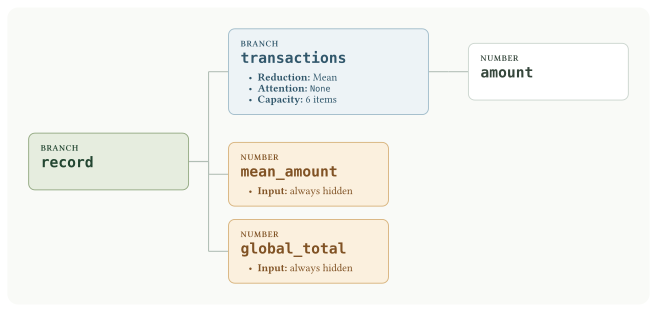
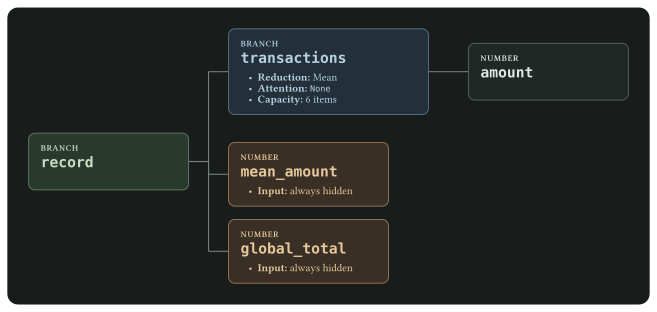
Both answers are hidden Number targets. The branch uses attention=None and rf.Mean(), so repeated identical amounts have the same reduced summary.
These are the different correct totals for the explicit one-versus-six comparison. The controlled Mean route produces identical total predictions; it does not recover both answers shown here.
Changing the common amount changes the average and its encoded summary. The held-out average task varies both this amount and the number of repeats, while the count distinction remains unavailable in the isolated Mean route.
Synthetic data and controls
Code
def records(*, rows: int, seed: int) -> Iterator[dict]:"""Yield variable-length bags of equal values with mean and sum targets.""" rng = np.random.default_rng(seed)for _ inrange(rows): count =int(rng.integers(1, 7)) amount =float(rng.uniform(0.5, 1.5))yield {"transactions": [{"amount": amount} for _ inrange(count)],"mean_amount": amount,"global_total": count * amount, }def prediction(model: rf.Model, rows: list[dict], source: str, target: str) -> np.ndarray:"""Predict one hidden scalar from its visible repeated context.""" inputs = [{source: row[source]} for row in rows] output = model.predict(inputs).to_pylist()return np.asarray([row["predictions"][f"record/{target}"]["content"] for row in output], dtype=np.float64)def rmse(actual: np.ndarray, predicted: np.ndarray |float) ->float:returnfloat(np.sqrt(np.mean(np.square(actual - predicted))))
Model tree
Figure 1: Transactions use Mean reduction with attention disabled and capacity for six items. Both numerical targets are hidden from input.
How it works
The transaction branch uses attention=None, reduction=rf.Mean(). Its identical encoded amounts are averaged without preceding branch attention introducing count or position information. The parent sees the same summary for one and six repeats, so it cannot recover their different totals.
The synthetic training process varies the number of repeated equal amounts from one to six and varies the shared amount across observations. After 300 deterministic steps, evaluation checks the average on 512 held-out rows and compares predictions for the explicit one-versus-six pair. Training and validation contain 1,024 and 256 independently generated rows.
Training and evaluation
Code
def run(seed: int, steps: int|None, accelerator: str) ->tuple[dict, dict]: lit.seed_everything(seed, workers=True) data_seed = (seed -2599) % (2**32) train = partial(records, rows=1024, seed=data_seed +1) validate = partial(records, rows=256, seed=data_seed +2) test =list(records(rows=512, seed=data_seed +3)) model = rf.Model( d_model=24, n_layers=1, n_heads=4, batch_size=64, transactions=rf.Branch(length=6, attention=None, reduction=rf.Mean(), amount=rf.Number), mean_amount=rf.Number(mask=True, objective="mse"), global_total=rf.Number(mask=True, objective="mse"), ) model.optimizer =lambda module: torch.optim.AdamW(module.parameters(), lr=3e-3) data = rf.SyntheticDataModule(model=model, train=train, validate=validate, seed=seed) trainer = lit.Trainer( accelerator=accelerator, max_epochs=-1, max_steps=steps if steps isnotNoneelse300, logger=False, enable_progress_bar=False, enable_model_summary=False, enable_checkpointing=False, deterministic=True, ) trainer.fit(model=model, datamodule=data) test_mean = np.asarray([row["mean_amount"] for row in test]) train_mean = np.mean([row["mean_amount"] for row in train()]) baseline = rmse(test_mean, float(train_mean)) mean_rmse = rmse(test_mean, prediction(model, test, "transactions", "mean_amount")) mean_nrmse = mean_rmse / baseline paired = [ {"transactions": [{"amount": 1.25}]}, {"transactions": [{"amount": 1.25} for _ inrange(6)]}, ] paired_total = prediction(model, paired, "transactions", "global_total")return {"steps": trainer.global_step,"mean_baseline_rmse": baseline,"mean_rmse": mean_rmse,"mean_nrmse": mean_nrmse,"paired_total_predictions": paired_total.tolist(), }, {"Mean normalized RMSE is below 0.25": mean_nrmse <0.25,"One and six equal values produce the same total prediction": bool( np.allclose(paired_total[0], paired_total[1], atol=1e-6, rtol=0.0) ), }
Evidence
Latest full run
Seed 2599, gpu, recorded 2026-09-15T02:33:00.987438+00:00. Outcome: met.
Broaden the value patterns and nested partitions. The family still needs a nested global_total task and a largest_session_average target, then three paired core seeds and at least ten calibration seeds for the learned gates.
Use preprocessing for exact business arithmetic. For learned hierarchy compression, the nested Attention case tests a route that retains cardinality information.
Reproduce
Run by stable ID from the repository root:
uv run python proofs/run.py P041
Or run the self-contained script directly:
PYTHONPATH=proofs uv run python proofs/structure/mean_erases_cardinality.py
Add --accelerator gpu for CUDA or --seed 42 for another seeded experiment. --steps 2 checks execution with a short training budget; it is recorded as a smoke run.