Attention reductions can preserve enough local cardinality to predict the largest session total from nested transactions.
Six equal amounts can form three equal sessions or one large session between two small ones. Their global total stays the same, but their largest session total changes. This proof asks the hierarchy to preserve that distinction.
Seed 2601 on gpu: 2 of 2 behavioral checks met. See the measurements below.
Insights
How values are grouped can change the answer even when the values themselves stay the same. The matched observations contain the same six amounts but divide them into different session sizes, changing the largest session total.
Attention reduction includes an additive sum and count contribution alongside normalized attention. The model beats the best flattened-information prediction and recovers much of the true difference between the paired observations. The difference metric uses absolute magnitudes; the separate RMSE gate checks closeness to actual targets.
This supports the tested route through two partitions of equal values. It does not establish exact nested arithmetic or arbitrary capacity. Varying amounts within sessions and testing more partitions remain necessary extensions.
Setup
Code
"""P040: retain local counts before selecting the largest session total.Paired records contain the same six values partitioned as (2, 2, 2) and(1, 4, 1). Flattening loses the answer. Attention must beat that erased-inputoracle and recover the difference between the paired targets."""from collections.abc import Iteratorfrom functools import partialimport lightning.pytorch as litimport numpy as npimport torchfrom reporting import reportimport relflow as rfPROOF_ID ="P040"
Examples
largest_session_total is a hidden Number target. The generator also includes global_total, but this model does not define or use that field.
The generator varies the common amount between pairs. The correct target must reflect both value and local count. The displayed totals are exact ground truth; the reported learned recovery is approximate.
Synthetic data and controls
Code
def records(*, pairs: int, seed: int) -> Iterator[dict]:"""Yield adjacent regroupings of the same six equal transaction values.""" rng = np.random.default_rng(seed)for _ inrange(pairs): amount =float(rng.uniform(0.4, 1.6))for lengths in ((2, 2, 2), (1, 4, 1)):yield {"sessions": [{"transactions": [{"amount": amount} for _ inrange(length)]} for length in lengths],"global_total": 6* amount,"largest_session_total": max(lengths) * amount, }def prediction(model: rf.Model, rows: list[dict], source: str, target: str) -> np.ndarray:"""Predict one hidden scalar from its visible repeated context.""" inputs = [{source: row[source]} for row in rows] output = model.predict(inputs).to_pylist()return np.asarray([row["predictions"][f"record/{target}"]["content"] for row in output], dtype=np.float64)def rmse(actual: np.ndarray, predicted: np.ndarray |float) ->float:returnfloat(np.sqrt(np.mean(np.square(actual - predicted))))
Model tree
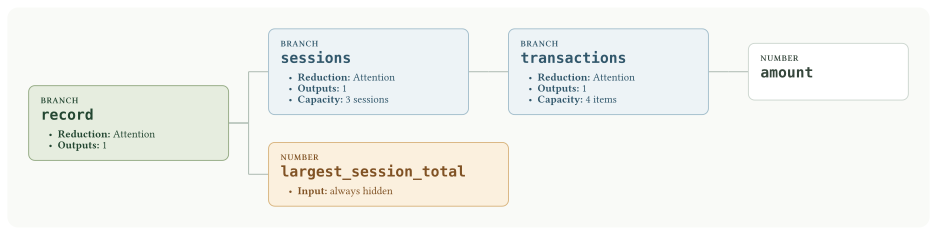
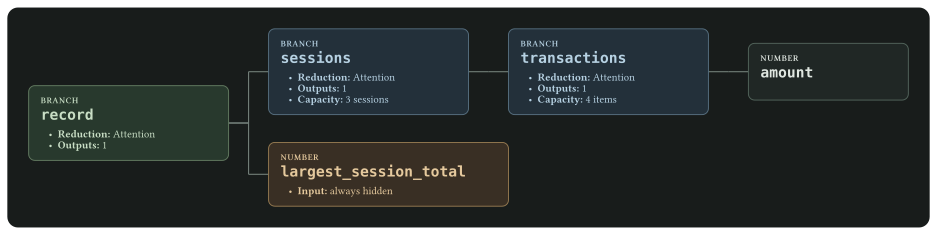
Figure 1: Root, sessions, and transactions each use one-output Attention reduction. Local capacities preserve the tested groupings; the largest total is hidden.
How it works
The session, transaction, and root contexts all use Attention reduction. The reducer adds a projected sum and an explicit count contribution alongside normalized attention. This additional path lets equal tokens carry different mass when their repetition count changes.
Each pair uses the same six amounts, with session sizes (2, 2, 2) versus (1, 4, 1). The amount varies between pairs. The model trains on 128 pairs, validates on 32, and tests on 64 independently generated pairs, after 80 deterministic steps.
The comparison oracle sees only flattened values. It must predict the same answer for both members of a pair; their target average is its optimal squared-error prediction. Beating it requires retaining session structure.
Training and evaluation
Code
def run(seed: int, steps: int|None, accelerator: str) ->tuple[dict, dict]: lit.seed_everything(seed, workers=True) data_seed = (seed -2601) % (2**32) train = partial(records, pairs=128, seed=data_seed +44) validate = partial(records, pairs=32, seed=data_seed +55) test =list(records(pairs=64, seed=data_seed +66)) flattened = [[item for session in row["sessions"] for item in session["transactions"]] for row in test]ifnotall(flattened[index] == flattened[index +1] for index inrange(0, len(flattened), 2)):raiseValueError("regrouping pairs must contain identical flattened values") model = rf.Model( d_model=24, n_layers=1, n_heads=4, reduction=rf.Attention(), batch_size=64, sessions=rf.Branch( length=3, reduction=rf.Attention(), transactions=rf.Branch(length=4, reduction=rf.Attention(), amount=rf.Number), ), largest_session_total=rf.Number(mask=True, objective="mse"), ) model.optimizer =lambda module: torch.optim.AdamW(module.parameters(), lr=3e-3) data = rf.SyntheticDataModule(model=model, train=train, validate=validate, seed=seed) trainer = lit.Trainer( accelerator=accelerator, max_epochs=-1, max_steps=steps if steps isnotNoneelse80, logger=False, enable_progress_bar=False, enable_model_summary=False, enable_checkpointing=False, deterministic=True, ) trainer.fit(model=model, datamodule=data) targets = np.asarray([row["largest_session_total"] for row in test]) predictions = prediction(model, test, "sessions", "largest_session_total") paired_targets = targets.reshape(-1, 2) flat_oracle = np.repeat(paired_targets.mean(axis=1), 2) oracle_rmse = rmse(targets, flat_oracle) test_rmse = rmse(targets, predictions) predicted_delta =float(np.abs(np.diff(predictions.reshape(-1, 2), axis=1)).mean()) true_delta =float(np.abs(np.diff(paired_targets, axis=1)).mean())return {"steps": trainer.global_step,"flat_oracle_rmse": oracle_rmse,"test_rmse": test_rmse,"predicted_pair_delta": predicted_delta,"true_pair_delta": true_delta,"recovered_pair_delta_fraction": predicted_delta / true_delta, }, {"Attention improves over the flattened oracle by at least 25%": bool( np.isfinite(test_rmse) and test_rmse < oracle_rmse *0.75 ),"Attention recovers at least 75% of the pair delta": predicted_delta >= true_delta *0.75, }
Evidence
Latest full run
Seed 2601, gpu, recorded 2026-09-15T02:32:54.629950+00:00. Outcome: met.
Add nested global totals and largest-session averages. Vary amounts within sessions, test more partitions, and vary Attention output counts and nested capacities. Repeat the nested gates over three paired core seeds and at least ten calibration seeds without weakening either threshold.
Reproduce
Run by stable ID from the repository root:
uv run python proofs/run.py P040
Or run the self-contained script directly:
PYTHONPATH=proofs uv run python proofs/structure/attention_preserves_nested_cardinality.py
Add --accelerator gpu for CUDA or --seed 42 for another seeded experiment. --steps 2 checks execution with a short training budget; it is recorded as a smoke run.