Recover population variance from a repeated numerical field whose mean does not reveal its spread.
Seed 3504 on gpu: 2 of 2 behavioral checks met. See the measurements below. The experiment code has changed since this run; these measurements describe its earlier version.
Insights
The model can learn how spread out values are, even when their averages are the same. Independently varied location and scale prevent the mean alone from supplying the variance label. The matched-mean control requires a larger prediction for the more dispersed collection, without providing squared deviations as inputs.
This supports learning beyond a single raw-average statistic. It does not mean rf.Mean() always erases spread: averaging nonlinear encoded features is different from supplying only the arithmetic mean. This particular proof uses Attention. The squared-deviation control isolates the easier reduction task. This proof uses population variance; a sample-variance target, varying lengths, and missing values need separate checks.
Setup
Code
"""A raw repeated number should reveal spread beyond its mean.Learn a second central moment without receiving squared deviations.Run: uv run python proofs/run.py P007"""from __future__ import annotationsfrom collections.abc import Iteratorimport lightning.pytorch as litimport numpy as npimport torchfrom reporting import reportimport relflow as rfPROOF_ID ="P007"ITEMS =8
Examples
Targets use mask=True; the labels below are supervision hidden from the encoder.
The mean remains 0.3, but the variance rises to 1.21. This illustrates the matched-mean control; the actual probe uses a normalized linear sequence instead of these alternating values.
The mean is now −0.3 while variance remains 0.04. Location is independently varied in the generator, so a mean-only rule cannot recover the target. This example states the label semantics, not an additional translation gate.
Synthetic data and controls
Code
def dispersion_records(*, rows: int, seed: int) -> Iterator[dict]:"""Draw rows whose location and spread are statistically independent.""" rng = np.random.default_rng(seed)for _ inrange(rows): basis = rng.normal(size=ITEMS) basis -= basis.mean() basis /= np.sqrt(np.mean(np.square(basis))) location =float(rng.uniform(-0.8, 0.8)) scale =float(rng.uniform(0.12, 1.25)) values = location + scale * basis items = [{"value": float(value)} for value in values]yield {"items": items, "variance": scale * scale}def prediction(model: rf.Model, observations: list[dict]) -> np.ndarray: inputs = [{"items": row["items"]} for row in observations] output = model.predict(inputs)["predictions"].to_pylist()return np.asarray([row["record/variance"]["content"] for row in output], dtype=np.float64)def rmse(actual: np.ndarray, predicted: np.ndarray |float) ->float:returnfloat(np.sqrt(np.mean(np.square(actual - predicted))))def score(*, train: list[dict], test: list[dict], predicted: np.ndarray) ->dict[str, float]:"""Compare held-out RMSE with the constant training-target mean.""" actual = np.asarray([row["variance"] for row in test], dtype=np.float64) baseline = rmse(actual, float(np.asarray([row["variance"] for row in train], dtype=np.float64).mean())) measured = rmse(actual, predicted)return {"rmse": measured, "baseline_rmse": baseline, "nrmse": measured / baseline}
Model tree
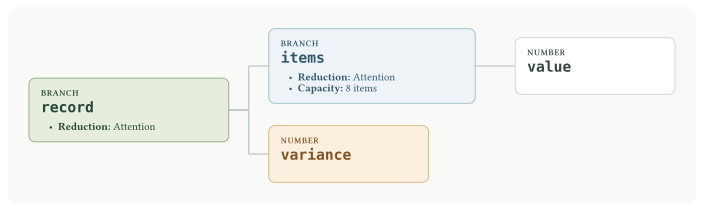
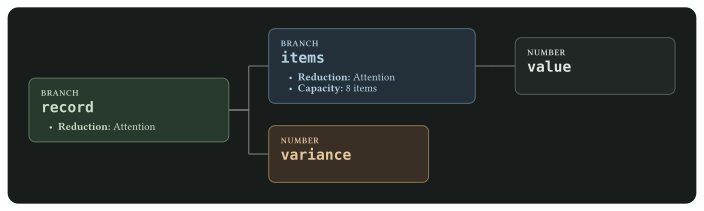
Figure 1: Learned Attention reduces eight raw values before decoding hidden population variance.
How it works
The item branch and root use learned rf.Attention reductions. Eight raw values arrive without a mean, squared deviation, or variance feature. The generator varies location and scale independently and exactly centers its basis, preventing location alone from predicting spread.
A matched-mean probe keeps the same normalized shape and mean of 0.3 while changing scale from 0.2 to 1.1. Its true population variances are 0.04 and 1.21; the predicted high-spread variance must exceed the low-spread one by more than 0.65. The squared-deviation control isolates averaging after the nonlinear statistic has already been supplied.
Training and evaluation
Code
def run(seed: int, steps: int|None, accelerator: str) ->tuple[dict, dict]: lit.seed_everything(seed, workers=True)# Split seeds are independent; rerunning a generator reproduces the same records. train =list(dispersion_records(rows=1280, seed=seed +1)) test =list(dispersion_records(rows=640, seed=seed +3)) model = rf.Model( d_model=32, n_layers=2, n_heads=4, reduction=rf.Attention(n_layers=2), batch_size=64, optimizer=lambda module: torch.optim.Adam(module.parameters(), lr=0.001), items=rf.Branch(length=ITEMS, n_layers=2, reduction=rf.Attention(n_layers=2), value=rf.Number), variance=rf.Number(mask=True, objective="mse"), ) datamodule = rf.SyntheticDataModule( model=model, train=lambda: dispersion_records(rows=1280, seed=seed +1), validate=lambda: dispersion_records(rows=320, seed=seed +2), seed=seed, ) trainer = lit.Trainer( accelerator=accelerator, devices=1, max_epochs=-1, max_steps=900if steps isNoneelsemin(steps, 900), logger=False, enable_progress_bar=False, enable_model_summary=False, enable_checkpointing=False, deterministic=True, num_sanity_val_steps=0, ) trainer.fit(model, datamodule=datamodule)# Evaluate held-out answers and retain their original labels in corruption controls. measured = score(train=train, test=test, predicted=prediction(model, test)) basis = np.linspace(-1.0, 1.0, ITEMS) basis -= basis.mean() basis /= np.sqrt(np.mean(np.square(basis))) matched = [{"items": [{"value": float(0.3+ scale * value)} for value in basis]} for scale in (0.2, 1.1)] paired_prediction = prediction(model, matched) metrics = {"measured": measured, "paired_prediction": paired_prediction.tolist(), "steps": trainer.global_step} checks = {"Variance nRMSE below 0.30": bool(measured["nrmse"] <0.3),"Matched-mean variance prediction gap above 0.65": bool(paired_prediction[1] - paired_prediction[0] >0.65), }return metrics, checks
Evidence
Latest full run
Seed 3504, gpu, recorded 2026-09-15T02:19:20.158395+00:00. Outcome: met.
Repeat across seeds; add variable lengths, missing values, outliers, zero-variance rows, and permutation controls. The label uses population variance (dividing by item count), not an unbiased sample-variance estimator.
The family’s promotion target is at least three core seeds and ten lightweight calibration seeds.
Reproduce
Run by stable ID from the repository root:
uv run python proofs/run.py P007
Or run the self-contained script directly:
PYTHONPATH=proofs uv run python proofs/aggregation/raw_value_variance.py
Add --accelerator gpu for CUDA or --seed 42 for another seeded experiment. --steps 2 checks execution with a short training budget; it is recorded as a smoke run.