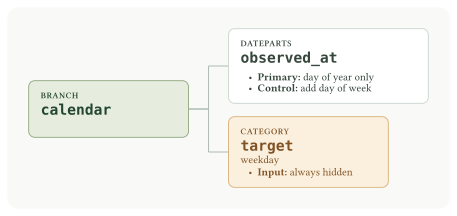
def fit(
    *,
    dateparts: Sequence[str],
    classes: int,
    train: Callable[[], Iterator[dict]],
    validate: Callable[[], Iterator[dict]],
    epochs: int,
    seed: int,
    steps: int | None,
    accelerator: str,
) -> rf.Model:
    """Train on the selected calendar coordinates with the remaining schema fixed."""
    lit.seed_everything(seed, workers=True)
    model = rf.Model(
        name="calendar",
        d_model=64,
        n_layers=3,
        n_heads=4,
        batch_size=128,
        observed_at=rf.DateParts(dateparts=list(dateparts)),
        target=rf.Category(mask=True, size=classes, p_unavailable=0.0),
    )
    model.optimizer = lambda module: torch.optim.AdamW(module.parameters(), lr=3e-3)
    data = rf.SyntheticDataModule(model=model, train=train, validate=validate, seed=seed)
    trainer = lit.Trainer(
        accelerator=accelerator,
        max_epochs=epochs,
        max_steps=steps if steps is not None else -1,
        logger=False,
        enable_progress_bar=False,
        enable_model_summary=False,
        enable_checkpointing=False,
        deterministic=True,
        num_sanity_val_steps=0,
    )
    trainer.fit(model=model, datamodule=data)
    return model


def accuracy(model: rf.Model, records: Callable[[], Iterator[dict]], accelerator: str) -> float:
    """Evaluate held-out labels without updating the Category vocabulary."""
    data = rf.SyntheticDataModule(model=model, test=records)
    trainer = lit.Trainer(
        accelerator=accelerator,
        logger=False,
        enable_progress_bar=False,
        enable_model_summary=False,
        enable_checkpointing=False,
        deterministic=True,
    )
    metrics = trainer.test(model=model, datamodule=data, verbose=False)[0]
    return float(metrics["calendar.target/test.accuracy.content"])


def run(seed: int, steps: int | None, accelerator: str) -> tuple[dict, dict]:
    train = partial(records, years=tuple(range(1901, 1936)))
    validate = partial(records, years=tuple(range(1951, 1986)))
    test = partial(records, years=tuple(range(2001, 2036)))
    day_only = fit(
        dateparts=("day_of_year",),
        classes=7,
        train=train,
        validate=validate,
        epochs=14,
        seed=seed,
        steps=steps,
        accelerator=accelerator,
    )
    ambiguous_accuracy = accuracy(day_only, test, accelerator)
    identified = fit(
        dateparts=("day_of_year", "day_of_week"),
        classes=7,
        train=train,
        validate=validate,
        epochs=14,
        seed=seed,
        steps=steps,
        accelerator=accelerator,
    )
    identified_accuracy = accuracy(identified, test, accelerator)
    gap = identified_accuracy - ambiguous_accuracy
    return {
        "day_only_accuracy": ambiguous_accuracy,
        "with_weekday_accuracy": identified_accuracy,
        "accuracy_gap": gap,
    }, {
        "Day-of-year accuracy is at most 0.20": ambiguous_accuracy <= 0.20,
        "Visible weekday accuracy reaches 0.95": identified_accuracy >= 0.95,
        "Visible weekday improves accuracy by at least 0.70": gap >= 0.70,
    }