Learning Month from Annual Phase

Calendar reasoning
A model can learn month boundaries from day-of-year on unseen dates in non-leap years.

Does a cyclic annual coordinate contain enough information to learn the month? This proof exposes only day_of_year, then tests month predictions on dates and years withheld from training.

Seed 41 on gpu: 3 of 3 behavioral checks met. See the measurements below.

Insights

In non-leap years, the day number is enough to learn which month a date belongs to. DateParts supplies only day-of-year, and the model learns its month intervals from odd dates before testing on even dates in unseen years.

Accuracy is high on intact observations and drops sharply when timestamps are permuted while labels stay fixed. That supports use of the date–month relationship rather than success from label frequencies alone. Evidence covers one model seed and the deliberately restricted calendar.

For exact month extraction, expose the month coordinate or derive it in preprocessing. This proof tests learned periodicity, not general calendar reasoning; leap-year ambiguity requires additional information.

Setup

Code
"""P044: learn month from day-of-year on unseen dates and years.

Only non-leap years are used. Training dates are odd days of the month;
held-out dates are even days in new years. Timestamp permutation retains the
labels and date marginals while removing their relationship.
"""

import calendar
from collections.abc import Callable, Iterator, Sequence
from datetime import date, timedelta
from functools import partial

import lightning.pytorch as lit
import numpy as np
import torch
from reporting import report

import relflow as rf

PROOF_ID = "P044"

Examples

The model sees only the cyclic day_of_year coordinate. The original year and explicit month are not additional inputs; target is a masked Category.

An unseen February date

observed_at: 2025-02-04
target: February

February 4 is ordinal day 35 in this non-leap year. It is an even day of the month, so it is outside the odd-day training selection.

Another annual phase

observed_at: 2025-11-18
target: November

November 18 is ordinal day 322. The model must learn a different interval of the annual cycle rather than recall a particular training timestamp.

Timestamp permutation

observed_at: 2025-11-18
target: February

A timestamp permutation can replace the first record’s date while leaving its label in place. February is intentionally inconsistent with this date; the corruption control checks that breaking the association harms aggregate accuracy. It does not define a second calendar rule.

Synthetic data and controls

Code
def records(years: Sequence[int], *, parity: int) -> Iterator[dict]:
    """Yield non-leap dates selected by day-of-month parity."""
    for year in years:
        if calendar.isleap(year):
            raise ValueError(f"month periodicity requires non-leap years, got {year}")
        current = date(year, 1, 1)
        while current.year == year:
            if current.day % 2 == parity:
                yield {"observed_at": current, "target": calendar.month_name[current.month]}
            current += timedelta(days=1)

Model tree

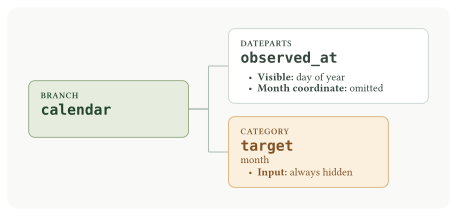
Calendar contains DateParts observed at exposing only day-of-year and omitting the month coordinate, with a Category month target always hidden from input.

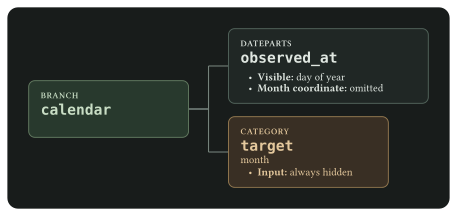
Calendar contains DateParts observed at exposing only day-of-year and omitting the month coordinate, with a Category month target always hidden from input.

Figure 1: The input exposes only day-of-year, omitting the month coordinate. The month label is hidden from input.

How it works

In a non-leap calendar, day-of-year determines month. The model must learn the intervals in that cyclic representation. Training uses odd-numbered days of each month in 2017–2019; validation uses odd days in 2021. Test dates are even-numbered days in 2023 and 2025. All these years are non-leap.

After 70 deterministic epochs, the test evaluates both the original held-out data and a version with timestamps permuted while labels stay put. Permutation preserves the marginals but destroys the useful relationship.

Training and evaluation

Code
def fit(
    *,
    dateparts: Sequence[str],
    classes: int,
    train: Callable[[], Iterator[dict]],
    validate: Callable[[], Iterator[dict]],
    epochs: int,
    seed: int,
    steps: int | None,
    accelerator: str,
) -> rf.Model:
    """Train on the selected calendar coordinates with the remaining schema fixed."""
    lit.seed_everything(seed, workers=True)
    model = rf.Model(
        name="calendar",
        d_model=64,
        n_layers=3,
        n_heads=4,
        batch_size=128,
        observed_at=rf.DateParts(dateparts=list(dateparts)),
        target=rf.Category(mask=True, size=classes, p_unavailable=0.0),
    )
    model.optimizer = lambda module: torch.optim.AdamW(module.parameters(), lr=3e-3)
    data = rf.SyntheticDataModule(model=model, train=train, validate=validate, seed=seed)
    trainer = lit.Trainer(
        accelerator=accelerator,
        max_epochs=epochs,
        max_steps=steps if steps is not None else -1,
        logger=False,
        enable_progress_bar=False,
        enable_model_summary=False,
        enable_checkpointing=False,
        deterministic=True,
        num_sanity_val_steps=0,
    )
    trainer.fit(model=model, datamodule=data)
    return model


def accuracy(model: rf.Model, records: Callable[[], Iterator[dict]], accelerator: str) -> float:
    """Evaluate held-out labels without updating the Category vocabulary."""
    data = rf.SyntheticDataModule(model=model, test=records)
    trainer = lit.Trainer(
        accelerator=accelerator,
        logger=False,
        enable_progress_bar=False,
        enable_model_summary=False,
        enable_checkpointing=False,
        deterministic=True,
    )
    metrics = trainer.test(model=model, datamodule=data, verbose=False)[0]
    return float(metrics["calendar.target/test.accuracy.content"])


def run(seed: int, steps: int | None, accelerator: str) -> tuple[dict, dict]:
    train = partial(records, (2017, 2018, 2019), parity=1)
    validate = partial(records, (2021,), parity=1)
    test = list(records((2023, 2025), parity=0))
    model = fit(
        dateparts=("day_of_year",),
        classes=12,
        train=train,
        validate=validate,
        epochs=70,
        seed=seed,
        steps=steps,
        accelerator=accelerator,
    )
    periodic_accuracy = accuracy(model, lambda: iter(test), accelerator)
    order = np.random.default_rng(seed + 1).permutation(len(test))
    permuted = [{**row, "observed_at": test[index]["observed_at"]} for row, index in zip(test, order, strict=True)]
    permuted_accuracy = accuracy(model, lambda: iter(permuted), accelerator)
    gap = periodic_accuracy - permuted_accuracy
    return {
        "periodic_accuracy": periodic_accuracy,
        "permuted_accuracy": permuted_accuracy,
        "accuracy_gap": gap,
    }, {
        "Unseen-date month accuracy reaches 0.90": periodic_accuracy >= 0.90,
        "Timestamp permutation accuracy is at most 0.20": permuted_accuracy <= 0.20,
        "Original dates exceed permutation by at least 0.65 accuracy": gap >= 0.65,
    }
Evidence

Latest full run

Seed 41, gpu, recorded 2026-09-15T02:33:33.068764+00:00. Outcome: met.

Source fingerprint: cae4dc037ec67b465f2ab85f206e430dced41943a92a823f44372077271946b9. Python 3.12.6; Torch 2.12.0.

Measurement Value
periodic_accuracy 0.915901
permuted_accuracy 0.104371
accuracy_gap 0.81153
Behavioral checks
Behavioral check Outcome
Unseen-date month accuracy reaches 0.90 Met
Timestamp permutation accuracy is at most 0.20 Met
Original dates exceed permutation by at least 0.65 accuracy Met

Recorded results.

Remaining work

Repeat the gates over three core seeds and at least ten calibration seeds. Extend the family to week and multi-coordinate targets. Characterize timezone, daylight-saving, and leap-day preprocessing policies separately rather than assuming that DateParts adds those semantics.

Reproduce

Run by stable ID from the repository root:

uv run python proofs/run.py P044

Or run the self-contained script directly:

PYTHONPATH=proofs uv run python proofs/temporal/month_from_day_of_year.py

Add --accelerator gpu for CUDA or --seed 42 for another seeded experiment. --steps 2 checks execution with a short training budget; it is recorded as a smoke run.

Download the complete proof.

Code
if __name__ == "__main__":
    report(PROOF_ID, run, seed=41)