Resolving the Leap-Day Boundary

Calendar reasoning
Day-of-year alone cannot distinguish leap-day February from non-leap March at ordinal day 60.

Ordinal day 60 can mean February 29 or March 1. This proof creates a balanced collision, then adds a calendar coordinate that separates the two cases.

Seed 53 on gpu: 3 of 3 behavioral checks met. See the measurements below.

Insights

Day 60 can be February 29 or March 1, so its number alone cannot identify the month. With balanced labels and only day-of-year visible, the model has no information that can resolve the two answers.

The day-only route stays at chance, while adding week-of-month separates the dates and resolves the ambiguity. The models use different training budgets, but additional optimization alone cannot resolve identical inputs with conflicting labels. This is a representation boundary with a positive control.

Supply the needed coordinate or calculate exact calendar results in preprocessing. Success with week-of-month does not establish general leap-year reasoning, timezone semantics, or reliability for every alternative coordinate choice.

Setup

Code
"""P043: distinguish February 29 from March 1 at ordinal day sixty.

Day-of-year is identical for both labels. Adding week-of-month reveals their
difference. The original budgets are retained: ten epochs for day-only and
twenty for the richer input, so this is not an equal-budget comparison.
"""

import calendar
from collections.abc import Callable, Iterator, Sequence
from datetime import date
from functools import partial

import lightning.pytorch as lit
import torch
from reporting import report

import relflow as rf

PROOF_ID = "P043"

Examples

The hidden Category target distinguishes February from March. The ambiguous model exposes only day_of_year; the positive control also exposes week_of_month.

Day 60 in a leap year

observed_at: 2024-02-29
target: February

Leap day is ordinal 60 and belongs to the fifth week-of-month bin.

Day 60 in a non-leap year

observed_at: 2023-03-01
target: March

This date has the same ordinal but a different month. Its week-of-month bin is the first, giving the positive control a visible distinction.

The boundary in another leap year

observed_at: 2028-02-29
target: February

The ambiguity recurs in another held-out year. Ordinal 60 alone still cannot select the label; adding week-of-month again separates this fifth-week date from a first-week March 1. These labels are calendar ground truth, not individual predictions from the recorded model.

Synthetic data and controls

Code
def records(*, years: Sequence[int], rows: int) -> Iterator[dict]:
    """Yield balanced leap-day and ordinary March-boundary observations."""
    leap = [date(year, 2, 29) for year in years if calendar.isleap(year)]
    ordinary = [date(year, 3, 1) for year in years if not calendar.isleap(year)]
    if not leap or not ordinary:
        raise ValueError("leap-boundary data requires both leap and non-leap years")
    if rows % 2:
        raise ValueError(f"leap-boundary rows must be even, got {rows}")
    for index in range(rows // 2):
        yield {"observed_at": leap[index % len(leap)], "target": "February"}
        yield {"observed_at": ordinary[index % len(ordinary)], "target": "March"}

Model tree

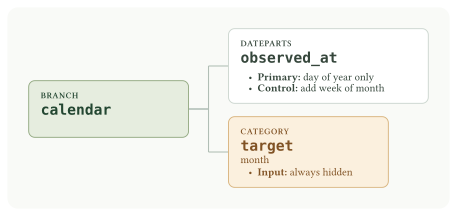
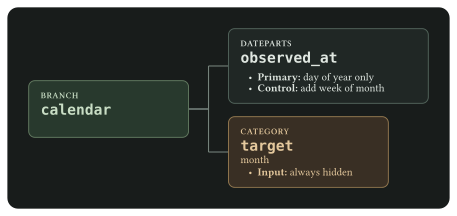
Calendar contains DateParts observed at with only day-of-year in the primary route and added week-of-month in the positive control, plus a Category month target always hidden from input.

Calendar contains DateParts observed at with only day-of-year in the primary route and added week-of-month in the positive control, plus a Category month target always hidden from input.

Figure 1: The primary route exposes only day-of-year. The positive control adds week-of-month; the month target stays hidden.

How it works

The ambiguous variant exposes only day_of_year. Every input coordinate is identical, with half the labels February and half March, so optimal accuracy is 0.50. The positive variant also exposes week_of_month.

The train, validation, and test year ranges are 1901–1950, 1951–2000, and 2001–2050, with 512, 128, and 256 rows respectively. The ambiguous model trains for ten deterministic epochs; the identified model trains for 20. The experiment isolates available information but does not match the two training budgets.

Training and evaluation

Code
def fit(
    *,
    dateparts: Sequence[str],
    classes: int,
    train: Callable[[], Iterator[dict]],
    validate: Callable[[], Iterator[dict]],
    epochs: int,
    seed: int,
    steps: int | None,
    accelerator: str,
) -> rf.Model:
    """Train on the selected calendar coordinates with the remaining schema fixed."""
    lit.seed_everything(seed, workers=True)
    model = rf.Model(
        name="calendar",
        d_model=64,
        n_layers=3,
        n_heads=4,
        batch_size=128,
        observed_at=rf.DateParts(dateparts=list(dateparts)),
        target=rf.Category(mask=True, size=classes, p_unavailable=0.0),
    )
    model.optimizer = lambda module: torch.optim.AdamW(module.parameters(), lr=3e-3)
    data = rf.SyntheticDataModule(model=model, train=train, validate=validate, seed=seed)
    trainer = lit.Trainer(
        accelerator=accelerator,
        max_epochs=epochs,
        max_steps=steps if steps is not None else -1,
        logger=False,
        enable_progress_bar=False,
        enable_model_summary=False,
        enable_checkpointing=False,
        deterministic=True,
        num_sanity_val_steps=0,
    )
    trainer.fit(model=model, datamodule=data)
    return model


def accuracy(model: rf.Model, records: Callable[[], Iterator[dict]], accelerator: str) -> float:
    """Evaluate held-out labels without updating the Category vocabulary."""
    data = rf.SyntheticDataModule(model=model, test=records)
    trainer = lit.Trainer(
        accelerator=accelerator,
        logger=False,
        enable_progress_bar=False,
        enable_model_summary=False,
        enable_checkpointing=False,
        deterministic=True,
    )
    metrics = trainer.test(model=model, datamodule=data, verbose=False)[0]
    return float(metrics["calendar.target/test.accuracy.content"])


def run(seed: int, steps: int | None, accelerator: str) -> tuple[dict, dict]:
    train = partial(records, years=tuple(range(1901, 1951)), rows=512)
    validate = partial(records, years=tuple(range(1951, 2001)), rows=128)
    test = partial(records, years=tuple(range(2001, 2051)), rows=256)
    day_only = fit(
        dateparts=("day_of_year",),
        classes=2,
        train=train,
        validate=validate,
        epochs=10,
        seed=seed,
        steps=steps,
        accelerator=accelerator,
    )
    ambiguous_accuracy = accuracy(day_only, test, accelerator)
    identified = fit(
        dateparts=("day_of_year", "week_of_month"),
        classes=2,
        train=train,
        validate=validate,
        epochs=20,
        seed=seed,
        steps=steps,
        accelerator=accelerator,
    )
    identified_accuracy = accuracy(identified, test, accelerator)
    gap = identified_accuracy - ambiguous_accuracy
    return {
        "day_only_accuracy": ambiguous_accuracy,
        "with_week_of_month_accuracy": identified_accuracy,
        "accuracy_gap": gap,
    }, {
        "Day-of-year accuracy remains between 0.49 and 0.51": 0.49 <= ambiguous_accuracy <= 0.51,
        "Visible week-of-month accuracy reaches 0.95": identified_accuracy >= 0.95,
        "Visible week-of-month improves accuracy by at least 0.40": gap >= 0.40,
    }
Evidence

Latest full run

Seed 53, gpu, recorded 2026-09-15T02:33:26.590070+00:00. Outcome: met.

Source fingerprint: 861d768941ab50df484595ff65b2015661898a445630cbc59a9a5c6d36124ddd. Python 3.12.6; Torch 2.12.0.

Measurement Value
day_only_accuracy 0.5
with_week_of_month_accuracy 1
accuracy_gap 0.5
Behavioral checks
Behavioral check Outcome
Day-of-year accuracy remains between 0.49 and 0.51 Met
Visible week-of-month accuracy reaches 0.95 Met
Visible week-of-month improves accuracy by at least 0.40 Met

Recorded results.

Remaining work

Repeat the gates over three core seeds and at least ten calibration seeds. Investigate why adding the finer day_of_month coordinate optimizes less reliably than week_of_month. Test application policies that map leap dates onto a canonical non-leap calendar separately.

Reproduce

Run by stable ID from the repository root:

uv run python proofs/run.py P043

Or run the self-contained script directly:

PYTHONPATH=proofs uv run python proofs/temporal/leap_boundary_requires_context.py

Add --accelerator gpu for CUDA or --seed 42 for another seeded experiment. --steps 2 checks execution with a short training budget; it is recorded as a smoke run.

Download the complete proof.

Code
if __name__ == "__main__":
    report(PROOF_ID, run, seed=53)