Combining Weekday and Hour

Calendar reasoning
Weekday and hour together identify a business window that neither coordinate resolves alone.

A business window depends on both the day and the time: weekday evenings and weekend mornings are closed, even though each shares one coordinate with an open observation.

Seed 59 on gpu: 4 of 4 behavioral checks met. See the measurements below.

Insights

Weekday and hour together identify a business window that neither coordinate resolves alone. A weekday evening and a weekend morning each share one coordinate with an open observation, so either single-coordinate representation loses a necessary distinction.

The combined representation distinguishes the labels more accurately than either weekday or hour alone. The weekday fit does not reach all the skill available from its marginal signal; these are observed fits, not three equally optimized solutions.

This supports learned coordinate composition in the constructed calendar. It does not cover holidays, timezones, or daylight-saving rules. Derive fixed business logic exactly in preprocessing when learning an approximation is unnecessary.

Setup

Code
"""P042: combine weekday and hour to identify an open business window.

Half the rows are open; the others are weekday/off-hour or weekend/work-hour
near misses. Either coordinate alone has an optimal accuracy of 0.75.
"""

from collections.abc import Callable, Iterator, Sequence
from datetime import date, datetime, time, timedelta
from functools import partial

import lightning.pytorch as lit
import numpy as np
import torch
from reporting import report

import relflow as rf

PROOF_ID = "P042"

Examples

The rule is open on weekdays from 09:00 through 16:00. Each displayed target is supervision hidden from the encoded inputs.

Weekday during business hours

observed_at: 2025-01-06T09:00:00
target: open

Monday at 09:00 satisfies both conditions.

Weekday outside business hours

observed_at: 2025-01-06T20:00:00
target: closed

The weekday is unchanged, but the hour changes the answer. A weekday-only representation cannot distinguish this near miss from the first record.

Weekend during business hours

observed_at: 2025-01-11T09:00:00
target: closed

Saturday shares the first record’s hour. An hour-only representation loses this distinction, while the two-coordinate representation contains both pieces needed to identify the open window.

Synthetic data and controls

Code
def records(*, start: date, weeks: int, rows: int, seed: int) -> Iterator[dict]:
    """Yield balanced open windows and two single-coordinate near misses."""
    if start.weekday() != 0:
        raise ValueError(f"business-window start must be a Monday, got {start.isoformat()}")
    if weeks < 1:
        raise ValueError(f"business-window weeks must be positive, got {weeks}")
    if rows % 4:
        raise ValueError(f"business-window rows must be divisible by four, got {rows}")
    business_hours = tuple(range(9, 17))
    off_hours = (*range(0, 9), *range(17, 24))
    observations = []
    for index in range(rows // 2):
        day = start + timedelta(weeks=index % weeks, days=index % 5)
        hour = business_hours[index % len(business_hours)]
        observations.append({"observed_at": datetime.combine(day, time(hour=hour)), "target": "open"})
    for index in range(rows // 4):
        day = start + timedelta(weeks=index % weeks, days=index % 5)
        hour = off_hours[index % len(off_hours)]
        observations.append({"observed_at": datetime.combine(day, time(hour=hour)), "target": "closed"})
    for index in range(rows // 4):
        day = start + timedelta(weeks=index % weeks, days=5 + index % 2)
        hour = business_hours[index % len(business_hours)]
        observations.append({"observed_at": datetime.combine(day, time(hour=hour)), "target": "closed"})
    for index in np.random.default_rng(seed).permutation(len(observations)):
        yield observations[index]

Model tree

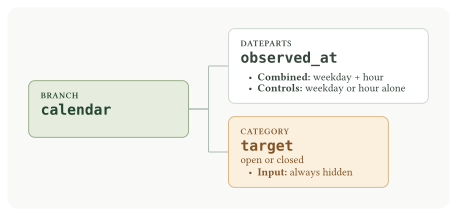
Calendar contains DateParts observed at with weekday and hour together, compared with separate weekday-only and hour-only controls, and a Category open-or-closed target always hidden from input.

Calendar contains DateParts observed at with weekday and hour together, compared with separate weekday-only and hour-only controls, and a Category open-or-closed target always hidden from input.

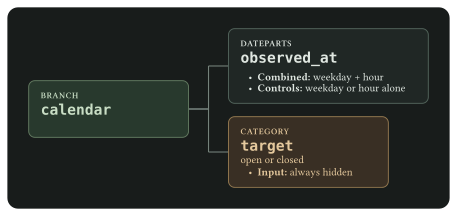
Figure 1: The combined route exposes weekday and hour together. Each control keeps only one coordinate; all hide the target.

How it works

Half the observations are weekdays during 09:00–16:00. A quarter are weekdays outside those hours, and a quarter are weekends during those hours. Neither coordinate alone identifies every label; a combined representation can distinguish the open window from both kinds of near miss.

Three otherwise matched models expose day_of_week, hour_of_day, or both. They train for 20 deterministic epochs. Training, validation, and test use 1,024, 512, and 1,024 observations from separate periods beginning in 2017, 2021, and 2025.

Training and evaluation

Code
def fit(
    *,
    dateparts: Sequence[str],
    classes: int,
    train: Callable[[], Iterator[dict]],
    validate: Callable[[], Iterator[dict]],
    epochs: int,
    seed: int,
    steps: int | None,
    accelerator: str,
) -> rf.Model:
    """Train on the selected calendar coordinates with the remaining schema fixed."""
    lit.seed_everything(seed, workers=True)
    model = rf.Model(
        name="calendar",
        d_model=64,
        n_layers=3,
        n_heads=4,
        batch_size=128,
        observed_at=rf.DateParts(dateparts=list(dateparts)),
        target=rf.Category(mask=True, size=classes, p_unavailable=0.0),
    )
    model.optimizer = lambda module: torch.optim.AdamW(module.parameters(), lr=3e-3)
    data = rf.SyntheticDataModule(model=model, train=train, validate=validate, seed=seed)
    trainer = lit.Trainer(
        accelerator=accelerator,
        max_epochs=epochs,
        max_steps=steps if steps is not None else -1,
        logger=False,
        enable_progress_bar=False,
        enable_model_summary=False,
        enable_checkpointing=False,
        deterministic=True,
        num_sanity_val_steps=0,
    )
    trainer.fit(model=model, datamodule=data)
    return model


def accuracy(model: rf.Model, records: Callable[[], Iterator[dict]], accelerator: str) -> float:
    """Evaluate held-out labels without updating the Category vocabulary."""
    data = rf.SyntheticDataModule(model=model, test=records)
    trainer = lit.Trainer(
        accelerator=accelerator,
        logger=False,
        enable_progress_bar=False,
        enable_model_summary=False,
        enable_checkpointing=False,
        deterministic=True,
    )
    metrics = trainer.test(model=model, datamodule=data, verbose=False)[0]
    return float(metrics["calendar.target/test.accuracy.content"])


def run(seed: int, steps: int | None, accelerator: str) -> tuple[dict, dict]:
    train = partial(records, start=date(2017, 1, 2), weeks=52, rows=1024, seed=seed + 1)
    validate = partial(records, start=date(2021, 1, 4), weeks=26, rows=512, seed=seed + 2)
    test = partial(records, start=date(2025, 1, 6), weeks=52, rows=1024, seed=seed + 3)
    day_only = fit(
        dateparts=("day_of_week",),
        classes=2,
        train=train,
        validate=validate,
        epochs=20,
        seed=seed,
        steps=steps,
        accelerator=accelerator,
    )
    day_accuracy = accuracy(day_only, test, accelerator)
    hour_only = fit(
        dateparts=("hour_of_day",),
        classes=2,
        train=train,
        validate=validate,
        epochs=20,
        seed=seed,
        steps=steps,
        accelerator=accelerator,
    )
    hour_accuracy = accuracy(hour_only, test, accelerator)
    composed = fit(
        dateparts=("day_of_week", "hour_of_day"),
        classes=2,
        train=train,
        validate=validate,
        epochs=20,
        seed=seed,
        steps=steps,
        accelerator=accelerator,
    )
    composed_accuracy = accuracy(composed, test, accelerator)
    gap = composed_accuracy - max(day_accuracy, hour_accuracy)
    return {
        "day_only_accuracy": day_accuracy,
        "hour_only_accuracy": hour_accuracy,
        "composed_accuracy": composed_accuracy,
        "accuracy_gap": gap,
    }, {
        "Weekday-only accuracy is at most 0.82": day_accuracy <= 0.82,
        "Hour-only accuracy is at most 0.82": hour_accuracy <= 0.82,
        "Combined coordinates reach 0.95 accuracy": composed_accuracy >= 0.95,
        "Composition improves over either coordinate by at least 0.15": gap >= 0.15,
    }
Evidence

Latest full run

Seed 59, gpu, recorded 2026-09-15T02:33:11.826682+00:00. Outcome: met.

Source fingerprint: 7cbac86d045a9eb1a03079a4157637b249bc961a9ea22c63256c06bbcce68823. Python 3.12.6; Torch 2.12.0.

Measurement Value
day_only_accuracy 0.75
hour_only_accuracy 0.75
composed_accuracy 1
accuracy_gap 0.25
Behavioral checks
Behavioral check Outcome
Weekday-only accuracy is at most 0.82 Met
Hour-only accuracy is at most 0.82 Met
Combined coordinates reach 0.95 accuracy Met
Composition improves over either coordinate by at least 0.15 Met

Recorded results.

Remaining work

Repeat all three fits over three core seeds and at least ten calibration seeds. Extend to further coordinate combinations and characterize timezone and daylight-saving preprocessing independently of this naive-calendar test.

Reproduce

Run by stable ID from the repository root:

uv run python proofs/run.py P042

Or run the self-contained script directly:

PYTHONPATH=proofs uv run python proofs/temporal/business_window_requires_composition.py

Add --accelerator gpu for CUDA or --seed 42 for another seeded experiment. --steps 2 checks execution with a short training budget; it is recorded as a smoke run.

Download the complete proof.

Code
if __name__ == "__main__":
    report(PROOF_ID, run, seed=59)