Null Is Not Zero

Value state
Number validity can carry predictive information even when every present value is zero.

A missing measurement and a real zero can mean different things. This proof isolates that distinction: every present number is zero, and missingness alone determines the Boolean target.

Seed 11 on gpu: 7 of 7 behavioral checks met. See the measurements below.

Insights

A null and a real zero carry different information, even when every present number is zero. Number encodes value state separately from continuous content, giving the model a route to recognize missingness.

The recorded signal model clears both AUC and accuracy gates. Independent validity stays at chance, and replacing nulls with zeros destroys the signal while retaining the original labels. The latter creates identical inputs that require different answers.

Preserve nulls when that distinction matters. Imputation can erase useful information before training begins. This proof establishes the representation’s capability; it does not show that missingness is predictive in every application or cover every kind of absent data.

Setup

Code
"""P038: distinguish an explicit null from a real numeric zero.

Validity is the only predictive feature. Independent validity and replacing
all nulls with zeros each remove that signal while retaining the targets.
"""

from collections.abc import Callable, Iterator
from functools import partial

import lightning.pytorch as lit
import numpy as np
import torch
from reporting import report

import relflow as rf

PROOF_ID = "P038"

Examples

The signal process labels missing measurements true and present zeros false. The Boolean target supplies supervision without being embedded.

Missing measurement

measurement: null
target: true

The null state is the entire useful signal; no numeric content is available.

A real zero

measurement: 0.0
target: false

A valued zero has a different state from null, even though every present number in this experiment has the same value.

Null filled with zero

measurement: 0.0
target: true

The inference intervention transforms the first record into this one while retaining its original label. It now looks identical to the second record but requires a different answer. The expected result is loss of predictive information, not learning a second rule for zero.

Synthetic data and controls

Code
def records(*, rows: int, seed: int, signal: bool, fill_nulls: bool = False) -> Iterator[dict]:
    """Yield zero-valued measurements with predictive or independent nulls."""
    rng = np.random.default_rng(seed)
    target = np.tile(np.array([False, True]), (rows + 1) // 2)[:rows]
    rng.shuffle(target)
    missing = target if signal else rng.integers(0, 2, size=rows).astype(bool)
    for index in range(rows):
        yield {
            "measurement": None if missing[index] and not fill_nulls else 0.0,
            "target": bool(target[index]),
        }


def score(model: rf.Model, records: Callable[[], Iterator[dict]], accelerator: str) -> tuple[float, float]:
    """Measure held-out AUC and accuracy at the fixed 0.5 threshold."""
    data = rf.SyntheticDataModule(model=model, test=records)
    trainer = lit.Trainer(
        accelerator=accelerator,
        logger=False,
        enable_progress_bar=False,
        enable_model_summary=False,
        enable_checkpointing=False,
        deterministic=True,
    )
    metrics = trainer.test(model=model, datamodule=data, verbose=False)[0]
    return float(metrics["state.target/test.auc.content"]), float(metrics["state.target/test.accuracy@0.5.content"])

Model tree

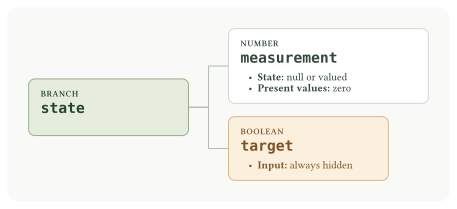
State contains a Number measurement that is null or a valued zero, and a Boolean target always hidden from input.

State contains a Number measurement that is null or a valued zero, and a Boolean target always hidden from input.

Figure 1: Number state distinguishes null from valued zero; the Boolean answer is always hidden from input.

How it works

relflow represents a Number’s state separately from its continuous content. The model can therefore distinguish an Arrow null from a valued zero without any variation among the actual numbers.

Two controls probe this explanation. A separate training run makes validity independent of the label. An inference intervention replaces every null with zero in the signal model’s test set, while retaining the original labels. Both should remove the useful information.

The paired runs use 1,024 training, 512 validation, and 2,048 test rows from independent streams, with eight deterministic epochs.

Training and evaluation

Code
def fit(*, signal: bool, seed: int, steps: int | None, accelerator: str) -> rf.Model:
    lit.seed_everything(seed, workers=True)
    model = rf.Model(
        name="state",
        d_model=16,
        n_layers=1,
        n_heads=4,
        batch_size=128,
        measurement=rf.Number,
        target=rf.Boolean(mask=True),
    )
    model.optimizer = lambda module: torch.optim.AdamW(module.parameters(), lr=5e-3)
    data = rf.SyntheticDataModule(
        model=model,
        train=partial(records, rows=1024, seed=seed + 1, signal=signal),
        validate=partial(records, rows=512, seed=seed + 2, signal=signal),
        seed=seed,
    )
    trainer = lit.Trainer(
        accelerator=accelerator,
        max_epochs=8,
        max_steps=steps if steps is not None else -1,
        logger=False,
        enable_progress_bar=False,
        enable_model_summary=False,
        enable_checkpointing=False,
        deterministic=True,
    )
    trainer.fit(model=model, datamodule=data)
    return model


def run(seed: int, steps: int | None, accelerator: str) -> tuple[dict, dict]:
    signal_model = fit(signal=True, seed=seed, steps=steps, accelerator=accelerator)
    control_model = fit(signal=False, seed=seed, steps=steps, accelerator=accelerator)
    state_auc, state_accuracy = score(
        signal_model, partial(records, rows=2048, seed=seed + 3, signal=True), accelerator
    )
    control_auc, control_accuracy = score(
        control_model, partial(records, rows=2048, seed=seed + 3, signal=False), accelerator
    )
    prefilled_auc, prefilled_accuracy = score(
        signal_model, partial(records, rows=2048, seed=seed + 3, signal=True, fill_nulls=True), accelerator
    )
    return {
        "state_auc": state_auc,
        "state_accuracy": state_accuracy,
        "independent_auc": control_auc,
        "independent_accuracy": control_accuracy,
        "prefilled_auc": prefilled_auc,
        "prefilled_accuracy": prefilled_accuracy,
        "auc_gap": state_auc - control_auc,
    }, {
        "Null state reaches 0.99 AUC": state_auc >= 0.99,
        "Null state reaches 0.98 accuracy": state_accuracy >= 0.98,
        "Independent validity AUC remains between 0.42 and 0.58": 0.42 <= control_auc <= 0.58,
        "Independent validity accuracy remains between 0.45 and 0.55": 0.45 <= control_accuracy <= 0.55,
        "Null-to-zero AUC remains between 0.42 and 0.58": 0.42 <= prefilled_auc <= 0.58,
        "Null-to-zero accuracy remains between 0.45 and 0.55": 0.45 <= prefilled_accuracy <= 0.55,
        "State exceeds its control by at least 0.40 AUC": state_auc - control_auc >= 0.40,
    }
Evidence

Latest full run

Seed 11, gpu, recorded 2026-09-15T02:32:33.163989+00:00. Outcome: met.

Source fingerprint: 96266262609686640fc4fd3293e42c70865a5abcb7a1de6fc3a127d4835c9f9c. Python 3.12.6; Torch 2.12.0.

Measurement Value
state_auc 1
state_accuracy 1
independent_auc 0.506348
independent_accuracy 0.5
prefilled_auc 0.5
prefilled_accuracy 0.5
auc_gap 0.493652
Behavioral checks
Behavioral check Outcome
Null state reaches 0.99 AUC Met
Null state reaches 0.98 accuracy Met
Independent validity AUC remains between 0.42 and 0.58 Met
Independent validity accuracy remains between 0.45 and 0.55 Met
Null-to-zero AUC remains between 0.42 and 0.58 Met
Null-to-zero accuracy remains between 0.45 and 0.55 Met
State exceeds its control by at least 0.40 AUC Met

Recorded results.

Remaining work

Measure all three variants over three paired core seeds and at least ten calibration seeds. Retain both controls when checking stability and selecting the final chance bands.

For the representation contract, see Data Types.

Reproduce

Run by stable ID from the repository root:

uv run python proofs/run.py P038

Or run the self-contained script directly:

PYTHONPATH=proofs uv run python proofs/state/null_versus_zero.py

Add --accelerator gpu for CUDA or --seed 42 for another seeded experiment. --steps 2 checks execution with a short training budget; it is recorded as a smoke run.

Download the complete proof.

Code
if __name__ == "__main__":
    report(PROOF_ID, run, seed=11)