Compare Each Item with Its Group

Peer-relative inference
Select same-group peers and route their mean back to each item’s deviation target.

Each item should receive its value minus the mean of its own group. Groups are interleaved, their locations vary independently, and no input supplies their means. The model must use membership as well as raw values.

Seed 3720 on gpu: 11 of 11 behavioral checks met. See the measurements below.

Insights

The model uses an item’s group to compare its value with the right peers. Rotating labels preserves value and label marginals while retaining original targets, and accuracy deteriorates. Independent group translations and whole-item permutations preserve the true relationship and pass their respective controls.

The repeated decoder can combine retained collection evidence with its own aligned group and value. That provides a route for membership-dependent peer context without a supplied mean. However, every group has exactly two members, where deviation is half the difference between their values. This is narrower than arbitrary group averaging. Approximate invariance, broader cardinalities, and missing membership still need separate evidence.

Setup

Code
"""Infer each item's value minus the mean of its own interleaved group.

No peer mean is supplied. Preserved tokens and coordinate-aligned queries must
support peer selection and local subtraction. Corrupt labels, translate each
group, and permute whole items to distinguish these behaviors.

Run this file with --help for seed, training-budget, and reporting options.
"""

from __future__ import annotations

from collections.abc import Iterator
from functools import partial

import lightning.pytorch as lit
import numpy as np
import torch
from reporting import report

import relflow as rf

PROOF_ID = "P032"
ITEMS = 6
GROUPS = ("A", "B", "C")

Examples

Use the mean of the matching group

items:
  - {group: A, value: 2.0, deviation: -1.0}
  - {group: B, value: 1.0, deviation: 1.0}
  - {group: C, value: -3.0, deviation: -1.0}
  - {group: A, value: 4.0, deviation: 1.0}
  - {group: C, value: -1.0, deviation: 1.0}
  - {group: B, value: -1.0, deviation: -1.0}

The group means are A: 3, B: 0, and C: −2. Deviations are supervision hidden by mask=True and removed at prediction.

Translate groups independently

items:
  - {group: A, value: 3.0, deviation: -1.0}
  - {group: B, value: 0.5, deviation: 1.0}
  - {group: C, value: -1.0, deviation: -1.0}
  - {group: A, value: 5.0, deviation: 1.0}
  - {group: C, value: 1.0, deviation: 1.0}
  - {group: B, value: -1.5, deviation: -1.0}

A moves by +1, B by −0.5, and C by +2. Their means move by the same amounts, so every original deviation target remains correct. The test applies this kind of independent group translation.

Rotate group labels while retaining targets

items:
  - {group: B, value: 2.0, deviation: -1.0}
  - {group: C, value: 1.0, deviation: 1.0}
  - {group: A, value: -3.0, deviation: -1.0}
  - {group: C, value: 4.0, deviation: 1.0}
  - {group: B, value: -1.0, deviation: 1.0}
  - {group: A, value: -1.0, deviation: -1.0}

This applies the test’s one-position label rotation to the first record. The retained targets intentionally describe its original grouping. Under the new labels, the first item’s deviation would be 1.5 rather than −1. Error against the old targets should rise when prediction depends on membership.

Synthetic data and controls

Code
def records(*, rows: int, seed: int) -> Iterator[dict]:
    """Generate randomly interleaved, exactly centered two-member groups."""
    rng = np.random.default_rng(seed)
    for _ in range(rows):
        items: list[dict[str, object]] = []
        for group in GROUPS:
            mean = float(rng.uniform(-3.5, 3.5))
            deviation = float(rng.uniform(0.2, 1.2))
            for signed in (-deviation, deviation):
                item: dict[str, object] = {"group": group, "value": mean + signed, "deviation": signed}
                items.append(item)
        order = rng.permutation(ITEMS)
        yield {"items": [items[index] for index in order]}


def targets(rows: list[dict]) -> np.ndarray:
    return np.asarray([item["deviation"] for row in rows for item in row["items"]])


def predict(model: rf.Model, rows: list[dict]) -> np.ndarray:
    inputs = [
        {"items": [{key: value for key, value in item.items() if key != "deviation"} for item in row["items"]]}
        for row in rows
    ]
    output = model.predict(inputs).to_pylist()
    return np.asarray(
        [value["content"] for row in output for value in row["predictions"]["collection/items/deviation"]]
    )


def rmse(actual: np.ndarray, predicted: np.ndarray | float) -> float:
    return float(np.sqrt(np.mean(np.square(actual - predicted))))


def corrupt_groups(rows: list[dict]) -> list[dict]:
    """Rotate only labels, preserving all values, targets, and label counts."""
    result = []
    for row in rows:
        labels = [item["group"] for item in row["items"]]
        shifted = labels[1:] + labels[:1]
        result.append({"items": [{**item, "group": label} for item, label in zip(row["items"], shifted, strict=True)]})
    return result


def implied_deviation(rows: list[dict]) -> np.ndarray:
    """Measure how strongly changed peer memberships alter the correct answer."""
    values = []
    for row in rows:
        means = {
            group: float(np.mean([item["value"] for item in row["items"] if item["group"] == group]))
            for group in GROUPS
        }
        values.extend(item["value"] - means[item["group"]] for item in row["items"])
    return np.asarray(values)


def translate(rows: list[dict], seed: int) -> list[dict]:
    """Shift visible values while retaining the original relative targets."""
    rng = np.random.default_rng(seed)
    result = []
    for row in rows:
        offsets = {group: float(rng.uniform(-2.5, 2.5)) for group in GROUPS}
        result.append({"items": [{**item, "value": item["value"] + offsets[item["group"]]} for item in row["items"]]})
    return result


def permute_items(rows: list[dict], seed: int) -> tuple[list[dict], np.ndarray]:
    """Reorder complete records and retain indices for comparing predictions."""
    rng = np.random.default_rng(seed)
    result, flattened = [], []
    for index, row in enumerate(rows):
        order = rng.permutation(ITEMS)
        result.append({"items": [row["items"][i] for i in order]})
        flattened.extend(index * ITEMS + order)
    return result, np.asarray(flattened)

Model tree

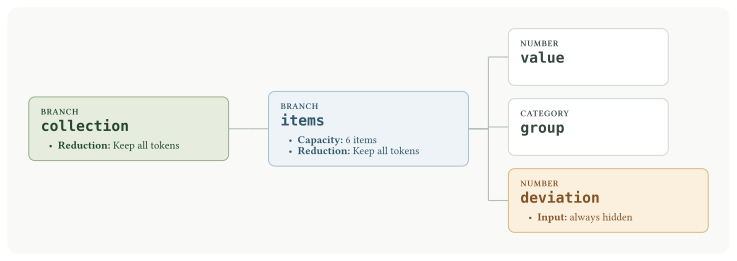
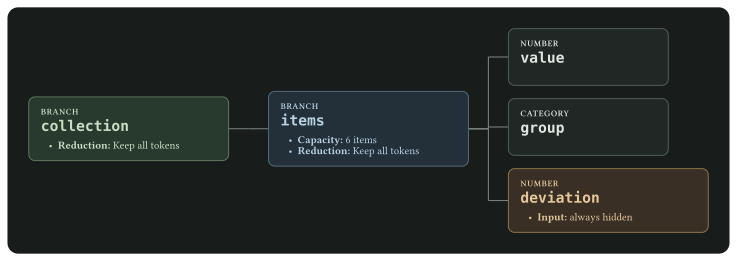
Collection contains six repeated items with value and group inputs and a masked Number deviation. The root keeps all tokens. The item branch also keeps all tokens.

Collection contains six repeated items with value and group inputs and a masked Number deviation. The root keeps all tokens. The item branch also keeps all tokens.

Figure 1: Both branch and root keep all tokens. The group and value stay aligned with each masked deviation.

The branch and root use reduction=None, retaining the item evidence available to each coordinate-conditioned decoder query.

How it works

Same-coordinate encoding binds membership to value, and the repeated decoder can use its own group/value context to select peers. Rotating labels preserves all values, group counts, and original targets while breaking membership. The separately recomputed oracle measures intervention strength. Independently shifting each group’s values preserves its deviations. Permuting complete items should permute the outputs with them.

Training and evaluation

Code
def run(seed: int, steps: int | None, accelerator: str) -> tuple[dict, dict]:
    lit.seed_everything(seed, workers=True)
    model = rf.Model(
        name="collection",
        d_model=48,
        n_layers=3,
        n_heads=4,
        reduction=None,
        batch_size=128,
        optimizer=lambda module: torch.optim.Adam(module.parameters(), lr=1e-3),
        items=rf.Branch(
            length=ITEMS,
            overflow="error",
            n_layers=2,
            reduction=None,
            value=rf.Number,
            group=rf.Category(size=len(GROUPS), p_unavailable=0.0),
            deviation=rf.Number(mask=True, objective="mse", n_linear=2),
        ),
    )
    data = rf.SyntheticDataModule(
        model=model,
        train=partial(records, rows=2048, seed=seed + 1),
        validate=partial(records, rows=512, seed=seed + 2),
        seed=seed,
    )
    trainer = lit.Trainer(
        accelerator=accelerator,
        max_steps=900 if steps is None else min(steps, 900),
        max_epochs=-1,
        logger=False,
        enable_progress_bar=False,
        enable_model_summary=False,
        enable_checkpointing=False,
        deterministic=True,
        num_sanity_val_steps=0,
    )
    trainer.fit(model, datamodule=data)
    train = list(records(rows=2048, seed=seed + 1))
    test = list(records(rows=768, seed=seed + 3))
    actual = targets(test)
    baseline = rmse(actual, float(targets(train).mean()))
    predicted = predict(model, test)
    intact_error = rmse(actual, predicted)
    intact_nrmse = intact_error / baseline
    metrics = {"intact_rmse": intact_error, "baseline_rmse": baseline, "intact_nrmse": intact_nrmse}
    checks = {"Baseline RMSE > 0.000001": baseline > 1e-6}
    corrupted = corrupt_groups(test)
    corrupted_error = rmse(actual, predict(model, corrupted))
    corrupted_nrmse = corrupted_error / baseline
    oracle = rmse(implied_deviation(corrupted), actual) / baseline
    metrics.update(corrupted_rmse=corrupted_error, corrupted_nrmse=corrupted_nrmse, oracle_corruption_nrmse=oracle)
    checks["Label corruption changes the oracle by > 0.75 nRMSE"] = oracle > 0.75
    translated = translate(test, seed + 4)
    translated_error = rmse(targets(translated), predict(model, translated))
    translated_nrmse = translated_error / baseline
    permuted, order = permute_items(test, seed + 5)
    drift = rmse(predict(model, permuted), predicted[order]) / baseline
    metrics.update(translated_rmse=translated_error, translated_nrmse=translated_nrmse, permutation_drift=drift)
    checks.update(
        {
            "Training deviations are exactly centered": abs(float(targets(train).mean())) < 1e-12,
            "Translation preserves target shape": targets(translated).shape == actual.shape,
            "Translation preserves all targets": rmse(targets(translated), actual) == 0.0,
            "Permutation preserves the target multiset": sorted(targets(permuted).tolist()) == sorted(actual.tolist()),
            "Normalized permutation drift < 0.20": drift < 0.20,
        }
    )
    checks.update(
        {
            "Grouped deviation nRMSE < 0.40": intact_nrmse < 0.40,
            "Group-translated nRMSE < 0.50": translated_nrmse < 0.50,
            "Label corruption increases nRMSE by >= 0.25": corrupted_nrmse >= intact_nrmse + 0.25,
        }
    )
    checks["Finite calibration and model metrics"] = bool(np.isfinite(list(metrics.values())).all())
    return metrics, checks
Evidence

Latest full run

Seed 3720, gpu, recorded 2026-09-15T02:29:09.246487+00:00. Outcome: met.

Source fingerprint: a10f24b8624a527c95bf8f3ce7018e8cbaf81185e82f903f2f6f38558f3bfe9a. Python 3.12.6; Torch 2.12.0.

Measurement Value
intact_rmse 0.0309479
baseline_rmse 0.750869
intact_nrmse 0.0412162
corrupted_rmse 1.19105
corrupted_nrmse 1.58623
oracle_corruption_nrmse 1.8012
translated_rmse 0.0573983
translated_nrmse 0.0764425
permutation_drift 0.0216797
Behavioral checks
Behavioral check Outcome
Baseline RMSE > 0.000001 Met
Label corruption changes the oracle by > 0.75 nRMSE Met
Training deviations are exactly centered Met
Translation preserves target shape Met
Translation preserves all targets Met
Permutation preserves the target multiset Met
Normalized permutation drift < 0.20 Met
Grouped deviation nRMSE < 0.40 Met
Group-translated nRMSE < 0.50 Met
Label corruption increases nRMSE by >= 0.25 Met
Finite calibration and model metrics Met

Recorded results.

Remaining work

Repeat three core seeds and ten calibration seeds. Vary group cardinalities, test missing membership and singleton groups, and extend targets to ranks or leave-one-out means. Current permutation gates allow approximate behavior. The one-summary variant tests whether a narrower collection route retains enough context.

Reproduce

Run by stable ID from the repository root:

uv run python proofs/run.py P032

Or run the self-contained script directly:

PYTHONPATH=proofs uv run python proofs/relational/grouped_peer_deviation.py

Add --accelerator gpu for CUDA or --seed 42 for another seeded experiment. --steps 2 checks execution with a short training budget; it is recorded as a smoke run.

Download the complete proof.

Code
if __name__ == "__main__":
    report(PROOF_ID, run, seed=3720)