Choose a Group and an Operation

Category-conditioned reduction
Compose category filtering with a requested sum, mean, minimum, or maximum.

One interleaved bag supports twelve requests: three groups combined with four operations. The model must use both root request fields to select the relevant items and infer the requested statistic.

Seed 16 on gpu: 24 of 24 behavioral checks met. See the measurements below.

Insights

The model can answer requests for different groups and operations, but this combined task still needs checks that it uses both requests. The same bag supplies different answers according to visible group and operation requests. Measuring every cell prevents an easy subset from hiding a failed operation or group.

Item coordinates bind categories to values, retained item slots preserve their evidence, and request fields can condition the scalar decoder. The twelve root outputs are learned summaries, not twelve declared statistics. Label and request corruptions have not been applied to this exact route; neighboring proofs do not substitute for them. The evidence supports bounded conditional prediction, with broader relational composition still requiring validation.

Setup

Code
"""Compose a requested group filter with sum, mean, minimum, or maximum.

Each bag contains four items from each of three groups and produces all twelve
requests. Score every group/operation cell against its own training-mean
baseline so one easy operation cannot hide failure on another.

Run this file with --help for seed, training-budget, and reporting options.
"""

from __future__ import annotations

from collections.abc import Iterator
from functools import partial

import lightning.pytorch as lit
import numpy as np
import torch
from reporting import report

import relflow as rf

PROOF_ID = "P027"
OPERATIONS = ("sum", "mean", "min", "max")
GROUPS = ("A", "B", "C")

Examples

Request group B’s maximum

bag: 0
items:
  - {group: A, value: 0.1}
  - {group: B, value: -0.1}
  - {group: C, value: 0.0}
  - {group: A, value: 0.4}
  - {group: B, value: 0.3}
  - {group: C, value: 0.5}
  - {group: A, value: -1.0}
  - {group: B, value: -0.9}
  - {group: C, value: -1.2}
  - {group: A, value: 1.2}
  - {group: B, value: 1.3}
  - {group: C, value: 1.0}
selected_group: B
operation: max
answer: 1.3

The answer is masked training supervision and omitted at prediction. bag is evaluation metadata, excluded from the model. The same bag also supplies B’s sum (0.6), mean (0.15), and minimum (−0.9) as separate requests.

Request the mean instead

bag: 0
items:
  - {group: A, value: 0.1}
  - {group: B, value: -0.1}
  - {group: C, value: 0.0}
  - {group: A, value: 0.4}
  - {group: B, value: 0.3}
  - {group: C, value: 0.5}
  - {group: A, value: -1.0}
  - {group: B, value: -0.9}
  - {group: C, value: -1.2}
  - {group: A, value: 1.2}
  - {group: B, value: 1.3}
  - {group: C, value: 1.0}
selected_group: B
operation: mean
answer: 0.15

The items and selected group stay fixed. Changing the operation changes the correct target from 1.3 to 0.15: B’s four values sum to 0.6.

Change both parts of the request

bag: 0
items:
  - {group: A, value: 0.1}
  - {group: B, value: -0.1}
  - {group: C, value: 0.0}
  - {group: A, value: 0.4}
  - {group: B, value: 0.3}
  - {group: C, value: 0.5}
  - {group: A, value: -1.0}
  - {group: B, value: -0.9}
  - {group: C, value: -1.2}
  - {group: A, value: 1.2}
  - {group: B, value: 1.3}
  - {group: C, value: 1.0}
selected_group: C
operation: min
answer: -1.2

This is another correctly labeled request for the same bag. The test evaluates each group-operation combination; it does not yet apply a corruption control to this composed task.

Synthetic data and controls

Code
def reduce(values: np.ndarray, operation: str) -> float:
    """Execute one synthetic reduction outside RelFlow."""

    match operation:
        case "sum":
            return float(values.sum())
        case "mean":
            return float(values.mean())
        case "min":
            return float(values.min())
        case "max":
            return float(values.max())
        case _:
            raise ValueError(f"unknown reduction operation: {operation!r}")


def values(rng: np.random.Generator, length: int) -> np.ndarray:
    """Draw bounded asymmetric values whose reductions are usually distinct."""

    if length < 4:
        raise ValueError("reduction bags require at least four values")
    middle = rng.uniform(-0.2, 0.6, size=length - 2)
    low = rng.uniform(-1.3, -0.7, size=1)
    high = rng.uniform(0.9, 1.7, size=1)
    return np.concatenate((middle, low, high))


def records(*, bags: int, items_per_group: int, seed: int) -> Iterator[dict]:
    """Expand interleaved grouped bags into every group-operation request."""
    rng = np.random.default_rng(seed)
    length = len(GROUPS) * items_per_group
    for bag in range(bags):
        bag_values = np.concatenate([values(rng, items_per_group) + rng.uniform(-1.5, 1.5) for _ in GROUPS])
        labels = np.repeat(np.asarray(GROUPS), items_per_group)
        order = rng.permutation(length)
        items = [{"group": str(labels[index]), "value": float(bag_values[index])} for index in order]
        for group in GROUPS:
            selected = bag_values[labels == group]
            for operation in OPERATIONS:
                yield {
                    "bag": bag,
                    "selected_group": group,
                    "operation": operation,
                    "items": items,
                    "answer": reduce(selected, operation),
                }


def scores(train: list[dict], test: list[dict], predicted: np.ndarray, keys: tuple[str, ...]) -> dict:
    """Normalize each request cell against that cell's training-target mean."""
    result = {}
    cells = sorted({tuple(row[key] for key in keys) for row in test})
    for cell in cells:
        mean = float(np.mean([row["answer"] for row in train if tuple(row[key] for key in keys) == cell]))
        indices = [i for i, row in enumerate(test) if tuple(row[key] for key in keys) == cell]
        actual = np.asarray([test[i]["answer"] for i in indices])
        error = float(np.sqrt(np.mean(np.square(predicted[indices] - actual))))
        baseline = float(np.sqrt(np.mean(np.square(mean - actual))))
        result["/".join(cell)] = {"rmse": error, "baseline_rmse": baseline, "nrmse": error / baseline}
    return result


def predict(model: rf.Model, rows: list[dict]) -> np.ndarray:
    inputs = [{key: value for key, value in row.items() if key != "answer"} for row in rows]
    output = model.predict(inputs).to_pylist()
    return np.asarray([row["predictions"]["request/answer"]["content"] for row in output])

Model tree

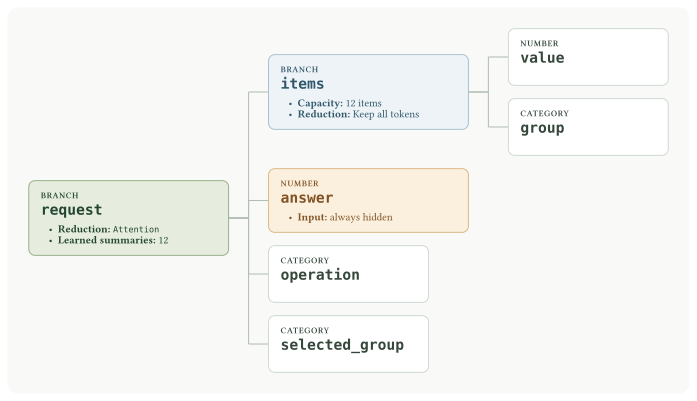
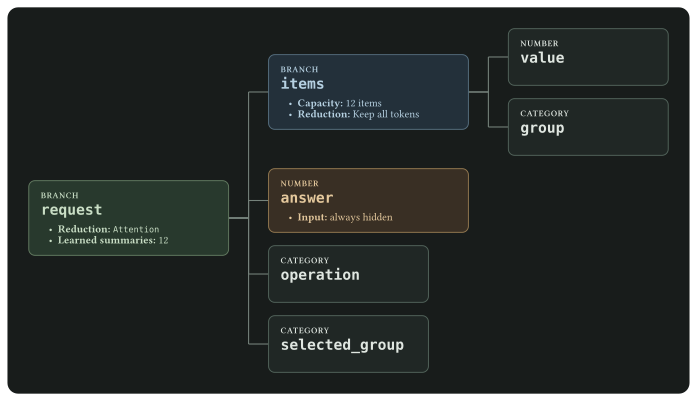
Request has 12 grouped Number items, visible operation and selected-group Categories, and a masked Number answer. The branch keeps all tokens and the root learns twelve attention summaries.

Request has 12 grouped Number items, visible operation and selected-group Categories, and a masked Number answer. The branch keeps all tokens and the root learns twelve attention summaries.

Figure 1: All twelve items remain available to a root with twelve learned summaries. Summary slots do not declare particular group-operation results.

The item branch uses reduction=None; the root uses rf.Attention(n_outputs=12, n_layers=2). The twelve learned outputs do not declare twelve semantic group-operation slots.

How it works

Coordinate-local mixing binds groups to values, retained item slots preserve their associations, and visible request fields condition the decoder query. Independently generated bags are assigned to each split before expansion into requests, so related answers stay together. Measuring all twelve cells prevents a favorable average from hiding one failed group or operation.

Training and evaluation

Code
def run(seed: int, steps: int | None, accelerator: str) -> tuple[dict, dict]:
    lit.seed_everything(seed, workers=True)
    model = rf.Model(
        name="request",
        d_model=64,
        n_layers=2,
        n_heads=4,
        reduction=rf.Attention(n_outputs=12, n_layers=2),
        batch_size=128,
        optimizer=lambda module: torch.optim.Adam(module.parameters(), lr=0.001),
        items=rf.Branch(
            length=12,
            n_layers=2,
            reduction=None,
            value=rf.Number,
            group=rf.Category(size=len(GROUPS), p_unavailable=0.0),
        ),
        answer=rf.Number(mask=True, objective="mse"),
        operation=rf.Category(size=len(OPERATIONS), p_unavailable=0.0),
        selected_group=rf.Category(size=len(GROUPS), p_unavailable=0.0),
    )
    data = rf.SyntheticDataModule(
        model=model,
        train=partial(records, bags=512, items_per_group=4, seed=seed + 144),
        validate=partial(records, bags=64, items_per_group=4, seed=seed + 145),
    )
    trainer = lit.Trainer(
        accelerator=accelerator,
        max_steps=1200 if steps is None else min(steps, 1200),
        max_epochs=-1,
        logger=False,
        enable_progress_bar=False,
        enable_model_summary=False,
        enable_checkpointing=False,
        deterministic=True,
        num_sanity_val_steps=0,
    )
    trainer.fit(model, datamodule=data)
    train = list(records(bags=512, items_per_group=4, seed=seed + 144))
    test = list(records(bags=128, items_per_group=4, seed=seed + 146))
    intact_prediction = predict(model, test)
    intact = scores(train, test, intact_prediction, ("operation", "selected_group"))
    metrics = {f"intact/{cell}/{name}": value for cell, score in intact.items() for name, value in score.items()}
    checks = {
        f"{cell} finite calibration nRMSE <= 1.60": bool(np.isfinite(score["nrmse"])) and score["nrmse"] <= 1.60
        for cell, score in intact.items()
    }
    checks.update({f"{cell} nRMSE <= 0.30": score["nrmse"] <= 0.30 for cell, score in intact.items()})
    return metrics, checks

Evidence

Latest full run

Seed 16, gpu, recorded 2026-09-15T02:26:50.904617+00:00. Outcome: met.

Source fingerprint: cb22c1a08f196d542a455a3c2afb632dfc40ce2daaaf964ec83921cd95d3b2b1. Python 3.12.6; Torch 2.12.0.

Measurement Value
intact/max/A/rmse 0.183085
intact/max/A/baseline_rmse 0.879892
intact/max/A/nrmse 0.208077
intact/max/B/rmse 0.169417
intact/max/B/baseline_rmse 0.864539
intact/max/B/nrmse 0.195962
intact/max/C/rmse 0.157999
intact/max/C/baseline_rmse 0.822622
intact/max/C/nrmse 0.192067
intact/mean/A/rmse 0.064804
intact/mean/A/baseline_rmse 0.870317
intact/mean/A/nrmse 0.0744603
intact/mean/B/rmse 0.0721159
intact/mean/B/baseline_rmse 0.847497
intact/mean/B/nrmse 0.0850928
intact/mean/C/rmse 0.0490257
intact/mean/C/baseline_rmse 0.814605
intact/mean/C/nrmse 0.0601834
intact/min/A/rmse 0.145296
intact/min/A/baseline_rmse 0.876608
intact/min/A/nrmse 0.165748
intact/min/B/rmse 0.171839
intact/min/B/baseline_rmse 0.836511
intact/min/B/nrmse 0.205423
intact/min/C/rmse 0.175595
intact/min/C/baseline_rmse 0.839128
intact/min/C/nrmse 0.209259
intact/sum/A/rmse 0.192319
intact/sum/A/baseline_rmse 3.48127
intact/sum/A/nrmse 0.0552439
intact/sum/B/rmse 0.256668
intact/sum/B/baseline_rmse 3.38999
intact/sum/B/nrmse 0.0757137
intact/sum/C/rmse 0.289758
intact/sum/C/baseline_rmse 3.25842
intact/sum/C/nrmse 0.0889259
Behavioral checks
Behavioral check Outcome
max/A finite calibration nRMSE <= 1.60 Met
max/B finite calibration nRMSE <= 1.60 Met
max/C finite calibration nRMSE <= 1.60 Met
mean/A finite calibration nRMSE <= 1.60 Met
mean/B finite calibration nRMSE <= 1.60 Met
mean/C finite calibration nRMSE <= 1.60 Met
min/A finite calibration nRMSE <= 1.60 Met
min/B finite calibration nRMSE <= 1.60 Met
min/C finite calibration nRMSE <= 1.60 Met
sum/A finite calibration nRMSE <= 1.60 Met
sum/B finite calibration nRMSE <= 1.60 Met
sum/C finite calibration nRMSE <= 1.60 Met
max/A nRMSE <= 0.30 Met
max/B nRMSE <= 0.30 Met
max/C nRMSE <= 0.30 Met
mean/A nRMSE <= 0.30 Met
mean/B nRMSE <= 0.30 Met
mean/C nRMSE <= 0.30 Met
min/A nRMSE <= 0.30 Met
min/B nRMSE <= 0.30 Met
min/C nRMSE <= 0.30 Met
sum/A nRMSE <= 0.30 Met
sum/B nRMSE <= 0.30 Met
sum/C nRMSE <= 0.30 Met

Recorded results.

Remaining work

Add label, selected-group, and operation corruptions to this composed case. Repeat three core seeds and ten calibration seeds, vary collection length, and test absent groups and missing values. Sweep reduction width independently of the number of requested cells. See the filtered-mean control.

Reproduce

Run by stable ID from the repository root:

uv run python proofs/run.py P027

Or run the self-contained script directly:

PYTHONPATH=proofs uv run python proofs/relational/group_operation_composition.py

Add --accelerator gpu for CUDA or --seed 42 for another seeded experiment. --steps 2 checks execution with a short training budget; it is recorded as a smoke run.
Download the complete proof.

Code
if __name__ == "__main__":
    report(PROOF_ID, run, seed=16)