Choose a Numeric Operation

Operation-conditioned reduction
Infer sum, mean, minimum, or maximum from the same collection and a visible request.

A visible operation tells the model which statistic to infer from eight numbers. Each bag appears with four different answers, so the collection alone cannot identify the requested answer.

Seed 15 on gpu: 11 of 11 behavioral checks met. See the measurements below.

Insights

The model changes its answer when the operation changes and approximately preserves it when item order changes. Hiding the operation makes the four requests for a bag identical while their original labels remain different. Their predictions collapse and lose skill, confirming that the request supplies necessary information.

The operation is an ordinary Category that can condition the scalar decoder; it does not select an exact Python arithmetic function. The permutation control checks prediction drift as well as accuracy. However, all bags have eight values, where sum is always eight times mean. Success therefore does not establish cardinality-aware reduction at unseen lengths or exact numerical invariance.

Setup

Code
"""Learn four visibly requested reductions of the same eight-value bag.

Every bag produces sum, mean, minimum, and maximum requests. Permuting whole
items should preserve answers. Hiding the operation makes these requests
identical, exposing whether the requested operation drives the prediction.

Run this file with --help for seed, training-budget, and reporting options.
"""

from __future__ import annotations

from collections.abc import Iterator
from functools import partial

import lightning.pytorch as lit
import numpy as np
import torch
from reporting import report

import relflow as rf

PROOF_ID = "P031"
OPERATIONS = ("sum", "mean", "min", "max")

Examples

Request the maximum

bag: 0
items:
  - {value: 0.1}
  - {value: -0.1}
  - {value: 0.4}
  - {value: 0.2}
  - {value: 0.5}
  - {value: 0.0}
  - {value: -1.0}
  - {value: 1.2}
operation: max
answer: 1.2

answer is masked supervision and removed from prediction requests. bag tracks related requests during evaluation and is excluded from the schema.

The same bag has a different mean

bag: 0
items:
  - {value: 0.1}
  - {value: -0.1}
  - {value: 0.4}
  - {value: 0.2}
  - {value: 0.5}
  - {value: 0.0}
  - {value: -1.0}
  - {value: 1.2}
operation: mean
answer: 0.1625

The values sum to 1.3, so their mean is 0.1625. The visible request is the only difference that tells the model which of these two correct answers is wanted.

Hide the requested operation

bag: 0
items:
  - {value: 0.1}
  - {value: -0.1}
  - {value: 0.4}
  - {value: 0.2}
  - {value: 0.5}
  - {value: 0.0}
  - {value: -1.0}
  - {value: 1.2}
operation: null
answer: 1.2

The control replaces the operation with null while retaining the original maximum target. The mean request becomes the same visible record but retains 0.1625. Their predictions should coincide, since the information distinguishing the requests has been removed.

Synthetic data and controls

Code
def reduce(values: np.ndarray, operation: str) -> float:
    """Execute one synthetic reduction outside RelFlow."""

    match operation:
        case "sum":
            return float(values.sum())
        case "mean":
            return float(values.mean())
        case "min":
            return float(values.min())
        case "max":
            return float(values.max())
        case _:
            raise ValueError(f"unknown reduction operation: {operation!r}")


def values(rng: np.random.Generator, length: int) -> np.ndarray:
    """Draw bounded asymmetric values whose reductions are usually distinct."""

    if length < 4:
        raise ValueError("reduction bags require at least four values")
    middle = rng.uniform(-0.2, 0.6, size=length - 2)
    low = rng.uniform(-1.3, -0.7, size=1)
    high = rng.uniform(0.9, 1.7, size=1)
    return np.concatenate((middle, low, high))


def records(*, bags: int, length: int, seed: int) -> Iterator[dict]:
    """Expand each independently drawn bag into its four reduction requests."""
    rng = np.random.default_rng(seed)
    for bag in range(bags):
        bag_values = values(rng, length)
        order = rng.permutation(length)
        items = [{"value": float(bag_values[index])} for index in order]
        for operation in OPERATIONS:
            yield {"bag": bag, "operation": operation, "items": items, "answer": reduce(bag_values, operation)}


def scores(train: list[dict], test: list[dict], predicted: np.ndarray, keys: tuple[str, ...]) -> dict:
    """Normalize each request cell against that cell's training-target mean."""
    result = {}
    cells = sorted({tuple(row[key] for key in keys) for row in test})
    for cell in cells:
        mean = float(np.mean([row["answer"] for row in train if tuple(row[key] for key in keys) == cell]))
        indices = [i for i, row in enumerate(test) if tuple(row[key] for key in keys) == cell]
        actual = np.asarray([test[i]["answer"] for i in indices])
        error = float(np.sqrt(np.mean(np.square(predicted[indices] - actual))))
        baseline = float(np.sqrt(np.mean(np.square(mean - actual))))
        result["/".join(cell)] = {"rmse": error, "baseline_rmse": baseline, "nrmse": error / baseline}
    return result


def predict(model: rf.Model, rows: list[dict]) -> np.ndarray:
    inputs = [{key: value for key, value in row.items() if key != "answer"} for row in rows]
    output = model.predict(inputs).to_pylist()
    return np.asarray([row["predictions"]["request/answer"]["content"] for row in output])


def permute_items(rows: list[dict], seed: int) -> list[dict]:
    """Reorder whole item records once per bag, preserving all four requests."""
    rng = np.random.default_rng(seed)
    reordered = {}
    result = []
    for row in rows:
        bag = row["bag"]
        if bag not in reordered:
            items = row["items"]
            reordered[bag] = [items[i] for i in rng.permutation(len(items))]
        result.append({**row, "items": reordered[bag]})
    return result

Model tree

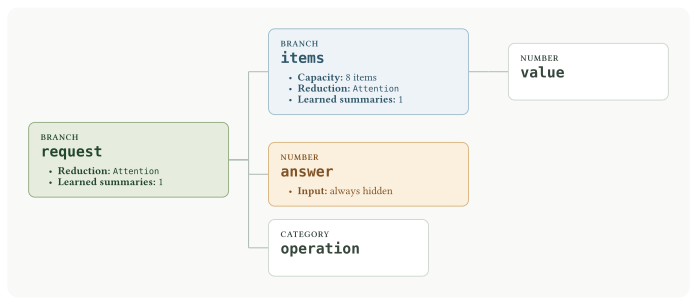
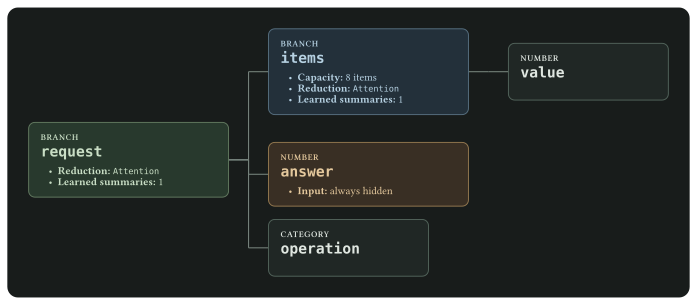
Request has eight repeated Number values, a Category operation, and a masked Number answer. Both branch and root use one learned attention summary.

Request has eight repeated Number values, a Category operation, and a masked Number answer. Both branch and root use one learned attention summary.

Figure 1: Eight visible values and an operation request feed a masked scalar answer; the branch and root each learn one summary.

The item branch and root both use attention reduction. The operation is a normal input Category, not a runtime instruction selecting a Python function.

How it works

The decoder must learn how the request changes the use of collection context. Permuting complete items should preserve a statistic; hiding the operation makes the four requests for a bag identical. Their predictions should then collapse to one value and lose accuracy on the contradictory targets.

Training and evaluation

Code
def run(seed: int, steps: int | None, accelerator: str) -> tuple[dict, dict]:
    lit.seed_everything(seed, workers=True)
    model = rf.Model(
        name="request",
        d_model=64,
        n_layers=2,
        n_heads=4,
        reduction=rf.Attention(n_layers=2),
        batch_size=128,
        optimizer=lambda module: torch.optim.Adam(module.parameters(), lr=0.001),
        items=rf.Branch(length=8, n_layers=2, reduction=rf.Attention(n_layers=2), value=rf.Number),
        answer=rf.Number(mask=True, objective="mse"),
        operation=rf.Category(size=len(OPERATIONS), p_unavailable=0.0),
    )
    data = rf.SyntheticDataModule(
        model=model,
        train=partial(records, bags=768, length=8, seed=seed + 135),
        validate=partial(records, bags=96, length=8, seed=seed + 136),
    )
    trainer = lit.Trainer(
        accelerator=accelerator,
        max_steps=800 if steps is None else min(steps, 800),
        max_epochs=-1,
        logger=False,
        enable_progress_bar=False,
        enable_model_summary=False,
        enable_checkpointing=False,
        deterministic=True,
        num_sanity_val_steps=0,
    )
    trainer.fit(model, datamodule=data)
    train = list(records(bags=768, length=8, seed=seed + 135))
    test = list(records(bags=192, length=8, seed=seed + 137))
    intact_prediction = predict(model, test)
    intact = scores(train, test, intact_prediction, ("operation",))
    metrics = {f"intact/{cell}/{name}": value for cell, score in intact.items() for name, value in score.items()}
    permuted_prediction = predict(model, permute_items(test, seed + 138))
    permuted = scores(train, test, permuted_prediction, ("operation",))
    hidden_prediction = predict(model, [{**row, "operation": None} for row in test])
    hidden = scores(train, test, hidden_prediction, ("operation",))
    for label, result in (("permuted", permuted), ("hidden", hidden)):
        metrics.update(
            {f"{label}/{cell}/{name}": value for cell, score in result.items() for name, value in score.items()}
        )
    scale = float(np.std([row["answer"] for row in test]))
    delta = float(np.sqrt(np.mean(np.square(intact_prediction - permuted_prediction)))) / scale
    hidden_spread = float(np.max(np.ptp(hidden_prediction.reshape(-1, len(OPERATIONS)), axis=1)))
    metrics.update(permutation_delta=delta, hidden_request_spread=hidden_spread)
    checks = {f"{cell} intact nRMSE <= 0.20": score["nrmse"] <= 0.20 for cell, score in intact.items()}
    checks.update({f"{cell} permuted nRMSE <= 0.25": score["nrmse"] <= 0.25 for cell, score in permuted.items()})
    checks.update(
        {
            "Permutation changes predictions by <= 0.05 target SD": delta <= 0.05,
            "Hidden operations yield identical predictions within each bag": hidden_spread <= 1e-6,
            "At least three hidden operations have nRMSE >= 0.75": sum(
                score["nrmse"] >= 0.75 for score in hidden.values()
            )
            >= 3,
        }
    )
    return metrics, checks
Evidence

Latest full run

Seed 15, gpu, recorded 2026-09-15T02:28:42.814023+00:00. Outcome: met.

Source fingerprint: 2d5872818918750d5dd4a892f068fcd0cf560af376de7e361367382beb0a5b72. Python 3.12.6; Torch 2.12.0.

Measurement Value
intact/max/rmse 0.0160757
intact/max/baseline_rmse 0.233853
intact/max/nrmse 0.0687425
intact/mean/rmse 0.00830803
intact/mean/baseline_rmse 0.0748917
intact/mean/nrmse 0.110934
intact/min/rmse 0.0154632
intact/min/baseline_rmse 0.169155
intact/min/nrmse 0.0914147
intact/sum/rmse 0.0782363
intact/sum/baseline_rmse 0.599134
intact/sum/nrmse 0.130582
permuted/max/rmse 0.0161857
permuted/max/baseline_rmse 0.233853
permuted/max/nrmse 0.0692131
permuted/mean/rmse 0.00821248
permuted/mean/baseline_rmse 0.0748917
permuted/mean/nrmse 0.109658
permuted/min/rmse 0.0156271
permuted/min/baseline_rmse 0.169155
permuted/min/nrmse 0.0923835
permuted/sum/rmse 0.0785526
permuted/sum/baseline_rmse 0.599134
permuted/sum/nrmse 0.13111
hidden/max/rmse 0.431099
hidden/max/baseline_rmse 0.233853
hidden/max/nrmse 1.84346
hidden/mean/rmse 1.01857
hidden/mean/baseline_rmse 0.0748917
hidden/mean/nrmse 13.6005
hidden/min/rmse 2.18709
hidden/min/baseline_rmse 0.169155
hidden/min/nrmse 12.9296
hidden/sum/rmse 0.499961
hidden/sum/baseline_rmse 0.599134
hidden/sum/nrmse 0.834473
permutation_delta 0.0035255
hidden_request_spread 0
Behavioral checks
Behavioral check Outcome
max intact nRMSE <= 0.20 Met
mean intact nRMSE <= 0.20 Met
min intact nRMSE <= 0.20 Met
sum intact nRMSE <= 0.20 Met
max permuted nRMSE <= 0.25 Met
mean permuted nRMSE <= 0.25 Met
min permuted nRMSE <= 0.25 Met
sum permuted nRMSE <= 0.25 Met
Permutation changes predictions by <= 0.05 target SD Met
Hidden operations yield identical predictions within each bag Met
At least three hidden operations have nRMSE >= 0.75 Met

Recorded results.

Remaining work

Evaluate every operation at lengths 4–16, then characterize degradation through 32. If sum fails alone, a visible-count control can isolate lost cardinality. Repeat three core seeds and ten calibration seeds before fixing the supported range. Exact numerical reductions belong in preprocessing when exactness is the application contract.

Reproduce

Run by stable ID from the repository root:

uv run python proofs/run.py P031

Or run the self-contained script directly:

PYTHONPATH=proofs uv run python proofs/relational/fixed_length.py

Add --accelerator gpu for CUDA or --seed 42 for another seeded experiment. --steps 2 checks execution with a short training budget; it is recorded as a smoke run.

Download the complete proof.

Code
if __name__ == "__main__":
    report(PROOF_ID, run, seed=15)