The Collection Overlap Boundary

Collection overlap
Document the current failure to infer overlap between two natural sibling collections of unseen identities.

Two collections overlap if any identity appears on both sides. The natural sibling-branch model currently remains near chance on this task, even when every identity token is retained.

Seed 3711 on gpu: 22 of 22 behavioral checks met. See the measurements below.

Insights

Retaining every identity token does not make the current model reliably detect overlap between two collections. The scalar target must discover a match anywhere across both sides, which is a different demand from a repeated target carrying its own visible query identity. The passing flat equality control shows that unseen Hash comparison itself can work.

This proof deliberately passes when predictions remain near chance and barely respond to removing the shared member. Low drift under renaming and permutation is not useful invariance by itself: an uninformative predictor can also stay stable. The result describes the tested architecture and budget, not an impossibility theorem. Compute overlap directly when an application requires it today.

Setup

Code
"""Measure the unresolved overlap boundary between two sibling collections.

Positive rows contain exactly one shared identity; negative rows contain none.
Fresh names, balanced labels, varying lengths, and shuffled order remove easy
shortcuts. The recorded gates describe the current expected chance behavior,
with renaming/permutation and overlap-removal controls.

Run this file with --help for seed, training-budget, and reporting options.
"""

from __future__ import annotations

from collections.abc import Iterator
from functools import partial

import lightning.pytorch as lit
import numpy as np
import torch
from reporting import report

import relflow as rf

PROOF_ID = "P028"
MIN_LENGTH = 2
MAX_LENGTH = 5

Examples

One identity is shared

left:
  - {entity_id: fox}
  - {entity_id: owl}
  - {entity_id: lynx}
right:
  - {entity_id: yak}
  - {entity_id: owl}
has_overlap: true

The shared identity is owl. has_overlap is supervision hidden by mask=True. The example states the true answer, not a successful prediction.

No identity is shared

left:
  - {entity_id: fox}
  - {entity_id: owl}
  - {entity_id: lynx}
right:
  - {entity_id: yak}
  - {entity_id: eel}
has_overlap: false

The right side now shares no identity with the left, so the correct label is false. The unchanged side lengths cannot distinguish this case from the first.

Remove an overlap but retain its old label

left:
  - {entity_id: fox}
  - {entity_id: owl}
  - {entity_id: lynx}
right:
  - {entity_id: yak}
  - {entity_id: broken-000000-1}
has_overlap: true

The corruption replaces the first record’s shared right member with a fresh identity. Its retained label is intentionally true even though actual overlap is now false. A successful detector should lower its positive probability; the current limitation proof instead records almost no response.

Synthetic data and controls

Code
def records(*, rows: int, seed: int, namespace: str) -> Iterator[dict]:
    """Generate balanced, variable-width sibling collections with zero/one overlap."""
    if rows <= 0 or rows % 2:
        raise ValueError(f"collection rows must be a positive even integer, got {rows}")
    rng = np.random.default_rng(seed)
    labels = np.tile(np.asarray([False, True]), rows // 2)
    rng.shuffle(labels)
    for row_index, has_overlap in enumerate(labels):
        left_length = int(rng.integers(MIN_LENGTH, MAX_LENGTH + 1))
        right_length = int(rng.integers(MIN_LENGTH, MAX_LENGTH + 1))
        left_ids = [f"{namespace}-{row_index:06d}-left-{index}" for index in range(left_length)]
        right_ids = [f"{namespace}-{row_index:06d}-right-{index}" for index in range(right_length)]
        if has_overlap:
            right_ids[int(rng.integers(0, right_length))] = left_ids[int(rng.integers(0, left_length))]
        rng.shuffle(left_ids)
        rng.shuffle(right_ids)
        yield {
            "left": [{"entity_id": value} for value in left_ids],
            "right": [{"entity_id": value} for value in right_ids],
            "has_overlap": bool(has_overlap),
        }


def auc(target: np.ndarray, predicted: np.ndarray) -> float:
    """Compute binary ROC AUC from all positive/negative score pairs."""

    positive = predicted[target]
    negative = predicted[~target]
    if not len(positive) or not len(negative):
        raise ValueError("AUC requires at least one positive and one negative example")
    comparisons = positive[:, None] - negative[None, :]
    return float((comparisons > 0).mean() + 0.5 * (comparisons == 0).mean())


def rename_and_permute(rows: list[dict], *, seed: int) -> Iterator[dict]:
    """Apply an equality-preserving unseen-ID bijection and reorder both sides."""
    rng = np.random.default_rng(seed)
    for row_index, row in enumerate(rows):
        left_ids = [item["entity_id"] for item in row["left"]]
        right_ids = [item["entity_id"] for item in row["right"]]
        identities = list(dict.fromkeys([*left_ids, *right_ids]))
        replacements = [f"renamed-{seed}-{row_index:06d}-{index}" for index in range(len(identities))]
        rng.shuffle(replacements)
        mapping = dict(zip(identities, replacements, strict=True))
        renamed_left = [mapping[value] for value in left_ids]
        renamed_right = [mapping[value] for value in right_ids]
        rng.shuffle(renamed_left)
        rng.shuffle(renamed_right)
        yield {
            "left": [{"entity_id": value} for value in renamed_left],
            "right": [{"entity_id": value} for value in renamed_right],
            "has_overlap": row["has_overlap"],
        }


def break_overlaps(rows: list[dict]) -> Iterator[dict]:
    """Remove the shared right member while retaining labels and all controls."""
    for row_index, row in enumerate(rows):
        left_ids = [item["entity_id"] for item in row["left"]]
        left_set = set(left_ids)
        replacements = {
            value: f"broken-{row_index:06d}-{index}"
            for index, value in enumerate((item["entity_id"] for item in row["right"]))
            if value in left_set
        }
        right_ids = [replacements.get(item["entity_id"], item["entity_id"]) for item in row["right"]]
        yield {
            "left": row["left"],
            "right": [{"entity_id": value} for value in right_ids],
            "has_overlap": row["has_overlap"],
        }


def overlap_truth(rows: list[dict]) -> np.ndarray:
    return np.asarray(
        [
            bool({item["entity_id"] for item in row["left"]} & {item["entity_id"] for item in row["right"]})
            for row in rows
        ]
    )


def probabilities(model: rf.Model, rows: list[dict]) -> np.ndarray:
    output = model.predict(rows).to_pylist()
    return np.asarray([row["predictions"]["overlap/has_overlap"]["content"]["probability"] for row in output])

Model tree

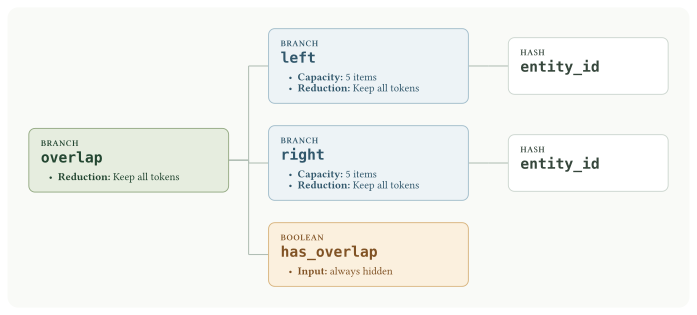
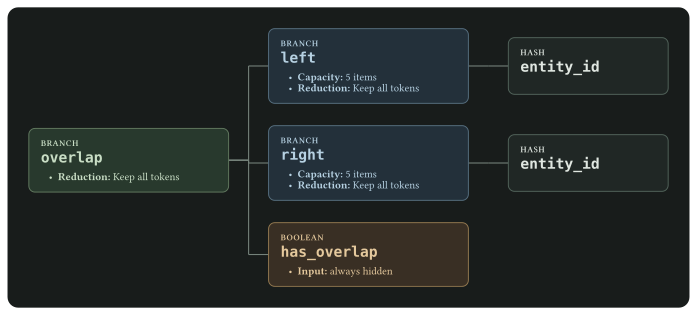
Overlap has left and right Hash-identity branches, each with capacity five, and a masked Boolean target. Both branches and root keep all tokens; this remains the recorded unsupported collection-comparison route.

Overlap has left and right Hash-identity branches, each with capacity five, and a masked Boolean target. Both branches and root keep all tokens; this remains the recorded unsupported collection-comparison route.

Figure 1: Both sibling collections and the root keep all tokens, but the masked scalar target still does not reliably learn collection overlap in this proof.

The root and both branches use reduction=None. Retaining tokens by itself does not guarantee that a scalar decoder learns every cross-collection match.

How it works

Positive rows share exactly one identity; negative rows share none. Labels are balanced, identities are fresh per row and split, and independent side lengths range from two to five. Order, length, and vocabulary frequency cannot identify the label. Renaming identities consistently and permuting each side preserves the relation; removing the shared right member destroys it.

The flat equality control succeeds, localizing the observed gap beyond the primitive unseen-identity comparison.

Training and evaluation

Code
def run(seed: int, steps: int | None, accelerator: str) -> tuple[dict, dict]:
    lit.seed_everything(seed, workers=True)
    model = rf.Model(
        name="overlap",
        d_model=48,
        n_layers=3,
        n_heads=4,
        reduction=None,
        batch_size=128,
        optimizer=lambda module: torch.optim.AdamW(module.parameters(), lr=0.003),
        left=rf.Branch(length=MAX_LENGTH, n_layers=1, reduction=None, entity_id=rf.Hash(n_hashes=4, n_bands=8)),
        right=rf.Branch(length=MAX_LENGTH, n_layers=1, reduction=None, entity_id=rf.Hash(n_hashes=4, n_bands=8)),
        has_overlap=rf.Boolean(mask=True),
    )
    # Restart the training RNG independently of parameter initialization.
    lit.seed_everything(seed, workers=True)
    data = rf.SyntheticDataModule(
        model=model,
        train=partial(records, rows=3072, seed=seed + 1, namespace="train"),
        validate=partial(records, rows=768, seed=seed + 2, namespace="validate"),
        seed=seed,
    )
    trainer = lit.Trainer(
        accelerator=accelerator,
        max_steps=700 if steps is None else min(steps, 700),
        max_epochs=-1,
        logger=False,
        enable_progress_bar=False,
        enable_model_summary=False,
        enable_checkpointing=False,
        deterministic=True,
        check_val_every_n_epoch=5,
    )
    trainer.fit(model, datamodule=data)
    test = list(records(rows=1024, seed=seed + 3, namespace="test"))
    target = np.asarray([row["has_overlap"] for row in test], dtype=np.bool_)
    intact = probabilities(model, test)
    invariant = list(rename_and_permute(test, seed=seed + 4))
    broken = list(break_overlaps(test))
    invariant_probability = probabilities(model, invariant)
    broken_probability = probabilities(model, broken)
    metrics = {
        "intact_auc": auc(target, intact),
        "invariant_auc": auc(target, invariant_probability),
        "broken_auc": auc(target, broken_probability),
        "invariant_drift": float(np.mean(np.abs(intact - invariant_probability))),
        "positive_break_drop": float(np.mean(intact[target] - broken_probability[target])),
    }
    checks = {
        "Labels are exactly balanced": float(target.mean()) == 0.5,
        "Labels match actual overlap": bool(np.array_equal(target, overlap_truth(test))),
        "Renaming and permutation preserve overlap": bool(np.array_equal(target, overlap_truth(invariant))),
        "Intervention removes all overlaps": not bool(overlap_truth(broken).any()),
        "Finite metrics": bool(np.isfinite(list(metrics.values())).all()),
        "Intact AUC remains in the calibrated chance band": 0.35 <= metrics["intact_auc"] <= 0.65,
        "Renamed and permuted AUC remains in the chance band": 0.35 <= metrics["invariant_auc"] <= 0.65,
        "Broken AUC remains in the chance band": 0.35 <= metrics["broken_auc"] <= 0.65,
        "Invariant probability drift <= 0.15": metrics["invariant_drift"] <= 0.15,
        "Absolute positive break response <= 0.10": abs(metrics["positive_break_drop"]) <= 0.10,
    }
    # These are generator invariants, separate from the model's expected limitation.
    for split, rows in (
        ("train", list(records(rows=3072, seed=seed + 1, namespace="train"))),
        ("validate", list(records(rows=768, seed=seed + 2, namespace="validate"))),
        ("test", test),
        ("invariant", invariant),
    ):
        labels = np.asarray([row["has_overlap"] for row in rows])
        checks[f"{split} generator has balanced truthful labels"] = float(labels.mean()) == 0.5 and bool(
            np.array_equal(labels, overlap_truth(rows))
        )
        checks[f"{split} sides have two to five unique members"] = all(
            MIN_LENGTH <= len(row[side]) <= MAX_LENGTH
            and len(row[side]) == len({item["entity_id"] for item in row[side]})
            for row in rows
            for side in ("left", "right")
        )
        checks[f"{split} positive rows have exactly one overlap"] = all(
            len({item["entity_id"] for item in row["left"]} & {item["entity_id"] for item in row["right"]})
            == int(row["has_overlap"])
            for row in rows
        )
    return metrics, checks
Evidence

Latest full run

Seed 3711, gpu, recorded 2026-09-15T02:27:30.953191+00:00. Outcome: met.

Source fingerprint: da4241972f82b268dd5602e23ee7406ae38d32d5efe15b016539e9fd38034103. Python 3.12.6; Torch 2.12.0.

Measurement Value
intact_auc 0.472982
invariant_auc 0.507792
broken_auc 0.478189
invariant_drift 0.00113614
positive_break_drop -2.63226e-05
Behavioral checks
Behavioral check Outcome
Labels are exactly balanced Met
Labels match actual overlap Met
Renaming and permutation preserve overlap Met
Intervention removes all overlaps Met
Finite metrics Met
Intact AUC remains in the calibrated chance band Met
Renamed and permuted AUC remains in the chance band Met
Broken AUC remains in the chance band Met
Invariant probability drift <= 0.15 Met
Absolute positive break response <= 0.10 Met
train generator has balanced truthful labels Met
train sides have two to five unique members Met
train positive rows have exactly one overlap Met
validate generator has balanced truthful labels Met
validate sides have two to five unique members Met
validate positive rows have exactly one overlap Met
test generator has balanced truthful labels Met
test sides have two to five unique members Met
test positive rows have exactly one overlap Met
invariant generator has balanced truthful labels Met
invariant sides have two to five unique members Met
invariant positive rows have exactly one overlap Met

Recorded results.

Remaining work

Repeat across more seeds and larger training budgets, then evaluate bounded set-comparison designs with accuracy, intervention, and invariance gates. This result characterizes the tested schema and budget, not an impossibility result for transformers. Compute deterministic overlap in a preprocessor or the application when it is needed today.

Reproduce

Run by stable ID from the repository root:

uv run python proofs/run.py P028

Or run the self-contained script directly:

PYTHONPATH=proofs uv run python proofs/relational/direct_sibling_hash_overlap.py

Add --accelerator gpu for CUDA or --seed 42 for another seeded experiment. --steps 2 checks execution with a short training budget; it is recorded as a smoke run.

Download the complete proof.

Code
if __name__ == "__main__":
    report(PROOF_ID, run, seed=3711)