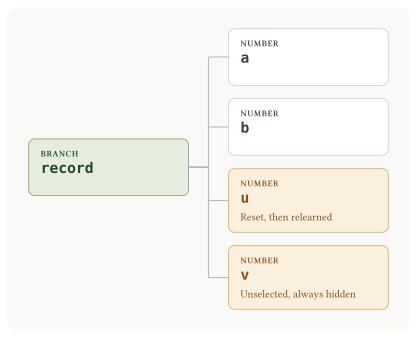
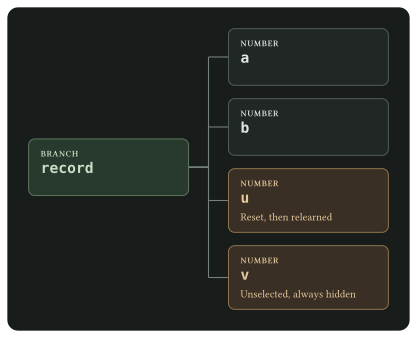
def records(*, rows: int, seed: int) -> Iterator[dict]:
    rng = np.random.default_rng(seed)
    for _ in range(rows):
        a, b = map(float, rng.uniform(-1, 1, size=2))
        yield {"a": a, "b": b, "u": a + 2 * b, "v": 2 * a - b}


def prediction(model: rf.Model, rows: list[dict], *, corrupt: bool = False) -> dict:
    inputs = [{"a": row["a"], "b": row["b"]} for row in rows]
    if corrupt:
        for row in inputs:
            row.update({name: 1000.0 for name in TARGETS})
    output = model.predict(inputs)["predictions"].to_pylist()
    return {
        name: np.asarray([row[f"record/{name}"]["content"] for row in output], dtype=np.float64) for name in TARGETS
    }


def scores(rows: list[dict], predicted: dict, means: dict) -> dict:
    measured = {}
    for name, values in predicted.items():
        actual = np.asarray([row[name] for row in rows])
        baseline = float(np.sqrt(np.mean((actual - means[name]) ** 2)))
        rmse = float(np.sqrt(np.mean((actual - values) ** 2)))
        measured[name] = {"rmse": rmse, "baseline_rmse": baseline, "nrmse": rmse / baseline}
    return measured


def equal(first, second) -> bool:
    """Compare tensor and extension-owned state, including normalization."""
    if isinstance(first, torch.Tensor):
        return isinstance(second, torch.Tensor) and torch.equal(first, second)
    if isinstance(first, dict):
        return (
            isinstance(second, dict)
            and first.keys() == second.keys()
            and all(equal(value, second[name]) for name, value in first.items())
        )
    if isinstance(first, (tuple, list)):
        return (
            type(first) is type(second)
            and len(first) == len(second)
            and all(equal(a, b) for a, b in zip(first, second, strict=True))
        )
    return type(first) is type(second) and first == second


class Curve(lit.Callback):
    """Observe fixed validation checkpoints without restarting the optimizer."""

    def __init__(self, rows: list[dict], means: dict, budget: int):
        self.rows, self.means = rows, means
        self.checkpoints = {32, 128, budget}
        self.measurements = []

    def on_train_start(self, trainer, pl_module):
        self.measurements.append(
            {
                "step": 0,
                "scores": scores(self.rows, prediction(pl_module, self.rows), self.means),
            }
        )

    def on_train_batch_end(self, trainer, pl_module, outputs, batch, batch_idx):
        if trainer.global_step in self.checkpoints:
            self.measurements.append(
                {
                    "step": trainer.global_step,
                    "scores": scores(self.rows, prediction(pl_module, self.rows), self.means),
                }
            )


def fit(model: rf.Model, *, seed: int, split: int, budget: int, accelerator: str) -> dict:
    lit.seed_everything(seed, workers=True)
    training = list(records(rows=2048, seed=split))
    means = {name: float(np.mean([row[name] for row in training])) for name in TARGETS}
    curve = Curve(list(records(rows=512, seed=split + 1)), means, budget)
    model.optimizer = rf.adamw(learning_rate=3e-3, fused=False)
    data = rf.SyntheticDataModule(
        model=model,
        train=partial(records, rows=2048, seed=split),
        validate=partial(records, rows=512, seed=split + 1),
        seed=seed,
    )
    trainer = lit.Trainer(
        accelerator=accelerator,
        devices=1,
        max_epochs=-1,
        max_steps=budget,
        callbacks=[curve],
        logger=False,
        enable_progress_bar=False,
        enable_model_summary=False,
        enable_checkpointing=False,
        deterministic=True,
        num_sanity_val_steps=0,
    )
    trainer.fit(model, datamodule=data)
    model.eval()
    optimized = {id(p) for group in trainer.optimizers[0].param_groups for p in group["params"]}
    current = {id(p) for p in model.parameters() if p.requires_grad}
    return {
        "steps": trainer.global_step,
        "optimizer_covers_current_parameters": current == optimized,
        "validation_curve": curve.measurements,
    }