Learned Predictions Survive Neutral Edits

Mutation retention
Metadata edits, an inactive field, and equivalent input rebinding should preserve a trained numerical and categorical relationship.

Rebuilding a model should preserve a learned function when the edit leaves its information and computation equivalent. This experiment learns a number plus a category-specific offset, then changes the schema without retraining.

Seed 7102 on gpu: 30 of 30 behavioral checks met. See the measurements below.

Insights

The tested neutral edits preserve the learned relationship. The full runs retain predictions, category identities, and normalization state through repeated rebuilding. A complete reset loses the learned skill, confirming that the comparison is preserving a useful trained function.

This experiment checks those properties after three repeated edit cycles, an equivalent input-key change, a rejected duplicate field, and save/load. A complete reset supplies a control that should lose the learned skill. The recorded checks establish only these neutral edits, not arbitrary renaming, tensor resizing, or changes to visible context.

Setup

Code
"""P046: preserve a trained function across neutral public schema edits."""

from collections.abc import Iterator
from copy import deepcopy
from functools import partial
from pathlib import Path
from tempfile import TemporaryDirectory

import lightning.pytorch as lit
import numpy as np
import torch
from reporting import report

import relflow as rf

PROOF_ID = "P046"
OFFSETS = (-0.75, -0.25, 0.25, 0.75)

Examples

Category labels retain their meanings across edits. y is always hidden.

x: 0.5
code: code-0
y: -0.25

The offset for code-0 is −0.75. Changing the identity changes the answer:

x: 0.5
code: code-3
y: 1.25

After rebinding the schema’s x field to renamed_x, the same information should produce the same first answer. The schema address remains record/x.

renamed_x: 0.5
code: code-0
y: -0.25

Data and comparisons

Code
def records(*, rows: int, seed: int) -> Iterator[dict]:
    rng = np.random.default_rng(seed)
    for _ in range(rows):
        x = float(rng.uniform(-1, 1))
        code = int(rng.integers(len(OFFSETS)))
        yield {"x": x, "code": f"code-{code}", "y": x + OFFSETS[code]}


def prediction(model: rf.Model, rows: list[dict], *, key: str = "x") -> np.ndarray:
    output = model.predict([{key: row["x"], "code": row["code"]} for row in rows])["predictions"].to_pylist()
    return np.asarray([row["record/y"]["content"] for row in output], dtype=np.float64)


def equal(first, second) -> bool:
    """Compare learned tensors and extension-owned nested state exactly."""
    if isinstance(first, torch.Tensor):
        return isinstance(second, torch.Tensor) and torch.equal(first, second)
    if isinstance(first, dict):
        return (
            isinstance(second, dict)
            and first.keys() == second.keys()
            and all(equal(value, second[name]) for name, value in first.items())
        )
    if isinstance(first, (tuple, list)):
        return (
            type(first) is type(second)
            and len(first) == len(second)
            and all(equal(a, b) for a, b in zip(first, second, strict=True))
        )
    return type(first) is type(second) and first == second


def errors(actual: np.ndarray, predicted: np.ndarray, baseline: float) -> dict:
    rmse = float(np.sqrt(np.mean((actual - predicted) ** 2)))
    return {"rmse": rmse, "baseline_rmse": baseline, "nrmse": rmse / baseline}

Before and after the edit

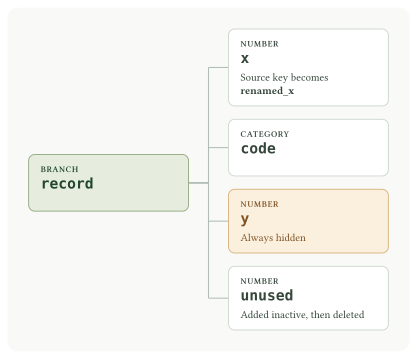
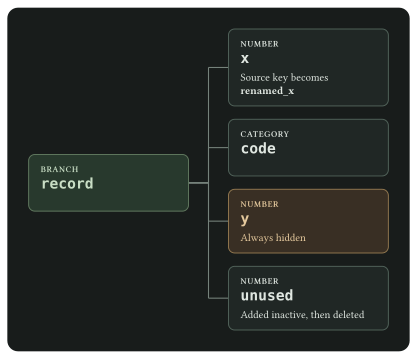
Record reads Number x and Category code to predict hidden Number y. An appended inactive Number unused supplies no information. Rebinding x changes its source key but keeps its schema name.

Record reads Number x and Category code to predict hidden Number y. An appended inactive Number unused supplies no information. Rebinding x changes its source key but keeps its schema name.

Figure 1: The active learned task stays the same throughout the neutral edit cycle.

Train on 2,048 records, validate on 512, and evaluate on 1,024 independent records. Category identities are shared across splits; numerical values are freshly drawn. This is retention of known identities, not OOV generalization. Training uses 512 updates. Evaluation performs no more optimization. nRMSE divides prediction RMSE by the error of a constant predictor fitted to the source-training targets. The provisional learning gate is 0.25. Prediction preservation uses rtol=1e-5 and atol=1e-6 times training target SD.

Training, edits, and evaluation

Code
def run(seed: int, steps: int | None, accelerator: str) -> tuple[dict, dict]:
    lit.seed_everything(seed, workers=True)
    budget = 512 if steps is None else min(steps, 512)
    train = list(records(rows=2048, seed=seed + 1))
    test = list(records(rows=1024, seed=seed + 3))
    actual = np.asarray([row["y"] for row in test])
    baseline = float(np.sqrt(np.mean((actual - np.mean([row["y"] for row in train])) ** 2)))
    scale = float(np.std([row["y"] for row in train]))
    model = rf.Model(
        d_model=32,
        n_layers=1,
        n_heads=4,
        dropout=0.0,
        batch_size=128,
        x=rf.Number,
        code=rf.Category(size=8, p_unavailable=0.0),
        y=rf.Number(mask=True, objective="mse"),
    )
    model.optimizer = rf.adamw(learning_rate=3e-3, fused=False)
    data = rf.SyntheticDataModule(
        model=model,
        train=partial(records, rows=2048, seed=seed + 1),
        validate=partial(records, rows=512, seed=seed + 2),
        seed=seed,
    )
    trainer = lit.Trainer(
        accelerator=accelerator,
        devices=1,
        max_epochs=-1,
        max_steps=budget,
        logger=False,
        enable_progress_bar=False,
        enable_model_summary=False,
        enable_checkpointing=False,
        deterministic=True,
        num_sanity_val_steps=0,
    )
    trainer.fit(model, datamodule=data)
    model.eval()
    reference = prediction(model, test)
    state = deepcopy(model.state_dict())
    vocabulary = model.nodes["record/code"].embedder.vocab.snapshot()
    root = rf.where("address") == "record"
    source = rf.where("address") == "record/x"
    measured = errors(actual, reference, baseline)
    edits = []
    checks = {"Source learns the relationship below 0.25 nRMSE": measured["nrmse"] < 0.25}

    def observe(label: str, *, key: str = "x") -> None:
        result = prediction(model, test, key=key)
        current = model.state_dict()
        missing = [name for name, value in state.items() if name not in current or not equal(value, current[name])]
        preserved = bool(np.allclose(reference, result, rtol=1e-5, atol=1e-6 * scale))
        same_vocabulary = model.nodes["record/code"].embedder.vocab.snapshot() == vocabulary
        edits.append(
            {
                "edit": label,
                "max_prediction_drift": float(np.max(np.abs(reference - result))),
                "nrmse": errors(actual, result, baseline)["nrmse"],
                "changed_or_missing_state_entries": missing,
                "vocabulary_preserved": same_vocabulary,
            }
        )
        checks[f"{label}: predictions survive"] = preserved
        checks[f"{label}: all original state and vocabulary survive"] = not missing and same_vocabulary

    for cycle in range(3):
        model.update(source, description=f"Equivalent input, cycle {cycle + 1}")
        observe(f"cycle {cycle + 1} metadata")
        model.extend(root, unused=rf.Number(active=False))
        observe(f"cycle {cycle + 1} inactive extension")
        model.delete(rf.where("address") == "record/unused")
        observe(f"cycle {cycle + 1} inactive deletion")
    model.update(source, query="renamed_x")
    observe("equivalent source rebind", key="renamed_x")
    model.update(source, query=None)
    observe("source rebind restoration")
    rejected = False
    try:
        model.extend(root, x=rf.Number)
    except ValueError:
        rejected = True
    checks["Duplicate-name edit is rejected"] = rejected
    observe("rejected duplicate extension")

    with TemporaryDirectory(prefix="relflow-mutation-") as directory:
        path = Path(directory) / "edited.ckpt"
        model.save(path)
        loaded = rf.Model.load(path).to(model.device).eval()
        restored = prediction(loaded, test)
        checks["Edited checkpoint preserves schema"] = loaded.schema.model_dump() == model.schema.model_dump()
        checks["Edited checkpoint preserves learned state"] = equal(model.state_dict(), loaded.state_dict())
        checks["Edited checkpoint preserves predictions"] = bool(
            np.allclose(reference, restored, rtol=1e-5, atol=1e-6 * scale)
        )
        lit.seed_everything(seed + 100, workers=True)
        loaded.reset(root, descendants=True)
        reset = errors(actual, prediction(loaded.eval(), test), baseline)
    checks["Complete reset loses the learned relationship"] = (
        reset["nrmse"] > 0.8 and reset["nrmse"] > 3 * measured["nrmse"]
    )
    return {
        "source": measured,
        "source_prerequisite_met": measured["nrmse"] < 0.25,
        "downstream_interpretable": measured["nrmse"] < 0.25,
        "source_steps": trainer.global_step,
        "edits": edits,
        "controls": {"complete_reset": reset},
        "source_vocabulary": vocabulary,
        "test_rows": len(test),
        "optimizer_policy": "Fresh AdamW for source training; no post-edit fitting",
    }, checks
Evidence

Latest full run

Seed 7102, gpu, recorded 2026-09-15T18:02:10.645831+00:00. Outcome: met.

Source fingerprint: b3208281c58d1be68c68809b5446640c4c4f4b7b3667d374ef8756cfa7e57ca3. Python 3.12.6; Torch 2.12.0.

Measurement Value
source rmse: 0.0130738; baseline_rmse: 0.803794; nrmse: 0.0162651
source_prerequisite_met True
downstream_interpretable True
source_steps 512
edits 12 values; final 8: edit: cycle 2 inactive extension; max_prediction_drift: 0; nrmse: 0.0162651; changed_or_missing_state_entries: ; vocabulary_preserved: True, edit: cycle 2 inactive deletion; max_prediction_drift: 0; nrmse: 0.0162651; changed_or_missing_state_entries: ; vocabulary_preserved: True, edit: cycle 3 metadata; max_prediction_drift: 0; nrmse: 0.0162651; changed_or_missing_state_entries: ; vocabulary_preserved: True, edit: cycle 3 inactive extension; max_prediction_drift: 0; nrmse: 0.0162651; changed_or_missing_state_entries: ; vocabulary_preserved: True, edit: cycle 3 inactive deletion; max_prediction_drift: 0; nrmse: 0.0162651; changed_or_missing_state_entries: ; vocabulary_preserved: True, edit: equivalent source rebind; max_prediction_drift: 0; nrmse: 0.0162651; changed_or_missing_state_entries: ; vocabulary_preserved: True, edit: source rebind restoration; max_prediction_drift: 0; nrmse: 0.0162651; changed_or_missing_state_entries: ; vocabulary_preserved: True, edit: rejected duplicate extension; max_prediction_drift: 0; nrmse: 0.0162651; changed_or_missing_state_entries: ; vocabulary_preserved: True
controls complete_reset: rmse: 0.754748; baseline_rmse: 0.803794; nrmse: 0.938982
source_vocabulary code-0, code-1, code-2, code-3
test_rows 1024
optimizer_policy Fresh AdamW for source training; no post-edit fitting
Behavioral checks
Behavioral check Outcome
Source learns the relationship below 0.25 nRMSE Met
cycle 1 metadata: predictions survive Met
cycle 1 metadata: all original state and vocabulary survive Met
cycle 1 inactive extension: predictions survive Met
cycle 1 inactive extension: all original state and vocabulary survive Met
cycle 1 inactive deletion: predictions survive Met
cycle 1 inactive deletion: all original state and vocabulary survive Met
cycle 2 metadata: predictions survive Met
cycle 2 metadata: all original state and vocabulary survive Met
cycle 2 inactive extension: predictions survive Met
cycle 2 inactive extension: all original state and vocabulary survive Met
cycle 2 inactive deletion: predictions survive Met
cycle 2 inactive deletion: all original state and vocabulary survive Met
cycle 3 metadata: predictions survive Met
cycle 3 metadata: all original state and vocabulary survive Met
cycle 3 inactive extension: predictions survive Met
cycle 3 inactive extension: all original state and vocabulary survive Met
cycle 3 inactive deletion: predictions survive Met
cycle 3 inactive deletion: all original state and vocabulary survive Met
equivalent source rebind: predictions survive Met
equivalent source rebind: all original state and vocabulary survive Met
source rebind restoration: predictions survive Met
source rebind restoration: all original state and vocabulary survive Met
Duplicate-name edit is rejected Met
rejected duplicate extension: predictions survive Met
rejected duplicate extension: all original state and vocabulary survive Met
Edited checkpoint preserves schema Met
Edited checkpoint preserves learned state Met
Edited checkpoint preserves predictions Met
Complete reset loses the learned relationship Met

Recorded results.

Remaining work

Three GPU seeds support these edits. Calibrate on ten separate seeds before freezing numerical gates. Test inactive nested branches separately. Renaming schema addresses and resizing learned tensors require separate experiments; matching physical input values does not make those neutral edits.

Reproduce

Run by stable ID from the repository root:

uv run python proofs/run.py P046

Or run the self-contained script directly:

PYTHONPATH=proofs uv run python proofs/mutations/neutral_edits_preserve_learning.py

Add --accelerator gpu for CUDA or --seed 42 for another seeded experiment. --steps 2 checks execution with a short training budget; it is recorded as a smoke run.

Download the complete proof.

Code
if __name__ == "__main__":
    report(PROOF_ID, run, seed=4601)