Deactivate a Learned Input and Restore Its Contribution

Mutation ablation
Remove an informative input with active=False, measure lost information, and restore trained predictions through updates and temporary overrides.

A node that starts inactive cannot demonstrate the loss of learned behavior. This experiment first learns to use both inputs, then disables one of them.

Seed 7202 on gpu: 42 of 42 behavioral checks met. See the measurements below.

Insights

Deactivation removes the input’s contribution while retaining the state needed to reactivate it. The full runs show increased prediction error while the input is inactive and exact restoration afterward, through repeated updates, normal and exceptional override exits, and an inactive checkpoint that is loaded and reactivated.

The selected node is a pure Number input. No optimization occurs while it is inactive. The claim does not cover trained output heads whose decoders are removed by deactivation, or state changes made inside an override.

Setup

Code
"""P049: remove and restore an informative input without further training."""

from collections.abc import Iterator
from copy import deepcopy
from functools import partial
from pathlib import Path
from tempfile import TemporaryDirectory

import lightning.pytorch as lit
import numpy as np
import torch
from reporting import report

import relflow as rf

PROOF_ID = "P049"

Examples

Independently draw a and b uniformly from [−1, 1], with hidden y = a + b.

a: 0.5
b: 0.75
y: 1.25

Holding a fixed and changing b changes the required answer:

a: 0.5
b: -0.75
y: -0.25

After deactivating b, these records become indistinguishable to the model. A remaining-input prediction can use only a, including on records like:

a: -0.5
b: 0.75
y: 0.25

Data and comparisons

Code
def records(*, rows: int, seed: int) -> Iterator[dict]:
    rng = np.random.default_rng(seed)
    for _ in range(rows):
        a, b = map(float, rng.uniform(-1, 1, size=2))
        yield {"a": a, "b": b, "y": a + b}


def prediction(model: rf.Model, rows: list[dict], *, include_b: bool = True, corrupt: bool = False) -> np.ndarray:
    inputs = [{"a": row["a"], **({"b": row["b"]} if include_b else {})} for row in rows]
    if corrupt:
        for row in inputs:
            row["y"] = 1000.0
    output = model.predict(inputs)["predictions"].to_pylist()
    return np.asarray([row["record/y"]["content"] for row in output], dtype=np.float64)


def errors(actual: np.ndarray, predicted: np.ndarray, baseline: float) -> dict:
    rmse = float(np.sqrt(np.mean((actual - predicted) ** 2)))
    return {"rmse": rmse, "baseline_rmse": baseline, "nrmse": rmse / baseline}


def equal(first, second) -> bool:
    """Compare tensors and extension-owned state, including normalization."""
    if isinstance(first, torch.Tensor):
        return isinstance(second, torch.Tensor) and torch.equal(first, second)
    if isinstance(first, dict):
        return (
            isinstance(second, dict)
            and first.keys() == second.keys()
            and all(equal(value, second[name]) for name, value in first.items())
        )
    if isinstance(first, (tuple, list)):
        return (
            type(first) is type(second)
            and len(first) == len(second)
            and all(equal(a, b) for a, b in zip(first, second, strict=True))
        )
    return type(first) is type(second) and first == second

Before, during, and after deactivation

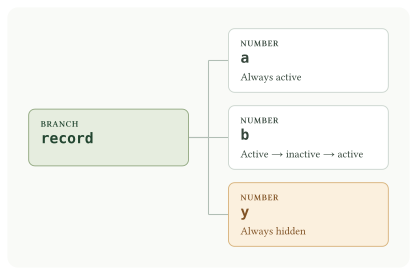
Record reads Number a and Number b to predict hidden Number y. The b input is deactivated and later reactivated with its trained state retained.

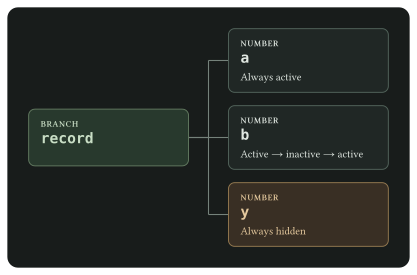
Record reads Number a and Number b to predict hidden Number y. The b input is deactivated and later reactivated with its trained state retained.

Figure 1: Disabling b removes information. Reactivation restores the trained function using both inputs.

Train for 512 updates on 2,048 records, validate on 512, and evaluate on an independent panel of 2,048 records. nRMSE divides prediction RMSE by the error of a constant fitted to the training targets. The source gate is below 0.25.

Without b, the conditional mean is a. Relative to a baseline using the population mean, its nRMSE is 1/sqrt(2); the experiment also records its actual error on the held-out panel. Removal must raise nRMSE by more than 0.35 and reach at least 90% of that measured information-limit error. No claim requires an unadapted model to attain the best prediction from the remaining input.

Restoration uses rtol=1e-5 and atol=1e-6 times training target SD. A shuffled b control establishes that the trained model uses the selected input. Supplying, omitting, or changing b while inactive must give the same output.

Training, deactivation, and restoration

Code
def run(seed: int, steps: int | None, accelerator: str) -> tuple[dict, dict]:
    lit.seed_everything(seed, workers=True)
    budget = 512 if steps is None else min(steps, 512)
    train = list(records(rows=2048, seed=seed + 1))
    test = list(records(rows=2048, seed=seed + 3))
    actual = np.asarray([row["y"] for row in test])
    baseline = float(np.sqrt(np.mean((actual - np.mean([row["y"] for row in train])) ** 2)))
    tolerance = 1e-6 * float(np.std([row["y"] for row in train]))
    oracle = errors(actual, np.asarray([row["a"] for row in test]), baseline)
    rng = np.random.default_rng(seed + 4)
    order = rng.permutation(len(test))
    shuffled = [{**row, "b": test[index]["b"]} for row, index in zip(test, order, strict=True)]
    changed = [{**row, "b": -row["b"]} for row in test]
    model = rf.Model(
        d_model=32,
        n_layers=1,
        n_heads=4,
        dropout=0.0,
        batch_size=128,
        a=rf.Number,
        b=rf.Number,
        y=rf.Number(mask=True, objective="mse"),
    )
    model.optimizer = rf.adamw(learning_rate=3e-3, fused=False)
    data = rf.SyntheticDataModule(
        model=model,
        train=partial(records, rows=2048, seed=seed + 1),
        validate=partial(records, rows=512, seed=seed + 2),
        seed=seed,
    )
    trainer = lit.Trainer(
        accelerator=accelerator,
        devices=1,
        max_epochs=-1,
        max_steps=budget,
        logger=False,
        enable_progress_bar=False,
        enable_model_summary=False,
        enable_checkpointing=False,
        deterministic=True,
        num_sanity_val_steps=0,
    )
    trainer.fit(model, datamodule=data)
    model.eval()
    reference = prediction(model, test)
    source = errors(actual, reference, baseline)
    corruption = errors(actual, prediction(model, shuffled), baseline)
    zero_filled = errors(actual, prediction(model, [{**row, "b": 0.0} for row in test]), baseline)
    schema = deepcopy(model.schema.model_dump())
    state = deepcopy(model.state_dict())
    selected = rf.where("address") == "record/b"
    learned = source["nrmse"] < 0.25
    checks = {
        "Source learns both-input relationship below 0.25 nRMSE": learned,
        "Shuffling b destroys useful signal": corruption["nrmse"] > source["nrmse"] + 0.35
        and corruption["nrmse"] >= 0.9 * oracle["nrmse"],
        "Source hidden target values cannot affect predictions": bool(
            np.allclose(reference, prediction(model, test, corrupt=True), rtol=1e-5, atol=tolerance)
        ),
    }
    edits = []

    def observe(label: str, *, inactive: bool) -> np.ndarray:
        """Evaluate the appropriate information-loss or restoration invariant."""
        values = prediction(model, test)
        measured = errors(actual, values, baseline)
        same_state = equal(state, model.state_dict())
        checks[f"{label}: all learned state survives"] = same_state
        if inactive:
            omitted = prediction(model, test, include_b=False)
            flipped = prediction(model, changed)
            checks[f"{label}: input is inactive"] = not model.schema.requests["record/b"].active
            checks[f"{label}: b values cannot affect predictions"] = bool(
                np.allclose(values, omitted, rtol=1e-5, atol=tolerance)
                and np.allclose(values, flipped, rtol=1e-5, atol=tolerance)
            )
            checks[f"{label}: removing b loses information"] = (
                measured["nrmse"] > source["nrmse"] + 0.35 and measured["nrmse"] >= 0.9 * oracle["nrmse"]
            )
        else:
            checks[f"{label}: original schema is restored"] = model.schema.model_dump() == schema
            checks[f"{label}: trained predictions are restored"] = bool(
                np.allclose(reference, values, rtol=1e-5, atol=tolerance)
            )
        edits.append(
            {
                "edit": label,
                "inactive": inactive,
                "scores": measured,
                "max_source_prediction_drift": float(np.max(np.abs(values - reference))),
                "learned_state_preserved": same_state,
            }
        )
        return values

    with TemporaryDirectory(prefix="relflow-mutation-") as directory:
        checkpoint = Path(directory) / "source.ckpt"
        model.save(checkpoint)
        unchanged = rf.Model.load(checkpoint).to(model.device).eval()
        checks["Unchanged checkpoint preserves predictions"] = bool(
            np.allclose(reference, prediction(unchanged, test), rtol=1e-5, atol=tolerance)
        )
        for cycle in range(3):
            model.update(selected, active=False)
            inactive_values = observe(f"cycle {cycle + 1} deactivate", inactive=True)
            if cycle == 0:
                path = Path(directory) / "inactive.ckpt"
                model.save(path)
                loaded = rf.Model.load(path).to(model.device).eval()
                checks["Inactive checkpoint preserves schema and state"] = (
                    loaded.schema.model_dump() == model.schema.model_dump() and equal(state, loaded.state_dict())
                )
                checks["Inactive checkpoint preserves predictions"] = bool(
                    np.allclose(inactive_values, prediction(loaded, test), rtol=1e-5, atol=tolerance)
                )
                loaded.update(selected, active=True)
                checks["Loaded inactive input can restore its trained function"] = bool(
                    loaded.schema.model_dump() == schema
                    and equal(state, loaded.state_dict())
                    and np.allclose(reference, prediction(loaded, test), rtol=1e-5, atol=tolerance)
                )
            model.update(selected, active=True)
            observe(f"cycle {cycle + 1} reactivate", inactive=False)
        with model.override(selected, active=False):
            observe("temporary override", inactive=True)
        observe("normal override exit", inactive=False)
        marker = RuntimeError("intentional override exit")
        try:
            with model.override(selected, active=False):
                observe("override before exception", inactive=True)
                raise marker
        except RuntimeError as error:
            if error is not marker:
                raise
        observe("exceptional override exit", inactive=False)
    return {
        "source": source,
        "source_steps": trainer.global_step,
        "source_prerequisite_met": learned,
        "downstream_interpretable": learned,
        "controls": {"shuffled_b": corruption, "zero_filled_b": zero_filled, "only_a_oracle": oracle},
        "edits": edits,
        "test_rows": len(test),
        "optimizer_policy": "Fresh AdamW for source; no fitting inside updates or overrides",
        "mutation": "update record/b active=False/True three times; override with normal and exceptional exits",
    }, checks
Evidence

Latest full run

Seed 7202, gpu, recorded 2026-09-15T18:24:58.506617+00:00. Outcome: met.

Source fingerprint: b6c88a66cf37b1ae7164ef5c44787d1d01d26b6f935db20e0b5332dd3966e061. Python 3.12.6; Torch 2.12.0.

Measurement Value
source rmse: 0.0200838; baseline_rmse: 0.835283; nrmse: 0.0240443
source_steps 512
source_prerequisite_met True
downstream_interpretable True
controls shuffled_b: rmse: 0.825726; baseline_rmse: 0.835283; nrmse: 0.988557; zero_filled_b: rmse: 0.57767; baseline_rmse: 0.835283; nrmse: 0.691585; only_a_oracle: rmse: 0.578087; baseline_rmse: 0.835283; nrmse: 0.692085
edits 10 values; final 8: edit: cycle 2 deactivate; inactive: True; scores: rmse: 0.805145; baseline_rmse: 0.835283; nrmse: 0.963918; max_source_prediction_drift: 1.96801; learned_state_preserved: True, edit: cycle 2 reactivate; inactive: False; scores: rmse: 0.0200838; baseline_rmse: 0.835283; nrmse: 0.0240443; max_source_prediction_drift: 0; learned_state_preserved: True, edit: cycle 3 deactivate; inactive: True; scores: rmse: 0.805145; baseline_rmse: 0.835283; nrmse: 0.963918; max_source_prediction_drift: 1.96801; learned_state_preserved: True, edit: cycle 3 reactivate; inactive: False; scores: rmse: 0.0200838; baseline_rmse: 0.835283; nrmse: 0.0240443; max_source_prediction_drift: 0; learned_state_preserved: True, edit: temporary override; inactive: True; scores: rmse: 0.805145; baseline_rmse: 0.835283; nrmse: 0.963918; max_source_prediction_drift: 1.96801; learned_state_preserved: True, edit: normal override exit; inactive: False; scores: rmse: 0.0200838; baseline_rmse: 0.835283; nrmse: 0.0240443; max_source_prediction_drift: 0; learned_state_preserved: True, edit: override before exception; inactive: True; scores: rmse: 0.805145; baseline_rmse: 0.835283; nrmse: 0.963918; max_source_prediction_drift: 1.96801; learned_state_preserved: True, edit: exceptional override exit; inactive: False; scores: rmse: 0.0200838; baseline_rmse: 0.835283; nrmse: 0.0240443; max_source_prediction_drift: 0; learned_state_preserved: True
test_rows 2048
optimizer_policy Fresh AdamW for source; no fitting inside updates or overrides
mutation update record/b active=False/True three times; override with normal and exceptional exits
Behavioral checks
Behavioral check Outcome
Source learns both-input relationship below 0.25 nRMSE Met
Shuffling b destroys useful signal Met
Source hidden target values cannot affect predictions Met
Unchanged checkpoint preserves predictions Met
cycle 1 deactivate: all learned state survives Met
cycle 1 deactivate: input is inactive Met
cycle 1 deactivate: b values cannot affect predictions Met
cycle 1 deactivate: removing b loses information Met
Inactive checkpoint preserves schema and state Met
Inactive checkpoint preserves predictions Met
Loaded inactive input can restore its trained function Met
cycle 1 reactivate: all learned state survives Met
cycle 1 reactivate: original schema is restored Met
cycle 1 reactivate: trained predictions are restored Met
cycle 2 deactivate: all learned state survives Met
cycle 2 deactivate: input is inactive Met
cycle 2 deactivate: b values cannot affect predictions Met
cycle 2 deactivate: removing b loses information Met
cycle 2 reactivate: all learned state survives Met
cycle 2 reactivate: original schema is restored Met
cycle 2 reactivate: trained predictions are restored Met
cycle 3 deactivate: all learned state survives Met
cycle 3 deactivate: input is inactive Met
cycle 3 deactivate: b values cannot affect predictions Met
cycle 3 deactivate: removing b loses information Met
cycle 3 reactivate: all learned state survives Met
cycle 3 reactivate: original schema is restored Met
cycle 3 reactivate: trained predictions are restored Met
temporary override: all learned state survives Met
temporary override: input is inactive Met
temporary override: b values cannot affect predictions Met
temporary override: removing b loses information Met
normal override exit: all learned state survives Met
normal override exit: original schema is restored Met
normal override exit: trained predictions are restored Met
override before exception: all learned state survives Met
override before exception: input is inactive Met
override before exception: b values cannot affect predictions Met
override before exception: removing b loses information Met
exceptional override exit: all learned state survives Met
exceptional override exit: original schema is restored Met
exceptional override exit: trained predictions are restored Met

Recorded results.

Remaining work

Three GPU seeds support this case. Calibrate numerical gates on ten independent seeds. Deactivating output heads and branches that produce context requires separate experiments. Training inside an override does not have checkpoint rollback semantics and is not covered here.

Reproduce

Run by stable ID from the repository root:

uv run python proofs/run.py P049

Or run the self-contained script directly:

PYTHONPATH=proofs uv run python proofs/mutations/deactivate_and_restore_input.py

Add --accelerator gpu for CUDA or --seed 42 for another seeded experiment. --steps 2 checks execution with a short training budget; it is recorded as a smoke run.

Download the complete proof.

Code
if __name__ == "__main__":
    report(PROOF_ID, run, seed=4901)