Equality for Unseen Identities

Identity
Hash fields can support equality predictions for identities absent from training.

Two identifiers can be equal even when neither appeared during training. This proof asks a model to recognize that relationship across two Hash fields on entirely new identity namespaces.

Seed 29 on gpu: 4 of 4 behavioral checks met. See the measurements below.

Insights

Hash can preserve equality across fields without learning each identifier in advance. Compatible batch-local representations let matching unseen strings supply a comparison signal to the shared model.

The recorded Hash model clears the held-out equality gate on a disjoint namespace. Shuffling labels removes that advantage, while matched Category fields cannot reliably distinguish unseen strings after their content becomes unavailable. The evidence below reports both the measured scores and their acceptance gates.

Use Hash when observation-local equality matters more than persistent category semantics. This result does not establish invertible identifiers, stable embeddings across separately encoded batches, or general relational joins. Prediction stability under a shared identity renaming remains untested.

Setup

Code
"""P021: infer equality between identities absent from the training vocabulary.

Hash is compared with shuffled held-out labels and a matched Category model.
Train, validation, and test identity namespaces are disjoint.
"""

from collections.abc import Callable, Iterator
from functools import partial
from typing import Literal

import lightning.pytorch as lit
import numpy as np
import torch
from reporting import report

import relflow as rf

PROOF_ID = "P021"

Examples

All identifiers below belong to the test namespace, which is absent during training. equal is a hidden Boolean target.

Matching unseen identities

left_id: test-17
right_id: test-17
equal: true

The two strings match. Compatible Hash representations preserve the equality signal even without a learned vocabulary entry for test-17.

Different unseen identities

left_id: test-17
right_id: test-93
equal: false

Only the right identity changed. The model must distinguish equality from the mere fact that both values are unfamiliar.

A shuffled-label control

left_id: test-17
right_id: test-17
equal: false

Shuffling held-out labels can produce this contradictory record. Its label is deliberately no longer the true equality answer. The control should return chance-level aggregate performance; one corrupted row alone is not a performance measurement.

Synthetic data and controls

Code
def records(*, rows: int, seed: int, namespace: str, shuffle_targets: bool = False) -> Iterator[dict]:
    """Yield balanced equal/unequal pairs from one identity namespace."""
    rng = np.random.default_rng(seed)
    target = np.tile(np.array([False, True]), (rows + 1) // 2)[:rows]
    rng.shuffle(target)
    left = rng.integers(0, rows * 2, size=rows)
    other = rng.integers(0, rows * 2 - 1, size=rows)
    other += other >= left
    right = np.where(target, left, other)
    labels = target.copy()
    if shuffle_targets:
        rng.shuffle(labels)
    for index in range(rows):
        yield {
            "left_id": f"{namespace}-{left[index]}",
            "right_id": f"{namespace}-{right[index]}",
            "equal": bool(labels[index]),
        }

Model tree

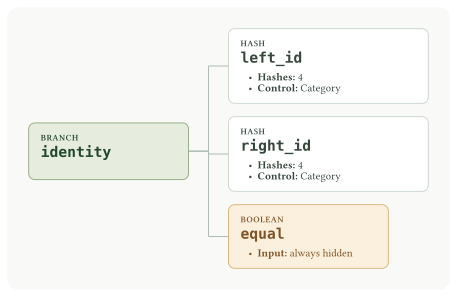
Identity contains left ID and right ID inputs using four hashes each, replaced by Category fields in the comparison, and a Boolean equal target always hidden from input.

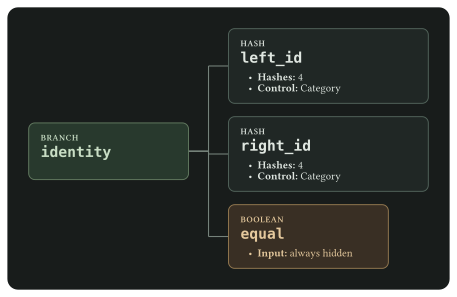
Identity contains left ID and right ID inputs using four hashes each, replaced by Category fields in the comparison, and a Boolean equal target always hidden from input.

Figure 1: Each identity uses four compatible hashes; the Category comparison replaces both inputs. The equality target stays hidden.

How it works

Hash preserves equality across fields within an encoded batch. Its representation does not require a persistent entry for each identifier, so new strings can still supply the comparison signal.

The test trains both a Hash model and a matched Category model. Train, validation, and test use disjoint train-, validate-, and test- namespaces. The Category control encounters unknown content in both fields at test time. A second control evaluates the trained Hash model after shuffling the test labels, preserving identities while breaking their association with the answer.

The protocol uses 4,096 training, 1,024 validation, and 4,096 test pairs, with 20 deterministic epochs. Equal and unequal pairs are balanced.

Training and evaluation

Code
def fit(*, identity: Literal["hash", "category"], seed: int, steps: int | None, accelerator: str) -> rf.Model:
    """Train one representation on the same identity pairs."""
    lit.seed_everything(seed, workers=True)
    model = rf.Model(
        name="identity",
        d_model=48,
        n_layers=2,
        n_heads=4,
        batch_size=128,
        left_id=rf.Hash(n_hashes=4) if identity == "hash" else rf.Category(size=8192, p_unavailable=0.0),
        right_id=rf.Hash(n_hashes=4) if identity == "hash" else rf.Category(size=8192, p_unavailable=0.0),
        equal=rf.Boolean(mask=True),
    )
    model.optimizer = lambda module: torch.optim.AdamW(module.parameters(), lr=3e-3)
    data = rf.SyntheticDataModule(
        model=model,
        train=partial(records, rows=4096, seed=seed + 1, namespace="train"),
        validate=partial(records, rows=1024, seed=seed + 2, namespace="validate"),
        seed=seed,
    )
    trainer = lit.Trainer(
        accelerator=accelerator,
        max_epochs=20,
        max_steps=steps if steps is not None else -1,
        logger=False,
        enable_progress_bar=False,
        enable_model_summary=False,
        enable_checkpointing=False,
        deterministic=True,
    )
    trainer.fit(model=model, datamodule=data)
    return model


def score(model: rf.Model, records: Callable[[], Iterator[dict]], accelerator: str) -> float:
    """Evaluate Boolean AUC without updating the vocabulary."""
    data = rf.SyntheticDataModule(model=model, test=records)
    trainer = lit.Trainer(
        accelerator=accelerator,
        logger=False,
        enable_progress_bar=False,
        enable_model_summary=False,
        enable_checkpointing=False,
        deterministic=True,
    )
    metrics = trainer.test(model=model, datamodule=data, verbose=False)[0]
    return float(metrics["identity.equal/test.auc.content"])


def run(seed: int, steps: int | None, accelerator: str) -> tuple[dict, dict]:
    test = partial(records, rows=4096, seed=seed + 3, namespace="test")
    control = partial(records, rows=4096, seed=seed + 3, namespace="test", shuffle_targets=True)
    hash_model = fit(identity="hash", seed=seed, steps=steps, accelerator=accelerator)
    category_model = fit(identity="category", seed=seed, steps=steps, accelerator=accelerator)
    equality_auc = score(hash_model, test, accelerator)
    control_auc = score(hash_model, control, accelerator)
    category_oov_auc = score(category_model, test, accelerator)
    gap = equality_auc - control_auc
    return {
        "hash_auc": equality_auc,
        "shuffled_auc": control_auc,
        "category_oov_auc": category_oov_auc,
        "auc_gap": gap,
    }, {
        "Unseen Hash equality AUC is at least 0.95": equality_auc >= 0.95,
        "Shuffled labels remain between 0.42 and 0.58 AUC": 0.42 <= control_auc <= 0.58,
        "Category OOV AUC is at most 0.65": category_oov_auc <= 0.65,
        "Hash exceeds shuffled labels by at least 0.35 AUC": gap >= 0.35,
    }
Evidence

Latest full run

Seed 29, gpu, recorded 2026-09-15T02:24:18.855867+00:00. Outcome: met.

Source fingerprint: f8f9e5eafa2d1516fa31c67b12cdedad7e96f80290c0c5ed32f0b6300cb6c0b0. Python 3.12.6; Torch 2.12.0.

Measurement Value
hash_auc 0.999877
shuffled_auc 0.498595
category_oov_auc 0.5
auc_gap 0.501282
Behavioral checks
Behavioral check Outcome
Unseen Hash equality AUC is at least 0.95 Met
Shuffled labels remain between 0.42 and 0.58 AUC Met
Category OOV AUC is at most 0.65 Met
Hash exceeds shuffled labels by at least 0.35 AUC Met

Recorded results.

Remaining work

Apply the same unseen-identity renaming to both fields and check whether predictions remain stable. Repeat the three evaluations over three core seeds and at least ten calibration seeds, keeping the Category boundary.

Reproduce

Run by stable ID from the repository root:

uv run python proofs/run.py P021

Or run the self-contained script directly:

PYTHONPATH=proofs uv run python proofs/identity/unseen_identity_equality.py

Add --accelerator gpu for CUDA or --seed 42 for another seeded experiment. --steps 2 checks execution with a short training budget; it is recorded as a smoke run.

Download the complete proof.

Code
if __name__ == "__main__":
    report(PROOF_ID, run, seed=29)