Weighted means across varying lengths

Weighted aggregation
Learn a weighted mean from raw item pairs while preserving the identities of a normalized aggregate.

Seed 3313 on gpu: 5 of 5 behavioral checks met. See the measurements below. The experiment code has changed since this run; these measurements describe its earlier version.

Insights

The model responds to relative weights while keeping the same answer when all weights are scaled together. The model is reported to preserve its answer when complete items are reordered or duplicated, and when all weights are scaled equally. Swapping weights between values instead removes accuracy against the original labels.

Those controls distinguish useful invariance from simply ignoring the weights. Keep each weight beside its value, and choose the target’s algebra deliberately: duplicating items preserves a weighted mean but doubles a weighted sum. This proof covers positive weights and lengths within the trained range; a zero denominator, signed weights, or substantially longer bags needs separate treatment.

Setup

Code
"""A weighted mean should remain identifiable when collection length varies.

Learn a normalized weighted mean from two through six raw pairs.

Run: uv run python proofs/run.py P016"""

from __future__ import annotations

from collections.abc import Iterator
from copy import deepcopy

import lightning.pytorch as lit
import numpy as np
import torch
from reporting import report

import relflow as rf

PROOF_ID = "P016"
ITEMS = 6

Examples

Targets use mask=True; the labels below are supervision hidden from the encoder.

Normalize by total weight

items:
  - {value: 0.8, weight: 0.5}
  - {value: -0.4, weight: 1.25}
  - {value: 0.2, weight: 2.0}
weighted_mean: 0.08

The weighted sum is 0.3 and total weight is 3.75, giving a weighted mean of 0.08.

Move weight to another value

items:
  - {value: 0.8, weight: 1.25}
  - {value: -0.4, weight: 0.5}
  - {value: 0.2, weight: 2.0}
weighted_mean: 0.08  # Retained original label

Swapping the first two weights changes the mathematical answer to 0.32. The corruption keeps 0.08 as its original target, so using the changed pairing should worsen the measured error.

Duplicate complete items

items:
  - {value: 0.8, weight: 0.5}
  - {value: -0.4, weight: 1.25}
  - {value: 0.2, weight: 2.0}
  - {value: 0.8, weight: 0.5}
  - {value: -0.4, weight: 1.25}
  - {value: 0.2, weight: 2.0}
weighted_mean: 0.08

Doubling both weighted contribution and total weight keeps the answer at 0.08. The six-item result stays within the proof’s branch capacity.

Synthetic data and controls

Code
def variable_weighted_mean_records(*, rows: int, seed: int) -> Iterator[dict]:
    """Draw variable-width rows with broad positive weights."""
    rng = np.random.default_rng(seed)
    for _ in range(rows):
        length = int(rng.integers(2, ITEMS + 1))
        values = rng.uniform(-1.0, 1.0, size=length)
        weights = np.exp(rng.uniform(np.log(0.03), np.log(3.0), size=length))
        yield {
            "items": [
                {"value": float(value), "weight": float(weight)} for value, weight in zip(values, weights, strict=True)
            ],
            "weighted_mean": float(np.dot(values, weights) / weights.sum()),
        }


def permute_weights(observations: list[dict], *, seed: int) -> list[dict]:
    """Break value/weight pairing within rows while preserving both marginals."""
    rng = np.random.default_rng(seed)
    rows = deepcopy(observations)
    changed = 0
    for row in rows:
        items = row["items"]
        permutation = rng.permutation(len(items))
        if np.array_equal(permutation, np.arange(len(items))):
            permutation = np.roll(permutation, 1)
        shuffled = [items[index]["weight"] for index in permutation]
        changed += sum((item["weight"] != weight for item, weight in zip(items, shuffled, strict=True)))
        row["items"] = [
            {"value": item["value"], "weight": weight} for item, weight in zip(items, shuffled, strict=True)
        ]
    if changed == 0:
        raise ValueError("weight permutation did not change any item-local associations")
    return rows


def permute_items(observations: list[dict], *, seed: int) -> list[dict]:
    """Jointly permute complete items without changing any target."""
    rng = np.random.default_rng(seed)
    rows = deepcopy(observations)
    for row in rows:
        items = row["items"]
        row["items"] = [items[index] for index in rng.permutation(len(items))]
    return rows


def scale_weights(observations: list[dict], *, factor: float) -> list[dict]:
    """Scale every raw weight and update targets according to their algebra."""
    if factor <= 0.0:
        raise ValueError(f"weight scale must be positive, got {factor}")
    rows = deepcopy(observations)
    for row in rows:
        row["items"] = [{**item, "weight": factor * item["weight"]} for item in row["items"]]
        if "weighted_sum" in row:
            row["weighted_sum"] *= factor
    return rows


def duplicate_items(observations: list[dict], *, maximum_original: int) -> list[dict]:
    """Duplicate every item on rows that remain within configured capacity."""
    rows = [row for row in deepcopy(observations) if len(row["items"]) <= maximum_original]
    if not rows:
        raise ValueError(f"no rows contain at most {maximum_original} items")
    for row in rows:
        row["items"] = [*row["items"], *row["items"]]
        if "weighted_sum" in row:
            row["weighted_sum"] *= 2.0
    return rows


def prediction(model: rf.Model, observations: list[dict]) -> np.ndarray:
    inputs = [{"items": row["items"]} for row in observations]
    output = model.predict(inputs)["predictions"].to_pylist()
    return np.asarray([row["record/weighted_mean"]["content"] for row in output], dtype=np.float64)


def rmse(actual: np.ndarray, predicted: np.ndarray | float) -> float:
    return float(np.sqrt(np.mean(np.square(actual - predicted))))


def score(*, train: list[dict], test: list[dict], predicted: np.ndarray) -> dict[str, float]:
    """Compare held-out RMSE with the constant training-target mean."""
    actual = np.asarray([row["weighted_mean"] for row in test], dtype=np.float64)
    baseline_rmse = rmse(actual, float(np.asarray([row["weighted_mean"] for row in train], dtype=np.float64).mean()))
    measured = rmse(actual, predicted)
    return {"rmse": measured, "baseline_rmse": baseline_rmse, "nrmse": measured / baseline_rmse}

Model tree

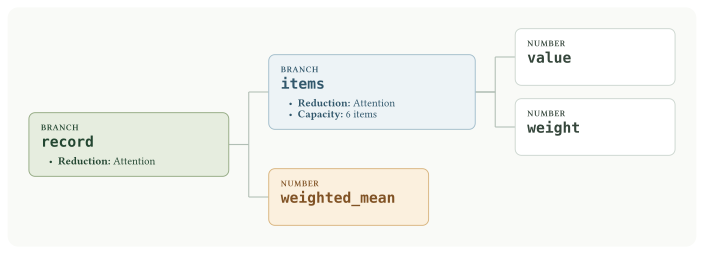
Record contains repeated items with value, weight inputs, and hidden weighted mean targets. Root reduction: Attention. Item reduction: Attention; capacity 6.

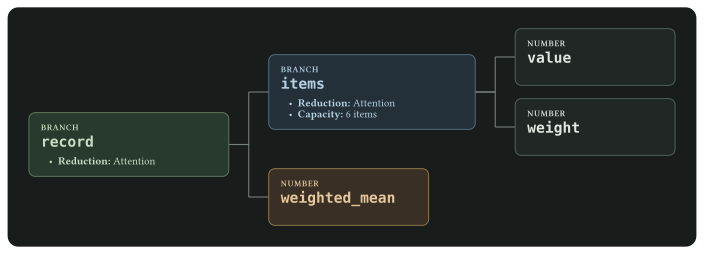
Record contains repeated items with value, weight inputs, and hidden weighted mean targets. Root reduction: Attention. Item reduction: Attention; capacity 6.

Figure 1: Attention reduces raw pairs within a six-item capacity to predict a hidden weighted mean.

How it works

Learned rf.Attention reductions receive two through six item pairs. The label is sum(value * weight) / sum(weight). Values vary independently; positive weights span 0.03 through 3.0 on a logarithmic scale, making an unweighted average a poor shortcut.

Complete-item permutation, scaling every weight by 0.75, and duplicating all items should preserve the answer. Duplication is checked only for original lengths two and three so the result stays within branch capacity. Permuting weights alone must worsen error against unchanged labels: normalization does not remove the need to bind each weight to its own value.

Training and evaluation

Code
def run(seed: int, steps: int | None, accelerator: str) -> tuple[dict, dict]:
    lit.seed_everything(seed, workers=True)
    # Split seeds are independent; rerunning a generator reproduces the same records.
    train = list(variable_weighted_mean_records(rows=1536, seed=seed + 1))
    test = list(variable_weighted_mean_records(rows=768, seed=seed + 3))
    model = rf.Model(
        d_model=32,
        n_layers=2,
        n_heads=4,
        reduction=rf.Attention(n_layers=2),
        batch_size=64,
        optimizer=lambda module: torch.optim.Adam(module.parameters(), lr=0.001),
        items=rf.Branch(
            length=ITEMS, n_layers=2, reduction=rf.Attention(n_layers=2), value=rf.Number, weight=rf.Number
        ),
        weighted_mean=rf.Number(mask=True, objective="mse"),
    )
    datamodule = rf.SyntheticDataModule(
        model=model,
        train=lambda: variable_weighted_mean_records(rows=1536, seed=seed + 1),
        validate=lambda: variable_weighted_mean_records(rows=384, seed=seed + 2),
        seed=seed,
    )
    trainer = lit.Trainer(
        accelerator=accelerator,
        devices=1,
        max_epochs=-1,
        max_steps=1100 if steps is None else min(steps, 1100),
        logger=False,
        enable_progress_bar=False,
        enable_model_summary=False,
        enable_checkpointing=False,
        deterministic=True,
        num_sanity_val_steps=0,
    )
    trainer.fit(model, datamodule=datamodule)

    # Evaluate held-out answers and retain their original labels in corruption controls.
    intact_prediction = prediction(model, test)
    intact = score(train=train, test=test, predicted=intact_prediction)
    corrupted_table = permute_weights(test, seed=seed + 4)
    corrupted = score(train=train, test=test, predicted=prediction(model, corrupted_table))
    permuted_prediction = prediction(model, permute_items(test, seed=seed + 5))
    scaled_prediction = prediction(model, scale_weights(test, factor=0.75))
    original_short = [row for row in deepcopy(test) if len(row["items"]) <= ITEMS // 2]
    duplicated_prediction = prediction(model, duplicate_items(test, maximum_original=ITEMS // 2))
    original_short_prediction = prediction(model, original_short)
    target_scale = float(np.std(np.asarray([row["weighted_mean"] for row in test], dtype=np.float64)))
    permutation_drift = rmse(intact_prediction, permuted_prediction) / target_scale
    scaling_drift = rmse(intact_prediction, scaled_prediction) / target_scale
    duplication_drift = rmse(original_short_prediction, duplicated_prediction) / target_scale
    metrics = {
        "intact": intact,
        "corrupted": corrupted,
        "permutation_drift": permutation_drift,
        "scaling_drift": scaling_drift,
        "duplication_drift": duplication_drift,
        "steps": trainer.global_step,
    }
    checks = {
        "Weighted mean nRMSE below 0.40": bool(intact["nrmse"] < 0.4),
        "Shuffled weights raise nRMSE by at least 0.25": bool(corrupted["nrmse"] >= intact["nrmse"] + 0.25),
        "Permutation drift below 0.10 target SD": bool(permutation_drift < 0.1),
        "Weight scaling drift below 0.10 target SD": bool(scaling_drift < 0.1),
        "Duplication drift below 0.10 target SD": bool(duplication_drift < 0.1),
    }
    return metrics, checks
Evidence

Latest full run

Seed 3313, gpu, recorded 2026-09-15T02:22:35.682947+00:00. Outcome: met.

Source fingerprint: 34adfb1bbd259cfa3cffaef8d4b502ab0fa44ab136c8895e33999b05c4508b5c. Python 3.12.6; Torch 2.12.0.

Measurement Value
intact rmse: 0.0187534; baseline_rmse: 0.391819; nrmse: 0.0478623
corrupted rmse: 0.384777; baseline_rmse: 0.391819; nrmse: 0.982026
permutation_drift 0.0133892
scaling_drift 0.0296659
duplication_drift 0.0213533
steps 1100
Behavioral checks
Behavioral check Outcome
Weighted mean nRMSE below 0.40 Met
Shuffled weights raise nRMSE by at least 0.25 Met
Permutation drift below 0.10 target SD Met
Weight scaling drift below 0.10 target SD Met
Duplication drift below 0.10 target SD Met

Recorded results.

Remaining work

Repeat every identity across seeds. Zero or signed total weight, missing weights, extreme magnitudes, and lengths outside the trained range still need explicit semantics and checks.

The family’s promotion target is at least three core seeds and ten lightweight calibration seeds.

Reproduce

Run by stable ID from the repository root:

uv run python proofs/run.py P016

Or run the self-contained script directly:

PYTHONPATH=proofs uv run python proofs/aggregation/variable_cardinality_weighted_mean.py

Add --accelerator gpu for CUDA or --seed 42 for another seeded experiment. --steps 2 checks execution with a short training budget; it is recorded as a smoke run.

Download the complete proof.

Code
if __name__ == "__main__":
    report(PROOF_ID, run, seed=3313)