Isolate covariance reduction after the item-level centered products are already available.
Seed 3513 on gpu: 1 of 1 behavioral checks met. See the measurements below. The experiment code has changed since this run; these measurements describe its earlier version.
Insights
Once centered products are supplied, the model can learn their average as covariance. The difficult information about pairing and centering has already been calculated outside the model. Positive, negative, and canceling contributions then share the same reduction task.
This control helps localize a failure in raw-pair covariance. If supplied products are easy but raw pairs are not, the missing behavior is more likely in the interaction than in final averaging. Passing here does not demonstrate learned centering, multiplication, or sensitivity to raw X–Y pairing. The proof checks numerical accuracy for its fixed collection length, without independently testing broader covariance identities.
Setup
Code
"""Supplied centered products isolate covariance reduction.Mean learns covariance once centered products are supplied.Run: uv run python proofs/run.py P008"""from __future__ import annotationsfrom collections.abc import Iteratorimport lightning.pytorch as litimport numpy as npimport torchfrom reporting import reportimport relflow as rfPROOF_ID ="P008"ITEMS =8
Examples
Targets use mask=True; the labels below are supervision hidden from the encoder.
These nonzero centered products average to zero. The model still receives the sufficient statistic directly; none of these records demonstrates learned centering or multiplication from raw pairs.
Synthetic data and controls
Code
def covariance_records(*, rows: int, seed: int) -> Iterator[dict]:"""Draw paired fields with controlled means, scales, and covariance.""" rng = np.random.default_rng(seed)for _ inrange(rows): x_basis = rng.normal(size=ITEMS) x_basis -= x_basis.mean() x_basis /= np.sqrt(np.mean(np.square(x_basis))) orthogonal = rng.normal(size=ITEMS) orthogonal -= orthogonal.mean() orthogonal -= np.mean(orthogonal * x_basis) * x_basis orthogonal /= np.sqrt(np.mean(np.square(orthogonal))) correlation =float(rng.uniform(-0.88, 0.88)) y_basis = correlation * x_basis + np.sqrt(1.0- correlation * correlation) * orthogonal x_scale =float(rng.uniform(0.35, 1.45)) y_scale =float(rng.uniform(0.35, 1.45)) x_location =float(rng.uniform(-0.8, 0.8)) y_location =float(rng.uniform(-0.8, 0.8)) x_values = x_location + x_scale * x_basis y_values = y_location + y_scale * y_basisyield {"items": [{"x": float(x), "y": float(y)} for x, y inzip(x_values, y_values, strict=True)],"covariance": correlation * x_scale * y_scale,"correlation": correlation, }def covariance_sufficient_records(*, rows: int, seed: int) -> Iterator[dict]:"""Expose per-item centered products while retaining the same targets.""" rows_with_pairs = covariance_records(rows=rows, seed=seed)for row in rows_with_pairs: x = np.asarray([item["x"] for item in row["items"]], dtype=np.float64) y = np.asarray([item["y"] for item in row["items"]], dtype=np.float64) cross_deviation = (x - x.mean()) * (y - y.mean())yield {"items": [{"cross_deviation": float(value)} for value in cross_deviation],"covariance": row["covariance"], }def prediction(model: rf.Model, observations: list[dict]) -> np.ndarray: inputs = [{"items": row["items"]} for row in observations] output = model.predict(inputs)["predictions"].to_pylist()return np.asarray([row["record/covariance"]["content"] for row in output], dtype=np.float64)def rmse(actual: np.ndarray, predicted: np.ndarray |float) ->float:returnfloat(np.sqrt(np.mean(np.square(actual - predicted))))def score(*, train: list[dict], test: list[dict], predicted: np.ndarray) ->dict[str, float]:"""Compare held-out RMSE with the constant training-target mean.""" actual = np.asarray([row["covariance"] for row in test], dtype=np.float64) baseline = rmse(actual, float(np.asarray([row["covariance"] for row in train], dtype=np.float64).mean())) measured = rmse(actual, predicted)return {"rmse": measured, "baseline_rmse": baseline, "nrmse": measured / baseline}
Model tree
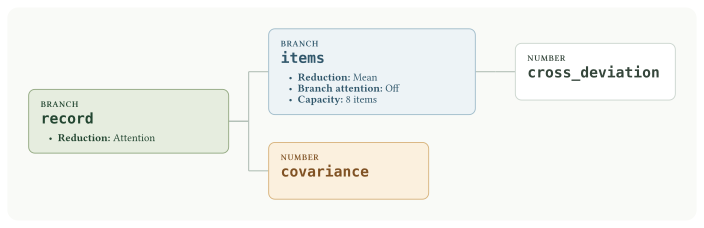
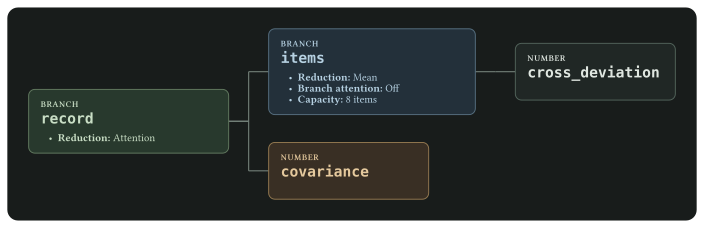
Figure 1: Mean averages eight supplied centered products without item attention before covariance is decoded.
How it works
The generator supplies (x - mean(x)) * (y - mean(y)) for every item. The model sees these eight centered products, not raw x and y values. The item branch has attention=None and rf.Mean(), followed by learned root attention and a covariance decoder.
This tests whether an encoded average can be decoded into the population cross-moment. It bypasses centering and pairwise multiplication. Compare it with aligned-pair covariance to localize a failure in sibling interaction rather than in the final reduction.
Repeat across seeds and broaden lengths, missing-value behavior, and outliers. This sufficient-statistic diagnostic should remain easier than the raw pairing task; it cannot establish that the model learned the supplied operation.
The family’s promotion target is at least three core seeds and ten lightweight calibration seeds.
Reproduce
Run by stable ID from the repository root:
uv run python proofs/run.py P008
Or run the self-contained script directly:
PYTHONPATH=proofs uv run python proofs/aggregation/supplied_cross_deviations.py
Add --accelerator gpu for CUDA or --seed 42 for another seeded experiment. --steps 2 checks execution with a short training budget; it is recorded as a smoke run.