Requesting a value by rank

Order statistics
Use one model to recover minimum, quartiles, median, and maximum from an unsorted numerical bag.

Seed 3700 on gpu: 11 of 11 behavioral checks met. See the measurements below. The experiment code has changed since this run; these measurements describe its earlier version.

Insights

The model can use a request to pick the minimum, maximum, median, or a quartile from an unsorted collection. Each bag appears with every request, so a bag-only answer cannot solve the task. Hiding rank collapses those predictions, while cycling rank labels destroys accuracy against the original targets.

Preserving encoded item coordinates leaves evidence available for request-conditioned decoding; it does not itself perform sorting. Separate gates for every rank and data shape prevent good minimum or maximum predictions from hiding failed quartiles. The tested quantiles select observed values from an odd-length bag. Even lengths, interpolation conventions, empty collections, and much larger bags are additional questions.

Setup

Code
"""Request five order statistics from one randomly ordered numeric bag.

Require endpoints, quartiles, median, and causal controls together.

Run: uv run python proofs/run.py P012"""

from __future__ import annotations

from collections.abc import Iterator
from copy import deepcopy

import lightning.pytorch as lit
import numpy as np
import torch
from reporting import report

import relflow as rf

PROOF_ID = "P012"
LENGTH = 9
RANKS = ("minimum", "q25", "median", "q75", "maximum")
RANK_INDEX = dict(zip(RANKS, (0, 2, 4, 6, 8), strict=True))
SHAPES = ("symmetric", "left_skewed", "right_skewed", "duplicates")

Examples

Targets use mask=True; the labels below are supervision hidden from the encoder.

Request the median

rank: median
items:
  - {value: 0.4}
  - {value: 0.1}
  - {value: 0.9}
  - {value: 0.3}
  - {value: 0.7}
  - {value: 0.2}
  - {value: 0.8}
  - {value: 0.6}
  - {value: 0.5}
answer: 0.5

The fifth sorted value is 0.5, even though the input bag is unsorted.

Request the lower quartile

rank: q25
items:
  - {value: 0.4}
  - {value: 0.1}
  - {value: 0.9}
  - {value: 0.3}
  - {value: 0.7}
  - {value: 0.2}
  - {value: 0.8}
  - {value: 0.6}
  - {value: 0.5}
answer: 0.3

For this nine-value convention, Q25 is the third sorted value: 0.3. The items are unchanged; only the visible rank request differs.

Cycle the request but retain its label

rank: q75
items:
  - {value: 0.4}
  - {value: 0.1}
  - {value: 0.9}
  - {value: 0.3}
  - {value: 0.7}
  - {value: 0.2}
  - {value: 0.8}
  - {value: 0.6}
  - {value: 0.5}
answer: 0.5  # Retained original label

Cycling the median request to Q75 makes the correct requested value 0.7. This corruption deliberately keeps the original median label of 0.5. A request-sensitive model should then score worse against that retained target.

Synthetic data and controls

Code
def values(rng: np.random.Generator, shape: str) -> np.ndarray:
    """Draw one independently located and scaled bag with a declared shape."""
    match shape:
        case "symmetric":
            standardized = rng.normal(size=LENGTH)
        case "left_skewed":
            standardized = 1.0 - rng.exponential(size=LENGTH)
        case "right_skewed":
            standardized = rng.exponential(size=LENGTH) - 1.0
        case "duplicates":
            standardized = rng.normal(size=LENGTH)
            standardized[2] = standardized[1]
            standardized[6] = standardized[5]
        case _:
            raise ValueError(f"unknown order-statistic shape: {shape!r}")
    standardized = np.clip(standardized, -3.0, 3.0)
    scale = float(rng.uniform(0.35, 1.35))
    location = float(rng.uniform(-1.25, 1.25))
    return location + scale * standardized


def records(*, bags: int, seed: int) -> Iterator[dict]:
    """Expand each base bag into all rank requests before split assignment."""
    rng = np.random.default_rng(seed)
    for bag in range(bags):
        shape = SHAPES[bag % len(SHAPES)]
        bag_values = values(rng, shape)
        ordered = np.sort(bag_values)
        permutation = rng.permutation(LENGTH)
        items = [{"value": float(bag_values[index])} for index in permutation]
        for rank in RANKS:
            yield {
                "bag": f"{seed}:{bag}",
                "shape": shape,
                "rank": rank,
                "items": items,
                "answer": float(ordered[RANK_INDEX[rank]]),
            }


def permute_items(observations: list[dict], *, seed: int) -> list[dict]:
    """Randomize each complete bag once while retaining targets and requests."""
    rng = np.random.default_rng(seed)
    rows = deepcopy(observations)
    reordered: dict[str, list[dict[str, float]]] = {}
    for row in rows:
        bag = str(row["bag"])
        if bag not in reordered:
            items = row["items"]
            reordered[bag] = [items[index] for index in rng.permutation(len(items))]
        row["items"] = reordered[bag]
    return rows


def validate_request_families(observations: list[dict]) -> set[str]:
    """Require one identical five-request family for every complete base bag."""
    families: dict[str, list[dict[str, object]]] = {}
    for row in observations:
        families.setdefault(str(row["bag"]), []).append(row)
    for bag, family in families.items():
        ranks = {str(row["rank"]) for row in family}
        if len(family) != len(RANKS) or ranks != set(RANKS):
            raise ValueError(f"bag {bag!r} does not contain exactly one request for every rank: {ranks!r}")
        if any((row["items"] != family[0]["items"] for row in family[1:])):
            raise ValueError(f"bag {bag!r} changes item evidence between rank requests")
    return set(families)


def cycle_rank(observations: list[dict]) -> list[dict]:
    """Break request/answer alignment while retaining every marginal exactly."""
    rows = deepcopy(observations)
    successor = {rank: RANKS[(index + 1) % len(RANKS)] for index, rank in enumerate(RANKS)}
    for row in rows:
        row["rank"] = successor[row["rank"]]
    return rows


def prediction(model: rf.Model, observations: list[dict]) -> np.ndarray:
    inputs = [{"items": row["items"], "rank": row["rank"]} for row in observations]
    output = model.predict(inputs)["predictions"].to_pylist()
    return np.asarray([row["request/answer"]["content"] for row in output], dtype=np.float64)


def rmse(actual: np.ndarray, predicted: np.ndarray | float) -> float:
    return float(np.sqrt(np.mean(np.square(actual - predicted))))


def scores(*, train: list[dict], test: list[dict], predicted: np.ndarray, key: str) -> dict[str, dict[str, float]]:
    """Compare each rank or shape with its own training-mean baseline."""
    result = {}
    for cell in sorted({row[key] for row in test}):
        train_mean = float(np.mean([row["answer"] for row in train if row[key] == cell]))
        indices = [index for index, row in enumerate(test) if row[key] == cell]
        actual = np.asarray([test[index]["answer"] for index in indices])
        baseline = rmse(actual, train_mean)
        measured = rmse(actual, predicted[indices])
        result[cell] = {"rmse": measured, "baseline_rmse": baseline, "nrmse": measured / baseline}
    return result


def overall_score(*, train: list[dict], test: list[dict], predicted: np.ndarray) -> dict[str, float]:
    """Calculate overall accuracy against per-rank training means."""
    train_rank = np.asarray([row["rank"] for row in train])
    train_answer = np.asarray([row["answer"] for row in train]).astype(np.float64)
    test_rank = np.asarray([row["rank"] for row in test])
    actual = np.asarray([row["answer"] for row in test]).astype(np.float64)
    means = {rank: float(train_answer[train_rank == rank].mean()) for rank in RANKS}
    baseline = np.asarray([means[rank] for rank in test_rank], dtype=np.float64)
    baseline_rmse = rmse(actual, baseline)
    measured_rmse = rmse(actual, predicted)
    return {"rmse": measured_rmse, "baseline_rmse": baseline_rmse, "nrmse": measured_rmse / baseline_rmse}

Model tree

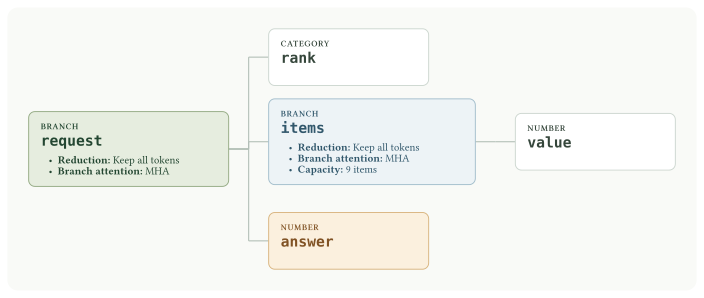
Request contains repeated items with value inputs, visible rank, and hidden answer targets. Root reduction: Keep all tokens. Item reduction: Keep all tokens; capacity 9; branch attention MHA.

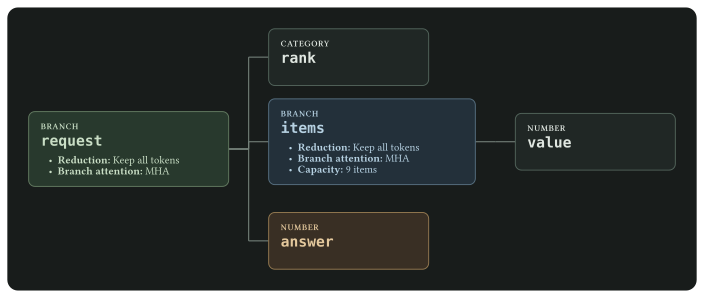
Request contains repeated items with value inputs, visible rank, and hidden answer targets. Root reduction: Keep all tokens. Item reduction: Keep all tokens; capacity 9; branch attention MHA.

Figure 1: Both root and item branch keep all tokens with branch attention enabled; the visible rank selects among nine raw values.

How it works

Both root and item branch use reduction=None to preserve encoded coordinates. A visible Category request chooses among minimum, q25, median, q75, and maximum. For nine values these are sorted positions 1, 3, 5, 7, and 9: no interpolated quantile is required, and ties retain their observed value.

Each bag appears with all five requests in the same split. Symmetric, skewed, and duplicate-bearing bags vary in location and scale. Reordering complete items should retain predictions. Hiding rank makes the five requests identical and must collapse their predictions; cycling rank labels while keeping targets must remove request-conditioned accuracy. Endpoint success alone cannot satisfy the separate interior-rank gates.

Training and evaluation

Code
def run(seed: int, steps: int | None, accelerator: str) -> tuple[dict, dict]:
    lit.seed_everything(seed, workers=True)
    train = list(records(bags=1024, seed=seed + 1))
    validate = list(records(bags=192, seed=seed + 2))
    test = list(records(bags=384, seed=seed + 3))
    model = rf.Model(
        name="request",
        d_model=64,
        n_layers=3,
        n_heads=4,
        reduction=None,
        batch_size=128,
        optimizer=lambda module: torch.optim.AdamW(module.parameters(), lr=0.003),
        items=rf.Branch(length=LENGTH, overflow="error", n_layers=3, n_heads=4, reduction=None, value=rf.Number),
        rank=rf.Category(size=len(RANKS), p_unavailable=0.0),
        answer=rf.Number(mask=True, objective="mse"),
    )
    datamodule = rf.SyntheticDataModule(
        model=model,
        train=lambda: records(bags=1024, seed=seed + 1),
        validate=lambda: records(bags=192, seed=seed + 2),
        seed=seed,
    )
    trainer = lit.Trainer(
        accelerator=accelerator,
        devices=1,
        max_epochs=-1,
        max_steps=800 if steps is None else min(steps, 800),
        logger=False,
        enable_progress_bar=False,
        enable_model_summary=False,
        enable_checkpointing=False,
        deterministic=True,
        num_sanity_val_steps=0,
    )
    trainer.fit(model, datamodule=datamodule)
    intact_prediction = prediction(model, test)
    by_rank = scores(train=train, test=test, predicted=intact_prediction, key="rank")
    by_shape = scores(train=train, test=test, predicted=intact_prediction, key="shape")
    intact = overall_score(train=train, test=test, predicted=intact_prediction)
    permuted_prediction = prediction(model, permute_items(test, seed=seed + 4))
    target_scale = float(np.std(np.asarray([row["answer"] for row in test]).astype(np.float64)))
    permutation_drift = rmse(intact_prediction, permuted_prediction) / target_scale
    cycled_prediction = prediction(model, cycle_rank(test))
    cycled = overall_score(train=train, test=test, predicted=cycled_prediction)
    hidden_prediction = prediction(model, [{**row, "rank": None} for row in test])
    hidden = scores(train=train, test=test, predicted=hidden_prediction, key="rank")
    hidden_family_spread = float(np.max(np.ptp(hidden_prediction.reshape(-1, len(RANKS)), axis=1)))
    train_bags = validate_request_families(train)
    validate_bags = validate_request_families(validate)
    test_bags = validate_request_families(test)
    calibration = np.asarray(
        [
            target_scale,
            intact["rmse"],
            intact["baseline_rmse"],
            intact["nrmse"],
            cycled["rmse"],
            cycled["baseline_rmse"],
            cycled["nrmse"],
            permutation_drift,
            hidden_family_spread,
            *(score["baseline_rmse"] for score in by_rank.values()),
            *(score["baseline_rmse"] for score in by_shape.values()),
        ]
    )
    endpoint_passes = max((by_rank[rank]["nrmse"] for rank in ("minimum", "maximum"))) < 0.3
    interior_passes = max((by_rank[rank]["nrmse"] for rank in ("q25", "median", "q75"))) < 0.35
    shape_passes = all((by_shape[shape]["nrmse"] < 0.45 for shape in SHAPES))
    controls_pass = (
        permutation_drift < 0.1
        and cycled["nrmse"] >= 0.8
        and (cycled["nrmse"] >= intact["nrmse"] + 0.35)
        and all((hidden[rank]["nrmse"] >= 0.65 for rank in ("minimum", "maximum")))
        and (sum((score["nrmse"] >= 0.65 for score in hidden.values())) >= 3)
    )
    metrics = {
        "intact": intact,
        "by_rank": by_rank,
        "by_shape": by_shape,
        "cycled": cycled,
        "hidden": hidden,
        "permutation_drift": permutation_drift,
        "hidden_family_spread": hidden_family_spread,
        "target_scale": target_scale,
        "steps": trainer.global_step,
    }
    checks = {
        "Expected number of rank requests": bool(len(train) == 1024 * len(RANKS) and len(test) == 384 * len(RANKS)),
        "All ranks represented": bool(set(np.asarray([row["rank"] for row in test])) == set(RANKS)),
        "All bag shapes represented": bool(set(np.asarray([row["shape"] for row in test])) == set(SHAPES)),
        "Training bags separate from validation and test": bool(train_bags.isdisjoint(validate_bags | test_bags)),
        "Validation bags separate from test": bool(validate_bags.isdisjoint(test_bags)),
        "All measurements finite": bool(np.isfinite(calibration).all()),
        "Target SD above 0.80": bool(target_scale > 0.8),
        "Per-rank baseline RMSE above 0.60": bool(min((score["baseline_rmse"] for score in by_rank.values())) > 0.6),
        "Per-shape baseline RMSE above 0.80": bool(min((score["baseline_rmse"] for score in by_shape.values())) > 0.8),
        "Hidden requests yield identical predictions": bool(hidden_family_spread <= 1e-06),
        "Endpoint, interior-rank, shape, and causal-control gates": bool(
            endpoint_passes and interior_passes and shape_passes and controls_pass
        ),
    }
    return metrics, checks
Evidence

Latest full run

Seed 3700, gpu, recorded 2026-09-15T02:21:13.612512+00:00. Outcome: met.

Source fingerprint: 39f67bb6c9feee68195d0831b099e7d1c7baa9126415cbc747ca26177e703b2b. Python 3.12.6; Torch 2.12.0.

Measurement Value
intact rmse: 0.0654655; baseline_rmse: 0.929037; nrmse: 0.070466
by_rank maximum: rmse: 0.0314864; baseline_rmse: 0.946604; nrmse: 0.0332625; median: rmse: 0.0777021; baseline_rmse: 0.843863; nrmse: 0.0920791; minimum: rmse: 0.048558; baseline_rmse: 1.08869; nrmse: 0.0446022; q25: rmse: 0.0775761; baseline_rmse: 0.887072; nrmse: 0.0874518; q75: rmse: 0.0776126; baseline_rmse: 0.857463; nrmse: 0.0905143
by_shape duplicates: rmse: 0.0704775; baseline_rmse: 1.20442; nrmse: 0.0585157; left_skewed: rmse: 0.0646002; baseline_rmse: 1.27243; nrmse: 0.050769; right_skewed: rmse: 0.0526303; baseline_rmse: 1.12072; nrmse: 0.0469611; symmetric: rmse: 0.0723376; baseline_rmse: 1.25849; nrmse: 0.0574798
cycled rmse: 1.34552; baseline_rmse: 0.929037; nrmse: 1.44829
hidden maximum: rmse: 1.88489; baseline_rmse: 0.946604; nrmse: 1.99121; median: rmse: 0.704776; baseline_rmse: 0.843863; nrmse: 0.835178; minimum: rmse: 0.883911; baseline_rmse: 1.08869; nrmse: 0.811902; q25: rmse: 0.217113; baseline_rmse: 0.887072; nrmse: 0.244752; q75: rmse: 1.20409; baseline_rmse: 0.857463; nrmse: 1.40425
permutation_drift 0.0298004
hidden_family_spread 0
target_scale 1.21481
steps 800
Behavioral checks
Behavioral check Outcome
Expected number of rank requests Met
All ranks represented Met
All bag shapes represented Met
Training bags separate from validation and test Met
Validation bags separate from test Met
All measurements finite Met
Target SD above 0.80 Met
Per-rank baseline RMSE above 0.60 Met
Per-shape baseline RMSE above 0.80 Met
Hidden requests yield identical predictions Met
Endpoint, interior-rank, shape, and causal-control gates Met

Recorded results.

Remaining work

Repeat the complete gate across seeds. Variable and even lengths need explicit quantile semantics; nulls, empty bags, all-equal values, heavy tails, and magnitude extrapolation need new cases. Permutation stability here is measured approximately, not guaranteed by every part of the architecture.

The family’s promotion target is at least three core seeds and ten lightweight calibration seeds.

Reproduce

Run by stable ID from the repository root:

uv run python proofs/run.py P012

Or run the self-contained script directly:

PYTHONPATH=proofs uv run python proofs/aggregation/requested_rank_values.py

Add --accelerator gpu for CUDA or --seed 42 for another seeded experiment. --steps 2 checks execution with a short training budget; it is recorded as a smoke run.

Download the complete proof.

Code
if __name__ == "__main__":
    report(PROOF_ID, run, seed=3700)