Weighted sums from raw pairs

Weighted aggregation
Learn each item’s value–weight relationship, then sum the contributions across the collection.

Seed 3304 on gpu: 5 of 5 behavioral checks met. See the measurements below. The experiment code has changed since this run; these measurements describe its earlier version.

Insights

The model uses the weight attached to each value, rather than only the collection’s separate values and weights. Swapping weights between items preserves both sets of numbers but worsens predictions against the original labels. Reordering complete items leaves predictions approximately stable, while scaling all weights changes the answer proportionally.

Keeping related fields on the same item gives the model a route to learn their interaction before aggregation. The supplied-product control helps isolate that interaction when diagnosing a failure. This proof supports the raw paired schema for its fixed collection length; it does not establish variable-length totals, negative-weight behavior, or exact multiplication.

Setup

Code
"""Raw sibling value and weight fields should support a weighted sum.

Learn products and their sum without a derived contribution field.

Run: uv run python proofs/run.py P014"""

from __future__ import annotations

from collections.abc import Iterator
from copy import deepcopy

import lightning.pytorch as lit
import numpy as np
import torch
from reporting import report

import relflow as rf

PROOF_ID = "P014"
ITEMS = 6

Examples

Targets use mask=True; the labels below are supervision hidden from the encoder.

Combine each pair

items:
  - {value: 0.8, weight: 0.5}
  - {value: -0.4, weight: 1.0}
  - {value: 0.2, weight: 1.4}
  - {value: 0.5, weight: 0.2}
  - {value: -0.5, weight: 0.4}
  - {value: 0.9, weight: 0.3}
weighted_sum: 0.45

Each product uses the value and weight from the same item; their sum is 0.45.

Scale every weight

items:
  - {value: 0.8, weight: 0.375}
  - {value: -0.4, weight: 0.75}
  - {value: 0.2, weight: 1.05}
  - {value: 0.5, weight: 0.15}
  - {value: -0.5, weight: 0.3}
  - {value: 0.9, weight: 0.225}
weighted_sum: 0.3375

Scaling all weights by 0.75 changes the correct sum from 0.45 to 0.3375.

Break the pairing

items:
  - {value: 0.8, weight: 1.0}
  - {value: -0.4, weight: 0.5}
  - {value: 0.2, weight: 1.4}
  - {value: 0.5, weight: 0.2}
  - {value: -0.5, weight: 0.4}
  - {value: 0.9, weight: 0.3}
weighted_sum: 0.45  # Retained original label

Only the first two weights are swapped. The visible pairs now imply 1.05, but this corruption retains the original 0.45 target. A model following the pairs should move away from that retained label.

Synthetic data and controls

Code
def weighted_records(*, rows: int, length: int, seed: int) -> Iterator[dict]:
    """Draw random value/weight pairs and expose raw fields or their products."""
    rng = np.random.default_rng(seed)
    for _ in range(rows):
        values = rng.uniform(-1.0, 1.0, size=length)
        weights = rng.uniform(0.15, 1.5, size=length)
        contributions = values * weights
        items = [
            {"value": float(value), "weight": float(weight)} for value, weight in zip(values, weights, strict=True)
        ]
        yield {
            "items": items,
            "weighted_sum": float(contributions.sum()),
            "weighted_mean": float(contributions.sum() / weights.sum()),
        }


def permute_weights(observations: list[dict], *, seed: int) -> list[dict]:
    """Break value/weight pairing within rows while preserving both marginals."""
    rng = np.random.default_rng(seed)
    rows = deepcopy(observations)
    changed = 0
    for row in rows:
        items = row["items"]
        permutation = rng.permutation(len(items))
        if np.array_equal(permutation, np.arange(len(items))):
            permutation = np.roll(permutation, 1)
        shuffled = [items[index]["weight"] for index in permutation]
        changed += sum((item["weight"] != weight for item, weight in zip(items, shuffled, strict=True)))
        row["items"] = [
            {"value": item["value"], "weight": weight} for item, weight in zip(items, shuffled, strict=True)
        ]
    if changed == 0:
        raise ValueError("weight permutation did not change any item-local associations")
    return rows


def permute_items(observations: list[dict], *, seed: int) -> list[dict]:
    """Jointly permute complete items without changing any target."""
    rng = np.random.default_rng(seed)
    rows = deepcopy(observations)
    for row in rows:
        items = row["items"]
        row["items"] = [items[index] for index in rng.permutation(len(items))]
    return rows


def scale_weights(observations: list[dict], *, factor: float) -> list[dict]:
    """Scale every raw weight and update targets according to their algebra."""
    if factor <= 0.0:
        raise ValueError(f"weight scale must be positive, got {factor}")
    rows = deepcopy(observations)
    for row in rows:
        row["items"] = [{**item, "weight": factor * item["weight"]} for item in row["items"]]
        if "weighted_sum" in row:
            row["weighted_sum"] *= factor
    return rows


def prediction(model: rf.Model, observations: list[dict]) -> np.ndarray:
    inputs = [{"items": row["items"]} for row in observations]
    output = model.predict(inputs)["predictions"].to_pylist()
    return np.asarray([row["record/weighted_sum"]["content"] for row in output], dtype=np.float64)


def rmse(actual: np.ndarray, predicted: np.ndarray | float) -> float:
    return float(np.sqrt(np.mean(np.square(actual - predicted))))


def score(*, train: list[dict], test: list[dict], predicted: np.ndarray) -> dict[str, float]:
    """Compare held-out RMSE with the constant training-target mean."""
    actual = np.asarray([row["weighted_sum"] for row in test], dtype=np.float64)
    baseline_rmse = rmse(actual, float(np.asarray([row["weighted_sum"] for row in train], dtype=np.float64).mean()))
    measured = rmse(actual, predicted)
    return {"rmse": measured, "baseline_rmse": baseline_rmse, "nrmse": measured / baseline_rmse}

Model tree

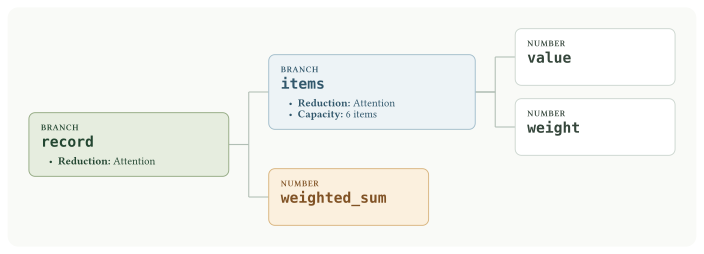
Record contains repeated items with value, weight inputs, and hidden weighted sum targets. Root reduction: Attention. Item reduction: Attention; capacity 6.

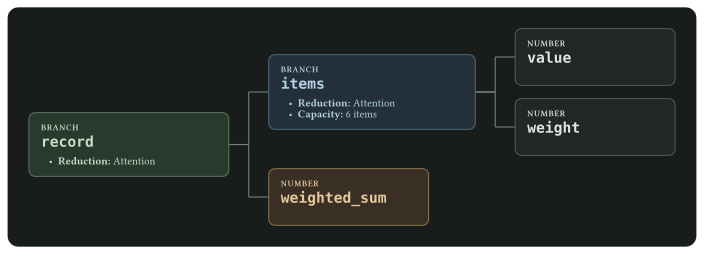
Record contains repeated items with value, weight inputs, and hidden weighted sum targets. Root reduction: Attention. Item reduction: Attention; capacity 6.

Figure 1: Learned Attention reduces six item pairs before the hidden weighted sum is decoded.

How it works

The item branch and root use learned rf.Attention reductions. Each of six items contains independently sampled values and positive weights. The model receives no product field: it must learn enough about the sibling relationship to predict sum(value * weight).

Swapping weights between items preserves both marginal distributions while breaking their pairing. Scoring these changed inputs against the original labels must worsen error. Reordering complete items should leave the answer stable; scaling every weight by 0.75 should scale the prediction by the same factor. The supplied-contribution control isolates the summation part of this task.

Training and evaluation

Code
def run(seed: int, steps: int | None, accelerator: str) -> tuple[dict, dict]:
    lit.seed_everything(seed, workers=True)
    # Split seeds are independent; rerunning a generator reproduces the same records.
    train = list(weighted_records(rows=1024, length=ITEMS, seed=seed + 1))
    test = list(weighted_records(rows=512, length=ITEMS, seed=seed + 3))
    model = rf.Model(
        d_model=32,
        n_layers=2,
        n_heads=4,
        reduction=rf.Attention(n_layers=2),
        batch_size=64,
        optimizer=lambda module: torch.optim.Adam(module.parameters(), lr=0.001),
        items=rf.Branch(
            length=ITEMS, n_layers=2, reduction=rf.Attention(n_layers=2), value=rf.Number, weight=rf.Number
        ),
        weighted_sum=rf.Number(mask=True, objective="mse"),
    )
    datamodule = rf.SyntheticDataModule(
        model=model,
        train=lambda: weighted_records(rows=1024, length=ITEMS, seed=seed + 1),
        validate=lambda: weighted_records(rows=256, length=ITEMS, seed=seed + 2),
        seed=seed,
    )
    trainer = lit.Trainer(
        accelerator=accelerator,
        devices=1,
        max_epochs=-1,
        max_steps=900 if steps is None else min(steps, 900),
        logger=False,
        enable_progress_bar=False,
        enable_model_summary=False,
        enable_checkpointing=False,
        deterministic=True,
        num_sanity_val_steps=0,
    )
    trainer.fit(model, datamodule=datamodule)

    # Evaluate held-out answers and retain their original labels in corruption controls.
    intact_prediction = prediction(model, test)
    intact = score(train=train, test=test, predicted=intact_prediction)
    corrupted_table = permute_weights(test, seed=seed + 4)
    corrupted = score(train=train, test=test, predicted=prediction(model, corrupted_table))
    permuted_prediction = prediction(model, permute_items(test, seed=seed + 5))
    factor = 0.75
    scaled_table = scale_weights(test, factor=factor)
    scaled_prediction = prediction(model, scaled_table)
    scaled = score(train=scale_weights(train, factor=factor), test=scaled_table, predicted=scaled_prediction)
    target_scale = float(np.std(np.asarray([row["weighted_sum"] for row in test], dtype=np.float64)))
    permutation_drift = rmse(intact_prediction, permuted_prediction) / target_scale
    scaling_error = rmse(factor * intact_prediction, scaled_prediction) / (factor * target_scale)
    metrics = {
        "intact": intact,
        "corrupted": corrupted,
        "scaled": scaled,
        "permutation_drift": permutation_drift,
        "scaling_error": scaling_error,
        "steps": trainer.global_step,
    }
    checks = {
        "Weighted sum nRMSE below 0.30": bool(intact["nrmse"] < 0.3),
        "Shuffled weights raise nRMSE by at least 0.35": bool(corrupted["nrmse"] >= intact["nrmse"] + 0.35),
        "Scaled-weight nRMSE below 0.35": bool(scaled["nrmse"] < 0.35),
        "Permutation drift below 0.08 target SD": bool(permutation_drift < 0.08),
        "Weight scaling error below 0.15 target SD": bool(scaling_error < 0.15),
    }
    return metrics, checks
Evidence

Latest full run

Seed 3304, gpu, recorded 2026-09-15T02:21:49.304365+00:00. Outcome: met.

Source fingerprint: 663ebdfbebc94e9be8bc9a1ae859d351aa37aa7fab3e21279afbeca2e745122c. Python 3.12.6; Torch 2.12.0.

Measurement Value
intact rmse: 0.0291466; baseline_rmse: 1.29717; nrmse: 0.0224694
corrupted rmse: 0.751085; baseline_rmse: 1.29717; nrmse: 0.579018
scaled rmse: 0.0372592; baseline_rmse: 0.972878; nrmse: 0.038298
permutation_drift 0.0103875
scaling_error 0.0329016
steps 900
Behavioral checks
Behavioral check Outcome
Weighted sum nRMSE below 0.30 Met
Shuffled weights raise nRMSE by at least 0.35 Met
Scaled-weight nRMSE below 0.35 Met
Permutation drift below 0.08 target SD Met
Weight scaling error below 0.15 target SD Met

Recorded results.

Remaining work

Repeat the pairing and scaling controls across seeds. Variable-length sum duplication, unseen lengths, and zero, negative, missing, or extreme weights remain unestablished for this particular weighted-sum schema.

The family’s promotion target is at least three core seeds and ten lightweight calibration seeds.

Reproduce

Run by stable ID from the repository root:

uv run python proofs/run.py P014

Or run the self-contained script directly:

PYTHONPATH=proofs uv run python proofs/aggregation/raw_value_weight_sum.py

Add --accelerator gpu for CUDA or --seed 42 for another seeded experiment. --steps 2 checks execution with a short training budget; it is recorded as a smoke run.

Download the complete proof.

Code
if __name__ == "__main__":
    report(PROOF_ID, run, seed=3304)