Sums beyond trained collection lengths

Cardinality generalization
Test whether a learned sum extends from shorter training bags to unseen lengths and responds to duplication.

Seed 3615 on gpu: 2 of 2 behavioral checks met. See the measurements below. The experiment code has changed since this run; these measurements describe its earlier version.

Insights

The learned sum extends beyond trained collection lengths and responds approximately to duplication. Longer held-out bags test length extrapolation. Duplicating complete bags checks that predictions roughly double, while equal-value probes isolate the need to distinguish different repetition counts.

Spare branch capacity only permits longer inputs; it does not establish their meaning. These behavioral checks provide the evidence that the model uses accumulated mass. The equal-value probes themselves use familiar lengths, so they complement rather than replace the unseen-length test. The result supports a bounded extension beyond training, not arbitrary-length or exact summation; missing values and nested totals require separate checks.

Setup

Code
"""Characterize sum extrapolation beyond every trained collection length.

Require unseen-length accuracy and exact complete-bag scaling together.

Run: uv run python proofs/run.py P002"""

from __future__ import annotations

from collections.abc import Iterator
from copy import deepcopy

import lightning.pytorch as lit
import numpy as np
import torch
from reporting import report

import relflow as rf

PROOF_ID = "P002"
TRAIN_MAX = 6
CAPACITY = 12

Examples

Targets use mask=True; the labels below are supervision hidden from the encoder.

An unseen length

items:
  - {amount: 0.5}
  - {amount: 0.5}
  - {amount: 0.5}
  - {amount: 0.5}
  - {amount: 0.5}
  - {amount: 0.5}
  - {amount: 0.5}
  - {amount: 0.5}
total: 4.0

Eight items require a total of 4.0, although training bags contain at most six.

Start a duplication probe

items:
  - {amount: 0.3}
  - {amount: -0.1}
total: 0.2

This shorter bag sums to 0.2 and fits inside the trained length range.

Duplicate the complete bag

items:
  - {amount: 0.3}
  - {amount: -0.1}
  - {amount: 0.3}
  - {amount: -0.1}
total: 0.4

The empirical distribution is unchanged, but the total doubles to 0.4. The proof compares predictions before and after duplication, in addition to its separate unseen-length accuracy gate.

Synthetic data and controls

Code
def random_records(*, rows: int, seed: int, minimum: int = 1, maximum: int = TRAIN_MAX) -> Iterator[dict]:
    """Draw variable-length numerical bags and their mean and sum."""
    if not 1 <= minimum <= maximum <= CAPACITY:
        raise ValueError(f"length range must satisfy 1 <= minimum <= maximum <= {CAPACITY}")
    rng = np.random.default_rng(seed)
    for _ in range(rows):
        length = int(rng.integers(minimum, maximum + 1))
        values = rng.uniform(-1.0, 1.0, size=length)
        row: dict[str, object] = {
            "items": [{"amount": float(value)} for value in values],
            "mean_amount": float(values.mean()),
            "total": float(values.sum()),
        }
        yield row


def duplicate(observations: list[dict]) -> list[dict]:
    """Duplicate every complete bag and update its algebraic targets."""
    rows = deepcopy(observations)
    if any((len(row["items"]) * 2 > CAPACITY for row in rows)):
        raise ValueError(f"duplicated collection exceeds configured capacity {CAPACITY}")
    for row in rows:
        row["items"] = [*row["items"], *row["items"]]
        row["total"] *= 2.0
    return rows


def equal_value_probes(*, value: float, lengths: tuple[int, ...]) -> list[dict]:
    """Create matched bags that differ only in repetition count."""
    if not lengths or min(lengths) < 1 or max(lengths) > CAPACITY:
        raise ValueError(f"probe lengths must be within 1..{CAPACITY}, got {lengths!r}")
    rows: list[dict[str, object]] = []
    for length in lengths:
        row: dict[str, object] = {"items": [{"amount": value}] * length, "mean_amount": value, "total": length * value}
        rows.append(row)
    return rows


def prediction(model: rf.Model, observations: list[dict]) -> np.ndarray:
    inputs = [{"items": row["items"]} for row in observations]
    output = model.predict(inputs)["predictions"].to_pylist()
    return np.asarray([row["record/total"]["content"] for row in output], dtype=np.float64)


def rmse(actual: np.ndarray, predicted: np.ndarray | float) -> float:
    return float(np.sqrt(np.mean(np.square(actual - predicted))))


def score(*, train: list[dict], test: list[dict], predicted: np.ndarray) -> dict[str, float]:
    """Compare held-out RMSE with the constant training-target mean."""
    actual = np.asarray([row["total"] for row in test], dtype=np.float64)
    baseline = rmse(actual, float(np.asarray([row["total"] for row in train], dtype=np.float64).mean()))
    measured = rmse(actual, predicted)
    return {"rmse": measured, "baseline_rmse": baseline, "nrmse": measured / baseline}

Model tree

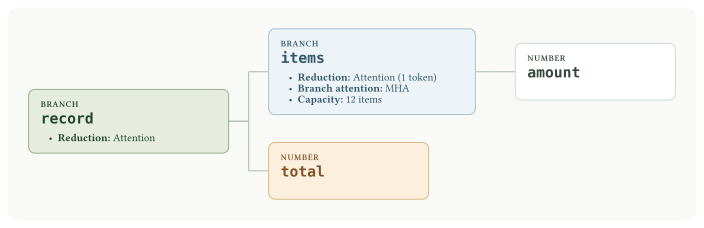
Record contains repeated items with amount inputs, and hidden total targets. Root reduction: Attention. Item reduction: Attention (1 token); capacity 12; branch attention MHA.

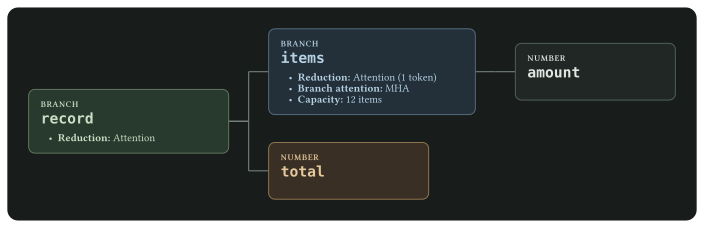
Record contains repeated items with amount inputs, and hidden total targets. Root reduction: Attention. Item reduction: Attention (1 token); capacity 12; branch attention MHA.

Figure 1: A twelve-item capacity leaves room for longer test bags while the item reduction still produces one Attention output.

How it works

The schema matches the in-range sum: learned rf.Attention reductions receive raw amounts without a supplied count. Training lengths are one through six, while the unseen test set uses seven through ten. Branch capacity is twelve, allowing these inputs without overflow.

A second intervention duplicates complete bags of at most five items and checks that predictions approximately double. Equal-value probes at lengths one, three, and six isolate sensitivity to multiplicity. The capacity bound permits these shapes; the accuracy and intervention gates establish the learned behavior.

Training and evaluation

Code
def run(seed: int, steps: int | None, accelerator: str) -> tuple[dict, dict]:
    lit.seed_everything(seed, workers=True)
    # Split seeds are independent; rerunning a generator reproduces the same records.
    train = list(random_records(rows=1536, seed=seed + 1))
    in_range = list(random_records(rows=512, seed=seed + 3))
    unseen = list(random_records(rows=512, seed=seed + 4, minimum=7, maximum=10))
    short = list(random_records(rows=256, seed=seed + 5, maximum=5))
    model = rf.Model(
        d_model=32,
        n_layers=2,
        n_heads=4,
        reduction=rf.Attention(n_layers=2),
        batch_size=64,
        optimizer=lambda module: torch.optim.Adam(module.parameters(), lr=0.001),
        items=rf.Branch(
            length=CAPACITY, attention="mha", n_layers=2, reduction=rf.Attention(n_layers=2), amount=rf.Number
        ),
        total=rf.Number(mask=True, objective="mse"),
    )
    datamodule = rf.SyntheticDataModule(
        model=model,
        train=lambda: random_records(rows=1536, seed=seed + 1),
        validate=lambda: random_records(rows=384, seed=seed + 2),
        seed=seed,
    )
    trainer = lit.Trainer(
        accelerator=accelerator,
        devices=1,
        max_epochs=-1,
        max_steps=1100 if steps is None else min(steps, 1100),
        logger=False,
        enable_progress_bar=False,
        enable_model_summary=False,
        enable_checkpointing=False,
        deterministic=True,
        num_sanity_val_steps=0,
    )
    trainer.fit(model, datamodule=datamodule)

    # Evaluate held-out answers and retain their original labels in corruption controls.
    in_range_score = score(train=train, test=in_range, predicted=prediction(model, in_range))
    unseen_score = score(train=train, test=unseen, predicted=prediction(model, unseen))
    short_prediction = prediction(model, short)
    duplicated_prediction = prediction(model, duplicate(short))
    duplication_error = rmse(2.0 * short_prediction, duplicated_prediction) / float(
        np.std(np.asarray([row["total"] for row in unseen], dtype=np.float64))
    )
    probes = equal_value_probes(value=0.65, lengths=(1, 3, 6))
    probe_prediction = prediction(model, probes)
    probe_target = np.asarray([row["total"] for row in probes], dtype=np.float64)
    probe_error = rmse(probe_target, probe_prediction) / float(
        np.std(np.asarray([row["total"] for row in unseen], dtype=np.float64))
    )
    metrics = {
        "in_range_score": in_range_score,
        "unseen_score": unseen_score,
        "duplication_error": duplication_error,
        "probe_error": probe_error,
        "probe_target": probe_target.tolist(),
        "probe_prediction": probe_prediction.tolist(),
        "steps": trainer.global_step,
    }
    checks = {
        "All measurements finite": bool(
            np.isfinite([in_range_score["nrmse"], unseen_score["nrmse"], duplication_error, probe_error]).all()
        ),
        "Seen nRMSE < 0.35, unseen nRMSE < 0.30, duplication and cardinality errors < 0.20": bool(
            in_range_score["nrmse"] < 0.35
            and unseen_score["nrmse"] < 0.3
            and (duplication_error < 0.2)
            and (probe_error < 0.2)
        ),
    }
    return metrics, checks
Evidence

Latest full run

Seed 3615, gpu, recorded 2026-09-15T02:17:20.021979+00:00. Outcome: met.

Source fingerprint: 70dfbf74a5344939544a0869e108d29b141f31a431040ac421f69ac2484d3787. Python 3.12.6; Torch 2.12.0.

Measurement Value
in_range_score rmse: 0.0177695; baseline_rmse: 1.04012; nrmse: 0.017084
unseen_score rmse: 0.131842; baseline_rmse: 1.78742; nrmse: 0.0737611
duplication_error 0.0699551
probe_error 0.0484787
probe_target 0.65, 1.95, 3.9
probe_prediction 0.669512, 1.96077, 3.75162
steps 1100
Behavioral checks
Behavioral check Outcome
All measurements finite Met
Seen nRMSE < 0.35, unseen nRMSE < 0.30, duplication and cardinality errors < 0.20 Met

Recorded results.

Remaining work

Repeat the gates across seeds, capacities, and nested branches. Heavy tails, high duplication, empty collections, missing values, and overflow semantics need separate coverage. The doubling gate allows approximation error; it is not an exact-sum contract.

The family’s promotion target is at least three core seeds and ten lightweight calibration seeds.

Reproduce

Run by stable ID from the repository root:

uv run python proofs/run.py P002

Or run the self-contained script directly:

PYTHONPATH=proofs uv run python proofs/aggregation/attention_sum_unseen_lengths.py

Add --accelerator gpu for CUDA or --seed 42 for another seeded experiment. --steps 2 checks execution with a short training budget; it is recorded as a smoke run.

Download the complete proof.

Code
if __name__ == "__main__":
    report(PROOF_ID, run, seed=3615)